 Hable con un agente al (888) 572-7520
 Enviar mensaje a un agente




Uber Technologies announced progress in the development of its autonomous vehicle services, with tests of robotaxis operating without safety drivers. The vehicles are being developed in collaboration with technology and mobility companies Nuro and Lucid Group. This new phase represents a key step toward the commercial launch of the service, scheduled for the first quarter of 2027.
For nearly a year, autonomous vehicle technology company Nuro has been conducting tests in the San Francisco Bay Area and Houston with a fleet of robotaxis based on the Lucid Gravity electric SUV, initially with safety operators behind the wheel. However, on November 24, the companies announced the start of a new development phase that involves completely removing the safety driver.
The first fully autonomous tests will take place in four California cities: Palo Alto, Mountain View, Los Altos, and Sunnyvale. The program will subsequently expand to other municipalities in the region throughout 2027.
According to Tilo Schwarz, Nuro’s Vice President of Engineering, this development represents a milestone in bringing the company’s autonomous driving expertise to passenger vehicles and moving closer to the launch of its next-generation robotaxis.
Uber to Offer Driverless Rides to Employees
As part of this new phase, employees of the companies will soon have access to fully autonomous rides, while Lucid expects to begin manufacturing the first vehicles intended for the commercial launch fleet in the coming weeks.
This development represents one of Uber’s most important projects in the robotaxi market, a strategic segment for the company amid changes in its relationship with Waymo, one of its main competitors in autonomous transportation.
Uber’s strategy is to integrate different transportation services into a single platform, connecting users with both human drivers and robotaxis. The company has signed agreements with more than a dozen companies seeking to integrate autonomous vehicles into its app in the coming years.
However, the development of this technology still faces significant challenges. Although driverless testing represents substantial progress for Uber, Nuro, and Lucid, all three companies still have a long way to go to catch up with Waymo, currently one of the leading providers of autonomous rides in the United States.
In the United States, few companies have managed to move beyond the testing phase and operate vehicles without safety drivers. Competitors already offering services without operators behind the wheel include Waymo, an Alphabet subsidiary, and Zoox, owned by Amazon. In contrast, Motional and Avride, two other companies partnered with Uber in Las Vegas and Texas, respectively, still conduct operations with safety personnel who can intervene in the event of potential system errors.
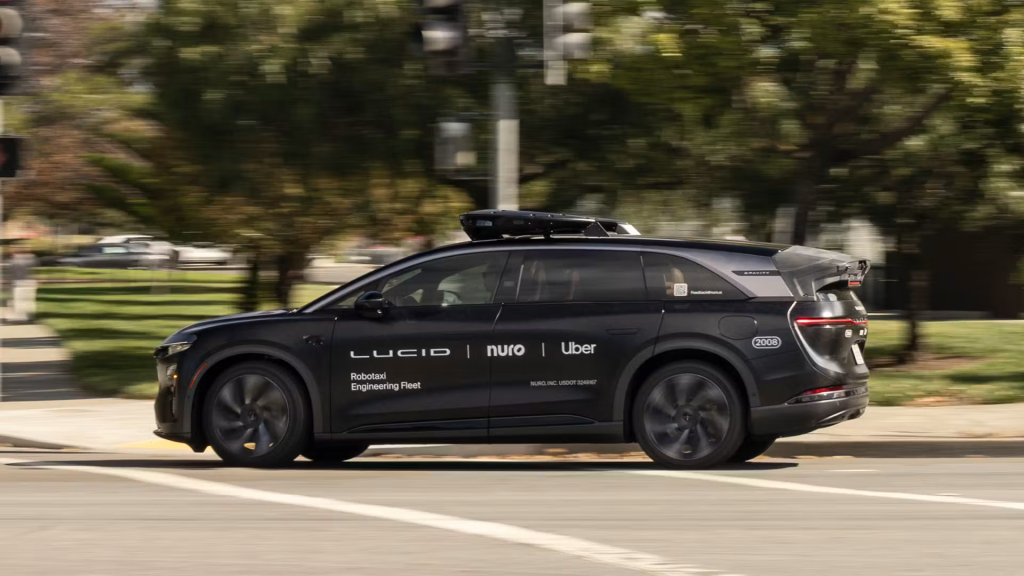
Lucid Gravity: Technology and Passenger Experience Aboard Robotaxis
The autonomous vehicles developed by Nuro and Lucid feature cameras, lidar sensors, and radar systems that allow them to identify their surroundings, detect obstacles, and analyze traffic conditions without human intervention. The model selected for the project is the Lucid Gravity, an electric SUV that offers more interior space than the Jaguar vehicles used by Waymo.
The passenger experience will also include technological features similar to those found in other autonomous driving services. These include a tablet and a display integrated into the dashboard that shows the vehicle’s route and the objects its sensors detect on the road.
With the start of tests without safety drivers, Uber, Nuro, and Lucid are moving closer to a new phase in the development of their partnership. The next major challenge will be to demonstrate that the technology can operate safely and reliably before its introduction to the U.S. market in 2027.
 Business hours: Monday to Friday from 8:00 AM to 5:00 PM. California time