 Hable con un agente al (888) 572-7520
 Enviar mensaje a un agente




For a long time, comparing a product manufactured in the United States with imports one seemed to be a matter of price. If the foreign product cost less, the decision seemed straightforward.
But that equation is changing. For U.S. companies, the true cost of purchasing an imported product does not end with the invoice. It includes tariffs, transportation, warehousing, lead times, the availability of components, and the risk that a disruption could affect the entire operation. A “Made in USA” product might cost more, yet still prove advantageous if it secures the supply chain or prevents a disruption.
In October, import prices rose by 1.1% month-over-month. Non-energy prices increased by 0.8%, according to the Bureau of Labor Statistics (BLS). However, the most significant data point for businesses concerns capital goods. Import prices for these items rose by 1.5% in October—the largest monthly increase since the series began in 1988. This category includes machinery, computers, semiconductors, and electrical equipment. Consequently, rising costs affect both the consumer and the expense of manufacturing within the United States.
The cost of importing no longer ends at customs
A company might import a machine, a component, or a part, incorporating it into its own cost structure. If the price rises, the company must either absorb the cost, reduce its profit margin, or pass the increase on to the customer.
Research from the Federal Reserve Bank of New York helps explain this mechanism. An analysis of 2025 tariffs found that a very large share of the associated costs ended up being borne within the United States—primarily by businesses and consumers.
The importer pays more, the distributor faces higher costs, and the manufacturer may pass a portion of the price increase on to the consumer. Therefore, making imports more expensive does not automatically create a price advantage for U.S.-made products.
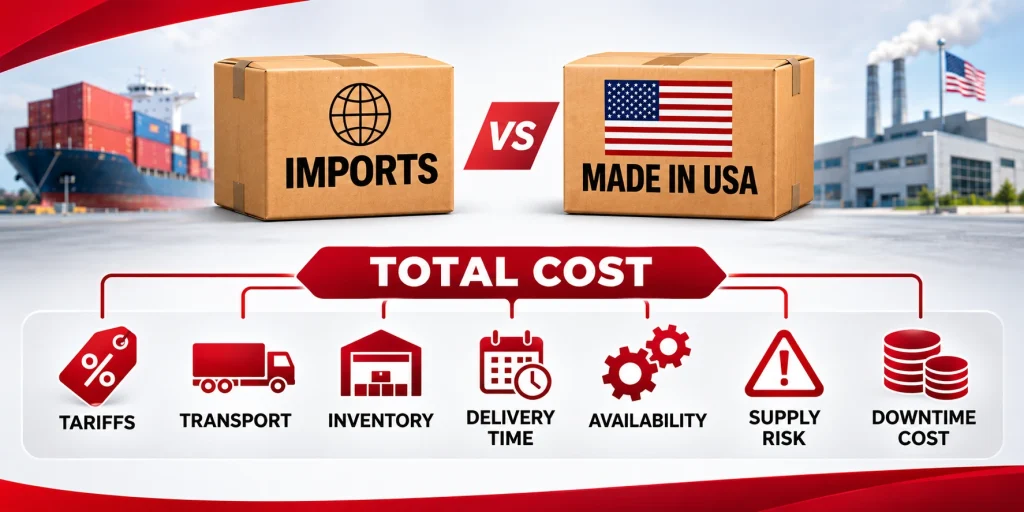
A domestic manufacturer might use foreign-made steel, aluminum, electronic components, machinery, or parts. The “Made in USA” label identifies the location of final assembly, not the origin of every individual component. The implication for a company is clear: it must compare cost structures, not just catalog prices.
A foreign supplier might offer a cheaper part, but one that comes with greater exposure to tariffs, delays, or logistical issues. A U.S.-based supplier might charge more, but offer faster and more predictable delivery.
This introduces a factor that does not necessarily appear on an invoice: the cost of uncertainty. The choice between imports and local production also depends on each company’s financial and operational capacity.
A sidelined truck can wipe out the savings gained from a cheap spare part
The transport sector provides a particularly clear example. A fleet requires tires, batteries, filters, brakes, electrical components, and engine parts. In each instance, there may be an imported alternative alongside one manufactured in the United States.
Suppose the imported part costs less; the savings seem obvious. But if the part takes weeks to arrive and the truck remains out of service, the equation changes. The company may lose a shipment, incur labor costs without generating revenue, fail to meet a delivery deadline, and be forced to reorganize its operations.
While the price of the part itself remains lower, the total cost of the decision may not be. That is why, for a transport company, the right comparison is not just the cost of a spare part—it is the cost of keeping a truck up and running.
Availability has a real, measurable economic value. This is particularly significant for independent operators and small fleets. A large company may have replacement vehicles and the capacity to maintain inventories, whereas an owner-operator might rely on a single unit to generate income.
In this context, paying more for a part that is available immediately can prove cheaper than waiting for an imported alternative. The purchase price is only one part of the equation.
The heavy-duty vehicle industry also illustrates the extent to which supply chains are integrated. Manufacturers rely on suppliers from the United States, Mexico, and Canada, while rules of origin and regional content requirements play an increasingly important role in sourcing decisions. A truck assembled in the United States may incorporate foreign components; consequently, the line between domestic and imported products is less distinct.
When domestic production is competitive
The transportation sector also demonstrates how these costs can ripple through other industries. In October, prices for truck freight transportation services rose by 3.9%, according to the Bureau of Labor Statistics (BLS). If maintaining and operating a fleet becomes more expensive, some of that cost increase may be passed on to freight rates. Freight costs, in turn, are embedded in the price of virtually everything that reaches a business, a retail store, or a consumer.
The chain can look like this: more expensive components lead to costlier maintenance, higher freight rates, more expensive distribution, and, ultimately, a higher-priced final product. A local supplier capable of rapid delivery can help reduce inventory levels, prevent disruptions, and improve asset utilization. This makes domestic production a competitive alternative in terms of both price and reliability.
This discussion takes on added importance given that the United States remains dependent on imports. In September, the country imported $426.6 billion worth of goods and services. Year-to-date, imports had increased by 6.2% compared to the same period in the previous year, according to the Bureau of Economic Analysis. These figures make the immediate replacement of all imported products unrealistic. Rebuilding industrial capacity requires factories, workers, infrastructure, suppliers, capital, and time. The most likely scenario is an economy that selectively determines what to produce domestically, what to import, and which components to secure.
This transformation changes the fundamental question. It is no longer just a matter of whether a U.S.-made product costs more than an imported alternative; it is about calculating the true cost of each option.
While the purchase price remains important, it must be weighed against tariffs, transportation, inventory, availability, lead times, and the potential cost of a disruption. For a manufacturer, this might mean choosing between two suppliers. For a small business, it involves determining the necessary level of inventory. For a transport operator, it means deciding whether it is worth paying a premium for a spare part that is immediately available.
The conclusion is straightforward: imports are not necessarily cheap, and “Made in USA” products are not necessarily expensive. The initial invoice is merely the starting point. In an economy shaped by tariffs, inflation, and global supply chains, the advantage may lie with a product that enables higher output, minimizes downtime, and provides greater certainty regarding operating costs.
In short, for a U.S. company, this distinction can be worth far more than the few dollars saved on the initial purchase.
 Business hours: Monday to Friday from 8:00 AM to 5:00 PM. California time