 Hable con un agente al (888) 572-7520
  Enviar mensaje a un agente



When Argentina and Spain meet in the 2026 FIFA World Cup Final on Sunday, July 19, at New York New Jersey Stadium (MetLife Stadium), millions of fans will focus on the action on the field. Kickoff is scheduled for 3:00 p.m. Eastern Time, bringing to a close a tournament that began on June 11 and featured 48 national teams across the United States, Mexico, and Canada.
Long before the opening whistle, however, another competition was already underway: the race to move enormous volumes of sporting equipment, broadcast technology, medical supplies, advertising materials, staging infrastructure, and countless other assets required to stage the world’s biggest sporting event.
Behind every match was a logistics operation unlike anything previously attempted in international football.
Beyond welcoming millions of visitors and hosting 78 matches across 11 U.S. metropolitan areas, the United States also had to keep stadiums supplied, national teams moving, television broadcasts operating, and security systems functioning—all while everyday business continued across the country.
More Than 453 Metric Tons on the Move
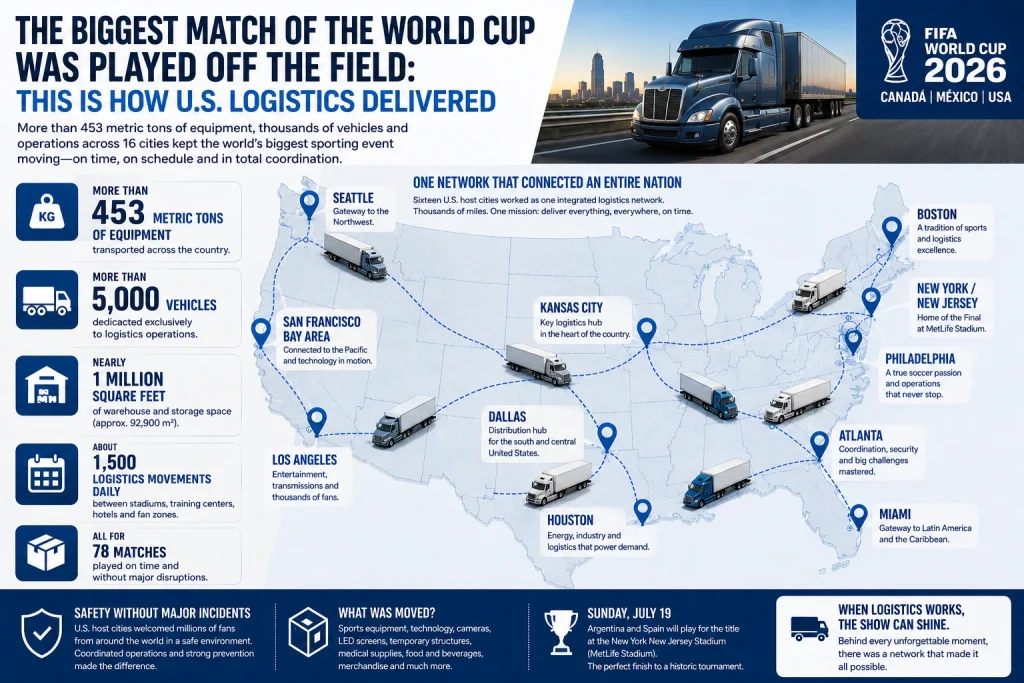
Rock-it Cargo, FIFA’s official logistics provider, estimated that the tournament would require transporting and storing more than one million pounds of equipment, equivalent to approximately 453.6 metric tons.
To manage that operation, the company planned the deployment of more than 5,000 trucks and support vehicles, supported by nearly one million square feet of warehouse space—roughly 92,900 square meters.
That cargo included national team equipment, stadium infrastructure, broadcast systems, advertising materials, medical supplies, and equipment for commercial partners and tournament vendors.
Freight moved continuously among the tournament’s 16 host cities across the United States, Mexico, and Canada, with the United States handling the largest share of operations.
The logistics effort extended far beyond transportation. It included customs clearance, international freight forwarding, warehousing, stadium deliveries, broadcast center support, and the constant movement of team equipment.
Every knockout-round result triggered new transportation plans.
Whenever a team advanced, uniforms, medical equipment, training gear, and support materials had to reach the next host city before the players themselves arrived. At the same time, cameras, communications systems, lighting, and television infrastructure needed to be installed, tested, and fully operational within extremely tight deadlines.
This was not a single shipment crossing the continent—it was thousands of synchronized movements connecting airports, warehouses, hotels, training grounds, and stadiums every day.
Eleven U.S. Host Markets Connected
Atlanta, Boston, Dallas, Houston, Kansas City, Los Angeles, Miami, New York–New Jersey, Philadelphia, the San Francisco Bay Area, and Seattle formed the backbone of the U.S. logistics network.
Geography presented one of the tournament’s greatest challenges.
Unlike previous World Cups hosted in more compact countries, the 2026 edition required freight to travel thousands of miles across multiple time zones.
Trucking became the backbone of regional transportation and final-mile deliveries. Air freight handled the most urgent shipments, while strategically located warehouses allowed inventories to remain close to the cities experiencing the highest demand.
The logistical pressure extended well beyond FIFA’s official cargo.
Hotels, restaurants, supermarkets, sporting goods retailers, fan zones, and catering companies all increased inventory levels throughout the tournament.
Freight markets in Dallas, Houston, Miami, Los Angeles, and the New York metropolitan area experienced stronger demand for truckload, refrigerated, expedited, and last-mile transportation.
Despite the surge, everyday commerce continued.
Stadiums received food, beverages, and equipment on schedule. Broadcast operations remained uninterrupted. Teams arrived at each venue as planned. Meanwhile, host cities continued supporting residents, businesses, and regular commercial activity alongside one of the largest sporting events ever organized.
A Strong Security Performance
The tournament also represented one of the most significant security operations ever associated with a sporting event in the United States.
Federal, state, and local agencies worked together to protect stadiums, fan zones, airports, hotels, public gathering areas, and transportation systems throughout the competition.
The challenge became particularly visible during the semifinal between Argentina and England in Atlanta.
Because of the historic rivalry between the two nations, authorities expanded security measures, coordinated closely with federal agencies, deployed approximately 1,600 law enforcement officers, and established separate access routes for supporters to minimize potential confrontations.
The match concluded peacefully.
Although a political message displayed during Argentina’s post-match celebrations generated some controversy afterward, officials reported no major clashes between supporters or significant acts of violence connected to the event.
Through the eve of the final, U.S. host cities also avoided the widespread disturbances seen at some major sporting events elsewhere in the world.
Stadiums and fan zones welcomed supporters from dozens of countries, while preventive security measures successfully managed the risks associated with massive crowds.
That does not mean the tournament was flawless. Traffic delays, road closures, and isolated operational issues were inevitable.
It does mean that an event attracting millions of visitors and dozens of international matches unfolded without violence significantly disrupting tournament operations.
When Nobody Talks About Logistics, Logistics Has Won
The 2026 World Cup offered an important lesson for the transportation industry: major global events depend on supply chains capable of adapting before problems emerge.
An unexpected qualification can completely change a transportation schedule.
A delayed shipment can leave a stadium without critical equipment.
A disruption in the last mile can impact a television broadcast watched by millions around the world.
Success, therefore, is measured not simply by the amount of freight transported, but by the ability to deliver every shipment to the right place at exactly the right time.
On Sunday, one nation will lift the World Cup trophy on the field.
Off the field, the United States has already demonstrated that its transportation infrastructure, logistics providers, and security agencies were capable of supporting one of the most complex operations ever assembled for an international sporting event.
More than 453 metric tons of equipment moved across a network spanning three countries, 16 host cities, and thousands of coordinated shipments.
Fans will remember the goals, the saves, and the celebrations.
The transportation industry will remember something different: for more than a month, logistics kept the biggest World Cup in history moving.
When everything arrives exactly when it should, almost nobody asks how it got there.
That may be the clearest sign that the job was done right.
 Business hours: Monday to Friday from 8:00 AM to 5:00 PM. California time