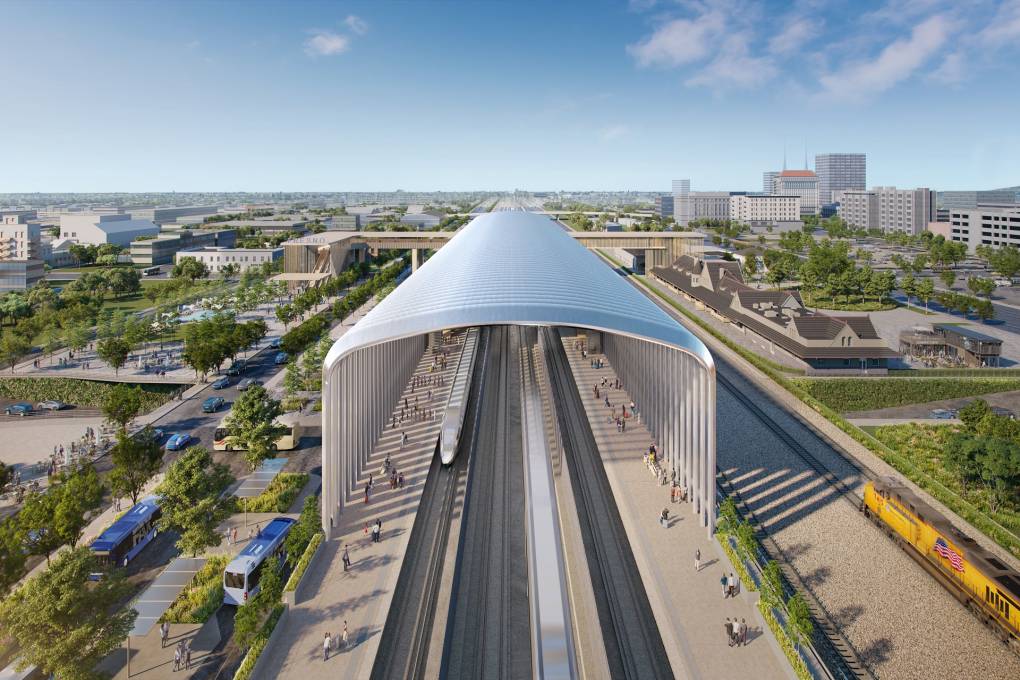
The Trump administration is targeting California’s controversial high-speed rail project, with federal transportation officials announcing an investigation and possible withdrawal of about $4 billion in federal funding.
The ambitious high-speed rail project aiming to connect Los Angeles and San Francisco in under three hours is facing a new challenge: the administration of Donald Trump has launched a review to determine whether the California High-Speed Rail Authority has met its commitments after receiving $4 billion in federal funding.
Governor Gavin Newsom’s Support
Despite the uncertainty surrounding the project, California Governor Gavin Newsom reaffirmed his support, emphasizing that the rail system is essential for the state’s transportation future. According to Newsom, the infrastructure will help reduce road congestion and play a key role in combating climate change by lowering carbon emissions.
However, the project faces serious scrutiny from the Trump administration, which questions its feasibility due to ongoing delays and escalating costs.

Federal Government Audit and Criticism
According to the Los Angeles Times, Trump has strongly criticized the project, calling it “mismanaged” and suggesting that federal funds could be reallocated if efficient use of resources is not demonstrated. In response to these concerns, the California High-Speed Rail Authority released a report outlining the progress made and justifying the investments so far.
To assess compliance with funding agreements, the U.S. Department of Transportation announced it will conduct an audit. The investigation will include a review of contracts, financial reports, and site visits in the Central Valley, where 275 kilometers (170 miles) of rail have already been constructed.
Sean Duffy, Trump’s Secretary of Transportation, stated that the priority is to ensure federal funds are being used efficiently and transparently. “We want to make sure every dollar spent is properly accounted for,” he said during a press conference at Union Station in Los Angeles.
In addition to financial oversight, the audit will examine project timelines and adherence to original goals. If irregularities or noncompliance are found, the federal government may reclaim the $4 billion or reallocate it to other infrastructure projects across the country.

Delays and Cost Overruns: A Persistent Issue
California’s high-speed rail project was approved in 2008 with an initial budget of $33 billion and a projected completion date of 2020. However, reality has been quite different: costs have skyrocketed to over $100 billion, and without additional funding, completion may be pushed back to 2040.
Despite progress in construction and the creation of over 14,000 jobs, chronic delays and cost overruns have drawn criticism at both the state and federal levels. The Trump administration remains highly skeptical about the project’s viability, while some Republican lawmakers have labeled it a “costly failure.”
What’s at Stake for California?
If the state loses the $4 billion in federal funding, the future of high-speed rail in California would be in jeopardy. The High-Speed Rail Authority has warned that these funds are crucial to completing the project’s first phase, which aims to connect Merced and Bakersfield.
Without this funding, construction could stall, undermining investor confidence and making it even harder to secure the additional resources needed to complete the full corridor between Los Angeles and San Francisco.

The best roadside attractions for truckers in the U.S.
America’s highways hide unique places that break up the routine, don’t hesitate to check out these roadside attractions along the way. The road is much

The trucker style: comfort, function, and identity
Truckers’ style is much more than workwear; it’s an identity. These are the most commonly worn garments among truckers. Truckers’ style is much more than

Chaos on Highway 61: Viral Wrong-Way Truck Video Reignites the CDL Debate
An 80-ton tractor-trailer traveling miles in the wrong direction on Missouri’s Highway 61 has reignited a nationwide debate over Commercial Driver’s License (CDL) standards, training

How technology affects driver retention
Friend or foe? 52% of drivers say technology directly influences their decision to stay with or leave a fleet. Fleet telematics company Platform Science published

Dalilah Law seeks to remove non-english speaking commercial drivers
President Donald Trump proposed the “Dalilah Law,” an initiative aimed at prohibiting undocumented immigrants from obtaining commercial driver’s licenses. On February 24, President Donald Trump

FORMULA 1 and the AI That Could Transform Transportation in the U.S.
The artificial intelligence system that Formula 1 implemented to monitor every car on every turn is opening the door to new applications in trucking, logistics,