 Hable con un agente al (888) 572-7520
  Enviar mensaje a un agente

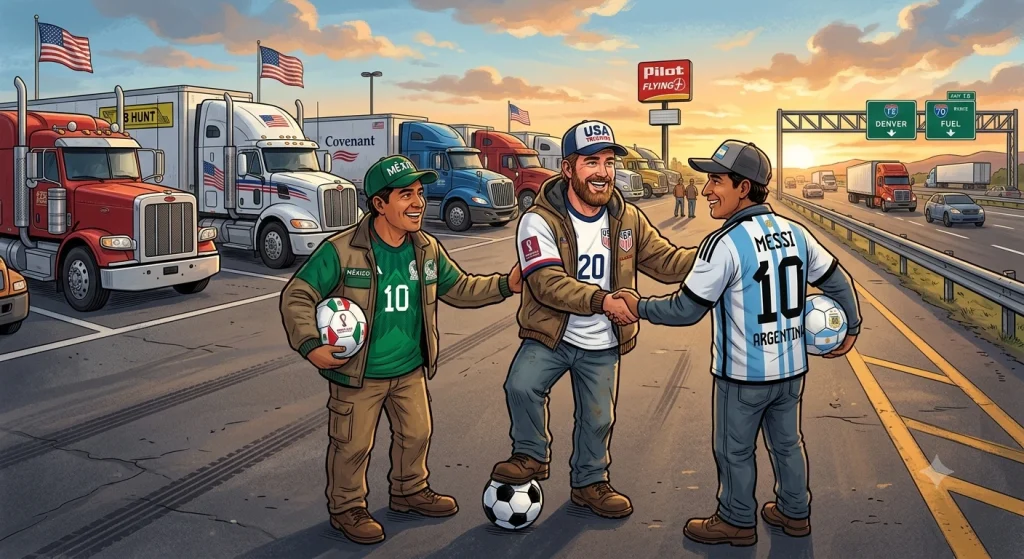

Those traveling the country these days have surely noticed. The 2026 FIFA World Cup is upon us! Interstate highways are experiencing much heavier traffic than usual. There are new faces at truck stops, foreign accents at gas stations, and multicolored flags waving from the windows of private cars.
This is no coincidence, nor is it just another holiday season. The World Cup is in full swing, and it’s being held in the United States. For many, this event is simply a ball game, a ninety-minute distraction on television. However, from the perspective of professional trucking, the reality is very different and is measured strictly in dollars and cents.
But this championship is not just a high-performance sporting competition. It’s a wild money-making machine. We are witnessing the biggest business on wheels on the planet. For independent truckers and large North American fleets, the raw numbers reveal an economic impact that is already being felt strongly on the pavement.
An $80 Billion Team
To understand the magnitude of the current opportunity, we must take a detailed look at the size of the pie. This is not a conventional tournament. We are facing the biggest World Cup in FIFA history. The logistical scale has changed dramatically, going from the 32 national teams that competed in previous editions to a total of 48 participating countries.
More teams on the field mathematically translates into more matches and more days of movement on the roads. The schedule jumped from the traditional 64 matches to a total of 104. This expansion generates a massive flow of goods throughout North America for almost 40 days of continuous activity.
FIFA estimates that the total impact of this mega-event on the global economy will reach the astronomical figure of $80 billion. The best part of this scenario is that our country gets the biggest slice of the logistics and commercial business.

Financial analysts estimate that the competition will directly contribute $17.2 billion to the United States’ Gross Domestic Product (GDP). A single tournament will inject this enormous wealth into our national economy over the course of just a few weeks, boosting domestic consumption.
FIFA, as the organizing body, projects generating more than $10.9 billion in direct revenue. This figure represents a 56% increase compared to the previous tournament held in Qatar. Breaking down this revenue into its various components, television contributes $4.2 billion and corporate sponsorships add another $2.8 billion.
The third major financial component directly impacts the host cities: ticket sales and stadium operations. While ticket sales in Qatar generated $950 million, here in the United States, that figure will jump to $3 billion. The growth exceeding 200% is due to the colossal size of our venues and the fact that fans are paying exorbitant prices for a seat.
The Real Benefit on the Ground
Let’s take these office numbers to the streets, directly to the asphalt that professional truck drivers tread every day. The World Cup is being held in 16 different North American cities, 11 of which are strategically located in the United States, including megacities like New York, Los Angeles, Miami, Dallas, and Houston.
Each of these cities is currently operating as a goldmine for the service sector. For example, the New York and New Jersey metropolitan area projects an economic impact of $3 billion with the arrival of more than one million tourists. Philadelphia estimates earnings of $770 million, while Los Angeles projects nearly $600 million just from hosting eight matches.
This massive influx of people requires a constant supply of lodging, heating, entertainment, and, most importantly, food. Hotels are reporting record-breaking rates, and platforms like Airbnb are overwhelmed. This is where trucking becomes indispensable: restaurants and distribution centers cannot afford to run out of supplies.
According to reports from financial firms like Morgan Stanley, the food and beverage sector is one of the tournament’s biggest winners. Consumption of beer, soft drinks, and bottled water has skyrocketed to record seasonal levels. To move those millions of cases of finished product from bottling plants to urban centers, trucks need to be on the road 24 hours a day.
As a direct result of this logistical urgency, freight rates for consumer goods have seen a surge, benefiting trucking companies. There is more than enough work on every mile of the national highway.
Additionally, the tournament’s dynamism fosters massive temporary employment. An estimated 20,000 new jobs are expected to be created in the United States during the season, primarily in logistics, security, and event support. Even the digital betting market has transformed the economics of the game, moving billions of dollars in real time with every goal scored on the field.
While some economists suggest this financial boom represents a short-term boost—a nitrous oxide effect in a diesel engine—the microeconomic reality is undeniable. For the roadside gas station owner, the truck stop operator, or the independent trucker, this flow of money is real, tangible, and makes for the best business month of the year.
The next time you encounter heavy traffic on the access roads to the host cities, take a deep breath and analyze the situation with a business mindset. Behind every soccer ball rolling are billions of dollars fueling the transportation economy. The World Cup is moving forward thanks to the sport, but it operates successfully thanks to the truckers who move the country’s heavy cargo. Let’s drive carefully, keep our distance from tourist motorists, and ensure a profitable delivery to your next destination.
 Business hours: Monday to Friday from 8:00 AM to 5:00 PM. California time