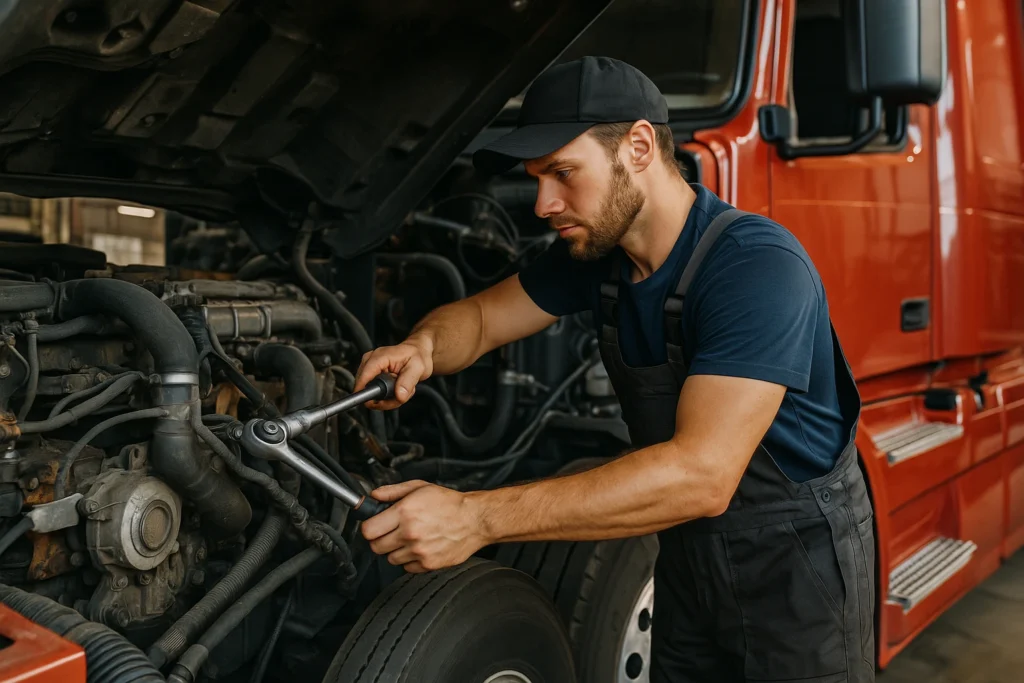
In a country where more than 70% of goods are transported by road, truck mechanics have become essential players in the U.S. logistics system. Today’s truck technicians must master technology, precision, and problem-solving—far beyond turning wrenches. In return, the profession offers stability, strong salaries, and high job demand.
While the debate about the value of college degrees continues, thousands of young Americans are choosing an alternative path: becoming certified diesel technicians. This is not a fallback option—it’s a strategic decision backed by clear data. The trucking industry urgently needs skilled workers and is willing to pay well for them.
Modern truck mechanics do far more than fix engines. They are digital code readers, electronic system specialists, data interpreters—and often the first to detect failures that could cost a logistics company millions or compromise safety on the road.
The average annual salary for a diesel technician in the U.S. ranges from $50,000 to $75,000, but can exceed $90,000 with experience and specialized certifications.
Demand is high. Shops, dealerships, private fleets, logistics hubs, and transportation companies are constantly hiring reliable mechanics—especially in states like Texas, California, Georgia, Florida, and Illinois.

What Does a Good Truck Mechanic Need to Know?
Being a professional truck mechanic takes far more than basic tool skills. It requires deep technical knowledge, sharp attention to detail, and problem-solving under pressure. Key competencies include:
Diagnosing and repairing modern diesel engines
Working with air brake systems and ABS
Servicing manual and automatic transmissions
Reading wiring diagrams and using computerized diagnostic tools
Understanding electronic engine management systems, including sensors and ECMs
Repairing hydraulic, suspension, steering, and cooling systems
Following Department of Transportation (DOT) safety and inspection standards
Using tools safely and following workshop and roadside safety protocols
Soft skills matter too: clear communication, organization, punctuality, and a strong commitment to technical and environmental standards.
“Today’s truck technician is half mechanic, half analyst,” say industry experts. “They have to know what the vehicle is telling them—through sensors, diagnostic codes, and real-world symptoms.”
Where Can You Study?
Becoming a diesel technician doesn’t require a four-year degree—but it does require formal training, typically ranging from 6 months to 2 years. Top training options in the U.S. include:
Universal Technical Institute (UTI): Intensive diesel programs at multiple campuses
Lincoln Tech: Hands-on training with strong industry partnerships
Penn Foster: Online courses with diesel engine modules
Community Colleges: Public institutions across the U.S. offering associate degrees in Diesel Technology
Apprenticeship Programs: On-the-job training through shops or fleet employers—often paid
ASE Certifications (Automotive Service Excellence): Optional but highly respected credentials for brakes, electronics, engines, and more
Many schools offer night classes or hybrid formats for working students. Financial aid and scholarships are also available, especially for high school graduates and military veterans.
A Career That Won’t Be Outsourced or Automated
Unlike many jobs threatened by automation or offshoring, heavy-duty mechanics are here to stay. The work is hands-on, practical, and grounded in real-world conditions. Every truck on the road needs expert maintenance—and that can’t be outsourced or handled by AI alone.
As the U.S. economy continues to rely heavily on freight trucking, mechanics remain essential. In that context, diesel technician training is not just a secure career move—it’s a strategic one.
Why AI Won’t Replace Truck Mechanics
Despite rapid advances in artificial intelligence, truck mechanics remain irreplaceable. Here’s why:
Direct manual intervention: Many repairs require physical strength, real-time adaptation, and dexterity with parts in unpredictable conditions.
Diagnosis in complex environments: Trucks operate in extreme weather and wear conditions that aren’t always standard or predictable—human judgment still wins.
Vehicle individuality: Each truck has a unique history, behavior, and wear pattern. AI can assist, but only human experience can give final answers.
Emergency and mobile work: Truck mechanics often work roadside, in distribution yards, or during off-hours. Robots aren’t doing that anytime soon.
Decision-making in real time: Adjusting a clutch, interpreting a strange sound, or deciding if a rig can hit the road involves responsibility and common sense—not just data.
Human trust and communication: Talking to drivers, explaining repairs, giving maintenance tips, and building trust—all remain deeply human aspects of the job.

Being a Parent From the Cab: The Other Life of a Truck Driver
Behind every truck driver, there is also a story that rarely appears on navigation maps: being a parent on the road.

Diesel Prices Hit Record High in the U.S. Prompting HOS exemption
The price of diesel reached a new record averaging nearly $6.45 per gallon in the United States.

$2.52 Billion I-10 Project Will Transform a Major U.S. Freight Corridor
A $2.52 billion federal loan will help expand I-10 in Alabama, one of the nation’s major freight corridors. The project aims to eliminate Mobile’s long-standing bottleneck, cut travel times by up to 30 minutes, and improve truck access to the Port of Mobile.

Inside Volvo’s 2027 Truck of the Year Lineup
Volvo Trucks has pushed its new electric generation to as much as 435 miles of range, with increased payload capacity and faster charging. Here’s a closer look at the lineup that just earned one of the trucking industry’s biggest awards.

What Is a Department of Transportation (DOT) Background Check?
Here’s what truck drivers need to know about DOT background checks.
South Florida Diesel Prices Rise More Than 70%, Impacting Trucking Industry
Trucking operations in South Florida have come under pressure following the recent increase in diesel prices.