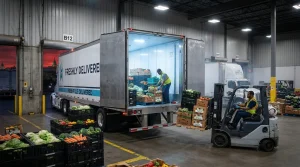
Waiting for loading and unloading is generally not paid as overtime. The study will determine how to improve this time and the safety of carriers.
The Federal Motor Carrier Safety Administration will conduct an analysis of the opinions of 80 carriers and 2,500 CMV drivers to assess the impact stopping time has on the safety of commercial vehicle drivers and on the wallet of employees.
For this reason, the FMCSA is seeking “comments from the industry on how delays in loading and unloading at the company’s docks are affecting safety and operations”, a Federal Register publication detailed.
This study must be approved by the White House Office of Management and Budget. Once that step is complete, the investigation will collect stoppage time data from different industry segments. Thus, it will be possible to know how many real hours the vehicles stop during loading and unloading times. The idea is to reduce these times and improve waiting times.
All public comments will be received until October 23. Many reactions from truckers and carriers are expected as this time is not generally credited as overtime.

“Although there is currently no standard definition of detention time, the CMV industry, the US government, and academic research on detention in the United States have generally used detention time (the total amount of time spent in a facility) that exceeds two hours to define when the detention is made. Detention time in the CMV industry is a long-standing problem and is constantly ranked as one of the main problems for a large part of CMV operators on an ongoing basis”, detailed the FMCSA.
The agency continued: “Reducing stop time can lower costs for carriers, increase driver pay, and improve the ability of CMV drivers to make deliveries on time or arrive at a destination as planned without violating the hours of service requirements”. “Drivers who experience less stopping time may also be more likely to drive safely to their destinations within HOS limits and less likely to operate beyond HOS limits and incorrectly record their driving time and of service to make deliveries on time,” he continued.
In the same study, the economic losses derived from arrests, delays in supply, traffic accidents and strategies to improve this flow will be analyzed.

The trucker style: comfort, function, and identity
Truckers’ style is much more than workwear; it’s an identity. These are the most commonly worn garments among truckers. Truckers’ style is much more than

Chaos on Highway 61: Viral Wrong-Way Truck Video Reignites the CDL Debate
An 80-ton tractor-trailer traveling miles in the wrong direction on Missouri’s Highway 61 has reignited a nationwide debate over Commercial Driver’s License (CDL) standards, training

How technology affects driver retention
Friend or foe? 52% of drivers say technology directly influences their decision to stay with or leave a fleet. Fleet telematics company Platform Science published

Dalilah Law seeks to remove non-english speaking commercial drivers
President Donald Trump proposed the “Dalilah Law,” an initiative aimed at prohibiting undocumented immigrants from obtaining commercial driver’s licenses. On February 24, President Donald Trump

FORMULA 1 and the AI That Could Transform Transportation in the U.S.
The artificial intelligence system that Formula 1 implemented to monitor every car on every turn is opening the door to new applications in trucking, logistics,

$170 billion at stake: 1,500 companies demand tariff refunds
Companies have challenged the global tariffs imposed by President Donald Trump, asking federal courts to reactivate proceedings to begin the refund process. The companies that