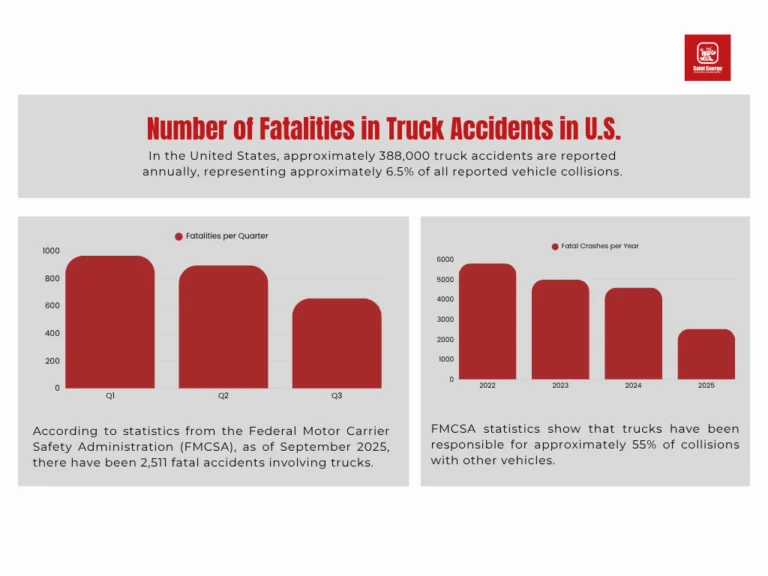
According to statistics FMCSA, as of September 2025, there have been 2,511 fatal truck accidents reported.
In the United States, approximately 388,000 truck accidents are recorded each year, representing about 6.5% of all reported vehicle collisions. So far in 2025, numerous truck-related accidents have been documented, many of them fatal. Although various studies indicate a gradual decrease in the overall number of these incidents, safety and prevention measures remain insufficient.
However, there is a silent epidemic that directly affects drivers and significantly contributes to these accidents: fatigue. Studies have shown that staying awake for 18 consecutive hours can impair driving ability as much as having a blood alcohol concentration (BAC) of 0.08%. Truck drivers often work up to 14-hour shifts, with limited rest and under high stress levels, leading to mental fatigue that reduces their ability to react to road hazards.
Main causes of truck accidents
According to statistics from the Federal Motor Carrier Safety Administration (FMCSA), as of September 2025, there have been 2,511 fatal truck accidents reported with 869 in the first quarter, 815 in the second, and 583 in the third. This represents an average of 250 deaths per month attributed to road freight transport.
The most affected states are Texas, California, Florida, Georgia, Illinois, and Oregon, with the Southern region accounting for 37% of all recorded accidents. While there are multiple factors contributing to the total number of crashes, driver fatigue ranks as the second most common cause. Based on the collected data, the main causes of truck accidents are as follows:
- Speeding / Loss of control – 29%
- Driver fatigue – 22%
- Distraction – 16%
- Intoxication – 9%
- Mechanical failure – 8%
- Adverse weather – 7%
Additionally, FMCSA statistics show that trucks were responsible for roughly 55% of all collisions involving other vehicles. Of these, truck driver errors accounted for about 87% of crashes, truck or trailer issues represented 10%, and environmental conditions made up the remainder.
The year 2025 has seen a slight increase in fatalities related to truck accidents. The causes are predominantly human, fatigue, distraction, and speeding, underscoring the need for both the transport industry and the government to take responsibility for this growing issue by implementing more effective regulations to ensure greater safety and control on the nation’s roads.
Fatigue, reckless driving, and lack of regulation: the hidden causes behind truck accidents
While fatigue remains one of the leading causes of truck accidents each year, a direct consequence of the lack of strict regulations regarding the mandatory rest hours drivers must take, the other contributing factors fall under what the industry defines as “reckless driving.”
Reckless driving has shown a steady increase in recent years across the transportation sector. This behavior includes speeding, distracted driving (such as using mobile devices), eating or drinking while driving, and driving under the influence of alcohol or drugs.
In recent months, organizations such as the Owner-Operator Independent Drivers Association (OOIDA) have urged authorities to implement stricter measures in the training, evaluation, and supervision of truck drivers. From the acquisition of a commercial driver’s license to weekly or annual inspections, these associations argue that the industry must enforce tougher standards to promote safer and more responsible driving practices.
The failure to enforce regulations with consistency and rigor has had direct consequences, reflected in the rise of truck-related accidents. To improve this situation, it is essential that drivers receive proper support and training, adopt safe driving techniques, respect mandatory rest periods, and face appropriate penalties when violating established regulations.

ATA Calls for Tougher Penalties Against Cargo Theft
Cargo theft has moved from being an industry nuisance to a national concern. The American Trucking Associations (ATA) warned Congress that the crime is draining billions from the U.S. supply chain, disrupting logistics operations, endangering drivers, and increasingly intersecting with organized crime and national security threats—prompting renewed calls for stronger federal penalties and coordinated enforcement.

The first Bipartisan Trucking Caucus
Led by a group of lawmakers who come together to pursue shared policy goals, the caucus will focus on the integrity, safety, and growth of

NDAA passed with new protections for truck drivers and military freight
Congress approved the National Defense Authorization Act, a key piece of legislation that includes provisions aimed at protecting truck drivers. Congress approved this week the

California to Reissue Contested Commercial Driver’s Licenses, Challenging Federal Pressure
California plans to reissue contested commercial driver’s licenses (CDLs), reopening a regulatory dispute with federal authorities and raising key questions for the U.S. trucking industry.

Tesla faces suspension in California due to false advertisement
The California DMV announced that sales of Tesla Inc. vehicles could be suspended for 30 days in the state, due to marketing practices that “mislead

Analyzing trucking safety: crash trends by fleet size
The FMCSA records reveal marked differences in crash rates based on fleet size. The digital outlet FreightWaves, in collaboration with a data partner, analyzed crash
All content and original artwork, unless otherwise noted, is protected by copyright. Saint George uses certain images under license from various licensing vendors for this purpose. Any unauthorized commercial reproduction or distribution of copyrighted materials is prohibited.