 Hable con un agente al (888) 572-7520
  Enviar mensaje a un agente



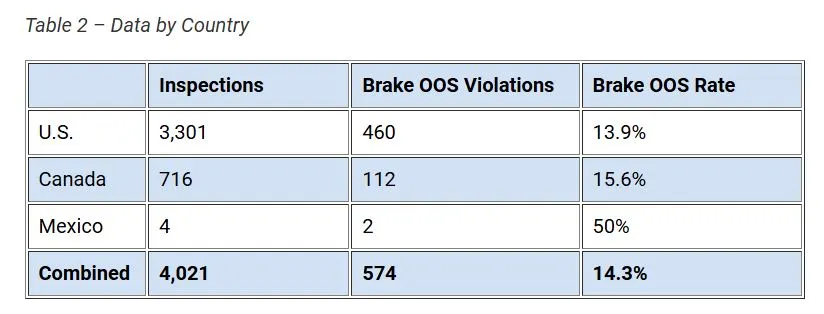
The Commercial Vehicle Safety Alliance (CVSA) carried out inspections of commercial vehicles throughout North America to identify potential brake-related violations. Out of 4,021 inspections conducted in a single day, 574 vehicles (equivalent to 14.3%) were placed out of service (OOS) due to brake violations.
These inspections were part of Brake Safety Day, the CVSA’s annual initiative dedicated to brake safety inspections, regulatory compliance, and data collection. A total of 47 jurisdictions across Canada, Mexico, and the United States participated in the inspection effort, which took place on April 14 without prior public announcement.
Of the 4,021 inspections conducted, 3,447 commercial motor vehicles showed no brake-related violations, representing 85.7% of the total vehicles inspected. These vehicles received a CVSA decal indicating that they had passed inspection and that the inspection had been completed recently.

Brake Safety Day Results
This year, Brake Safety Day placed special emphasis on drums and rotors. Inspectors identified 43 violations related to drums and rotors, 21 of which resulted in vehicles being placed out of service.
The violations identified included:
- Broken rotor – 8 total violations
- Rusty rotor – 24 total violations
- Metal-to-metal contact – 2 total violations
- Broken drum – 9 total violations
Inspectors identified 313 commercial vehicles that met the out-of-service criteria for having 20% defective brakes. This occurs when 20% or more of a vehicle’s brakes (or combination vehicle brakes) have a condition affecting braking capability to such a degree that the brake is considered defective, according to the CVSA’s official statement.
In addition, inspectors identified 121 out-of-service violations related to brake hoses and/or tubing:
- 47 vehicles with out-of-service violations on the steering axle
- 40 vehicles that failed an air loss rate test
- 193 additional out-of-service brake violations related to inoperative tractor protection systems, hydraulic or electric brake violations, inoperative parking/emergency brakes, inoperative low-air warning devices, and other issues
Finally, 26 vehicles (7.45%) failed to meet the required minimum braking efficiency rate of 43.5% and were placed out of service, as required by the U.S. Federal Motor Carrier Safety Regulations and the CVSA Out-of-Service Criteria.
Brake Safety Campaign
Of the inspections conducted, a total of 3,643 (90.6%) were Level I inspections under the North American Standard. A Level I inspection is a comprehensive 37-step procedure that examines driver operating requirements and evaluates the mechanical condition of the vehicle. According to the CVSA, Level I inspections are the most commonly performed type of inspection overall.
Brake Safety Day is part of Operation Airbrake, a CVSA program dedicated to improving commercial motor vehicle brake safety throughout North America. The CVSA’s seven-day Brake Safety Campaign is scheduled to take place from August 23 to 29 of this year.
 Business hours: Monday to Friday from 8:00 AM to 5:00 PM. California time