 Hable con un agente al (888) 572-7520
  Enviar mensaje a un agente

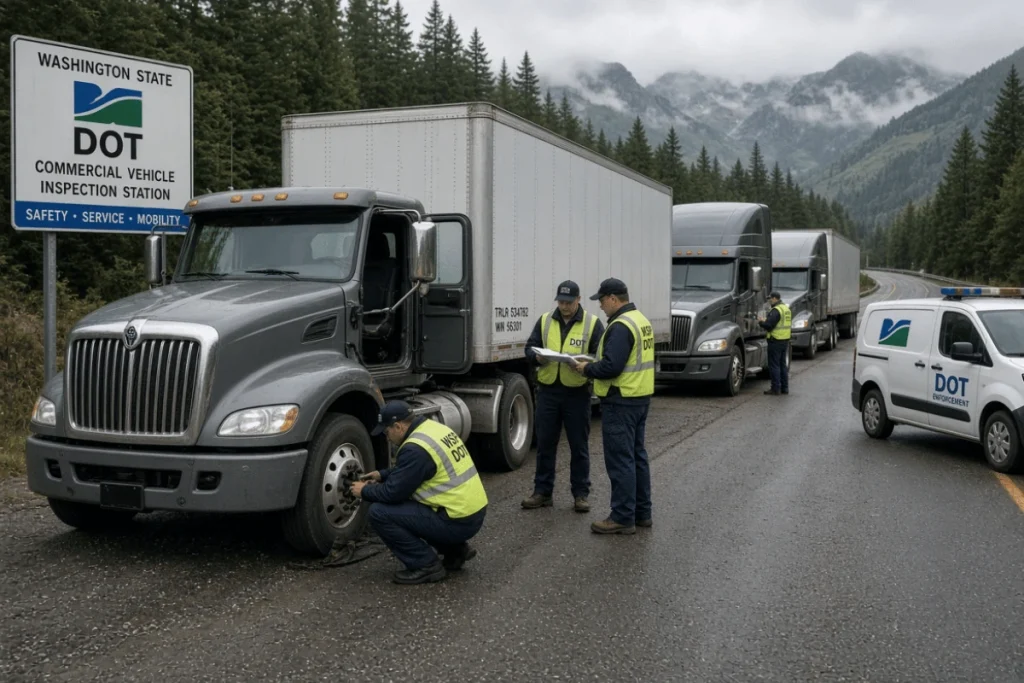

DOT inspections for trucks in Washington became more frequent and stricter in 2026 due to a combination of concrete factors: the new federal rule requiring any driver who fails the English language proficiency assessment to be placed out of service (in effect since June 2025 and reinforced by law in 2026), the expansion of automatic detection technology like the TACS tire-monitoring system at the state’s ports of entry, and the calendar of nationally coordinated enforcement events run by the Commercial Vehicle Safety Alliance (CVSA), which included the International Roadcheck (May 12-14, 2026) and Brake Safety Week (August 23-29, 2026).
The Washington State Patrol (WSP) conducts these checks mainly at weigh stations and through roving patrols on I-5, I-90, I-82, and US-97.
Why DOT inspections increased in Washington during 2026
Unlike previous years, 2026 brought a concrete regulatory change that explains much of the tightened enforcement: the English Language Proficiency (ELP) requirement went from being a simple noted observation to becoming a violation that puts a driver out of service immediately.
The Commercial Vehicle Safety Alliance (CVSA) added this rule to its North American Standard Out-of-Service Criteria on June 25, 2025, following a presidential executive order issued on April 28 of that year, and in February 2026 the U.S. Congress turned the measure into law through the Consolidated Appropriations Act of 2026 — making it permanent and no longer dependent on a policy directive a future administration could reverse.
The impact of this rule is already measurable: according to official data published by the FMCSA in the Federal Register, between June 25, 2025 and March 19, 2026, 60,399 English proficiency violations were issued nationwide, of which 19,045 resulted in an out-of-service order. In January 2026 alone, a national enforcement effort called “Operation SafeDRIVE” placed nearly 500 drivers out of service for this reason in just three days, across 26 states.
How the english proficiency inspection works today
The English proficiency assessment applied by roadside inspectors is a two-step process, according to FMCSA documentation: first, a verbal interview in which the inspector asks the driver questions in English about their identity, the cargo, and the trip, to evaluate whether they understand and can respond; and second, an assessment of the driver’s ability to read and interpret traffic signs in English.
Inspectors are explicitly instructed not to use translation apps, interpreters, or other passengers to help the driver pass the test — the goal is to confirm the driver can operate safely on a U.S. highway without outside assistance.
New technology at Washington’s Weigh Stations
Beyond the regulatory factor, the Washington State Patrol (WSP) has also added technology to detect violations before a truck even reaches the scale. The TACS (Tire Anomaly and Classification System), funded through a federal grant, uses sensors embedded in the roadway to detect missing, mismatched, or underinflated tires while trucks travel at highway speed. If the system identifies a possible violation, it automatically directs the vehicle to exit toward the weigh station and tells the officer exactly which tires to inspect. The equipment was installed at the ports of entry in Plymouth, Bow Hill, Spokane, Ridgefield, and Cle Elum.
Adding to that is the electronic screening system WSP already used before TACS was introduced: in 2023, more than 6.7 million commercial vehicles were identified and electronically screened, of which 2.7 million crossed while the scale was open, generating more than one million automatically detected potential violations.
The enforcement calendar driving up inspection frequency in 2026
Washington actively participates in the coordinated enforcement events organized by the CVSA across North America, which causes the frequency of inspections in the state to spike noticeably during certain weeks of the year:
- International Roadcheck (May 12-14, 2026): the largest commercial vehicle inspection event in the world, with an average of nearly 15 trucks and buses inspected per minute across North America over 72 hours. The 2026 focus was on electronic logging device (ELD) tampering on the driver side, and cargo securement on the vehicle side.
- Brake Safety Week (August 23-29, 2026): a dedicated event for intensive brake system inspections — historically the category responsible for the highest percentage of out-of-service orders.
- WSP state-level enforcement: beyond the national events, the Washington State Patrol maintains stepped-up enforcement during the “100 deadliest days of summer,” the period of highest traffic volume and crash rates of the year, with emphasis on commercial vehicles missing their required annual inspection, unsecured loads, and irregular driver qualifications — a risk that grows during harvest season.
What an inspector looks at during a DOT check
According to consolidated data from industry technical reports for 2026, brakes, tires, and lights continue to account for more than 75% of all out-of-service orders nationwide. During the 2025 International Roadcheck, CVSA inspectors examined 56,178 commercial vehicles and placed 22.6% of them out of service — roughly one out of every five trucks inspected.
On the driver side, hours-of-service violations led the ranking at 32.4% of the total, followed by lack of a valid CDL (24.4%) and lack of a current medical certificate (14.9%). A single violation resulting in an out-of-service order can damage a company’s CSA score and, according to industry reports, raise the cost of commercial insurance by 10% to 30%.
Which Washington corridors see the most enforcement
In Washington, the WSP and WSDOT conduct inspections both at fixed weigh stations and through roving patrols along the state’s main freight corridors: I-5 (the north-south axis between Oregon and Canada), I-90 (connecting Puget Sound with Spokane and Idaho), I-82, and US-97. The weigh stations located at the state’s ports of entry — including Plymouth, Bow Hill, Spokane, Ridgefield, and Cle Elum — use weigh-in-motion technology and electronic pre-screening systems like PrePass and Drivewyze, which allow carriers with a clean safety record to bypass the scale, while vehicles flagged by the system are directed in for inspection.
The FMCSA’s Inspection Selection System (ISS) assigns each carrier a score from 1 to 100 based on their BASIC categories under the CSA program. The higher that score, the greater the likelihood that truck will be directed for inspection when passing through a Washington weigh station.
Recommendations for reducing the risk of an out-of-service order
Ahead of the highest-intensity enforcement events — such as August’s Brake Safety Week or the next International Roadcheck — industry specialists recommend scheduling preventive maintenance and equipment checks well ahead of those dates. Passing a Level I inspection with no violations earns a CVSA decal valid for three months, which reduces the likelihood that vehicle will be selected for reinspection again during that period.
Frequently Asked Questions
Why did DOT inspections become stricter in Washington in 2026? Mainly because of the new English proficiency rule, which since June 2025 places a driver out of service immediately if they fail the assessment, and which Congress turned into permanent law in 2026. Add to that new detection technologies like the TACS system at the state’s weigh stations.
What happens if a driver fails the English proficiency assessment? They are placed out of service immediately, under the CVSA criteria in effect since June 2025 and codified into law in 2026. Between June 2025 and March 2026 alone, more than 19,000 such orders were recorded nationwide.
Which Washington corridors see the most truck enforcement? Mainly I-5, I-90, I-82, and US-97, along with the fixed weigh stations located at the state’s ports of entry, such as Plymouth, Bow Hill, Spokane, Ridgefield, and Cle Elum.
What are the most common violations found in a DOT inspection? Brakes, tires, and lights account for more than 75% of vehicle-side out-of-service orders. On the driver side, hours-of-service violations, lack of a CDL, and lack of a medical certificate are the most frequent.
 Business hours: Monday to Friday from 8:00 AM to 5:00 PM. California time