 Hable con un agente al (888) 572-7520
  Enviar mensaje a un agente

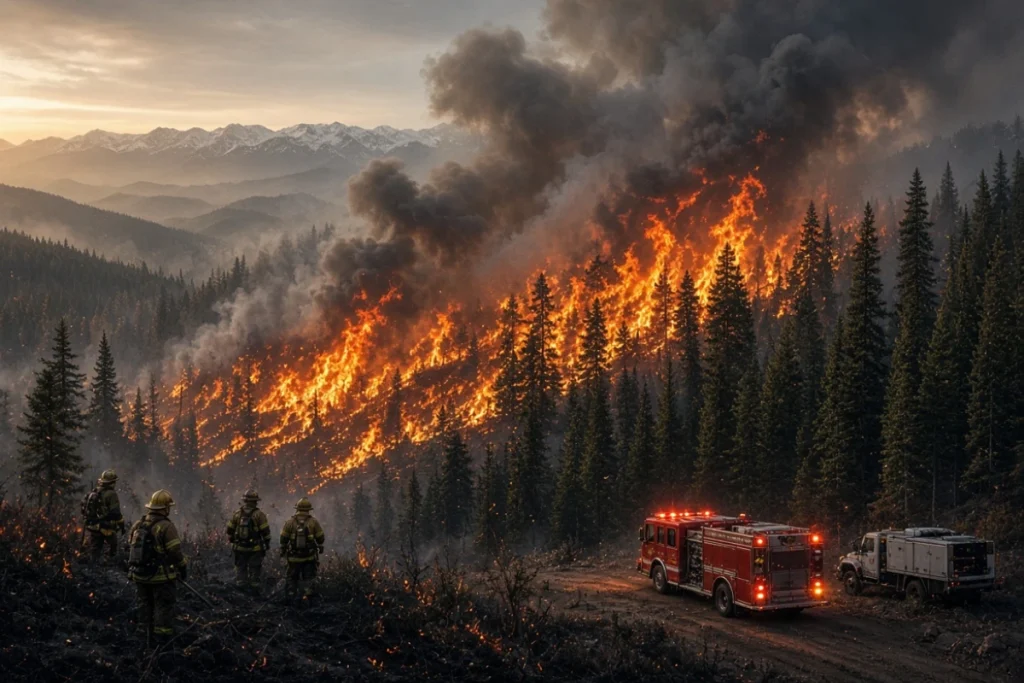

Wildfires affect freight transport in three concrete ways: full or partial road closures — including key interstates like I-84 in Oregon, closed for 70 miles in July 2026 — severe visibility reduction from smoke, and congestion on secondary roads not built for heavy truck traffic when a main route shuts down.
In 2026, Washington is going through one of its most intense wildfire seasons on record, with a statewide emergency declared, an emergency burn ban in effect through September 30, and more than $120 million allocated by the state legislature for firefighting — double the previous year’s budget. Against that backdrop, the FMCSA maintains a formal hours-of-service exemption mechanism for trucks providing direct assistance during the emergency.
A Wildfire Season Already Hitting Washington’s Logistics
Washington’s 2026 wildfire season is, according to official data, particularly severe. The National Interagency Fire Center had already forecast, back in May, above-average fire risk for eastern Washington in June, expanding to most of the state by July and August. That forecast played out: by early August 2026, the Washington State Department of Ecology reported “explosive” fire activity across multiple hotspots statewide, with hundreds of structures burned and potentially hazardous air quality.
Among the active fires most relevant to regional logistics are the Kaiser Canyon Fire in Ferry County — the state’s largest, having consumed more than 100,000 acres — along with active fires in Franklin, Chelan, Skamania, Pend Oreille, Stevens, and Douglas counties, several of which directly affect rural transport corridors. The state itself declared a drought emergency in early April 2026, a factor that, combined with a lighter winter snowpack and hotter, drier conditions, helps explain the scale of this season.
Road Closures: The Most Direct Impact on Freight
The most immediate effect of a wildfire on freight transport is a road closure. The most illustrative case in 2026 happened in Oregon — a key state for any operation connecting Washington to the rest of the country: the Fox Fire forced the closure of Interstate 84 along a 70-mile stretch between Baker City and Ontario, near the Idaho border, before partially reopening hours later. The Oregon Department of Transportation (ODOT) confirmed that fire activity remained active in the area and that further intermittent closures were possible.
I-84 is no minor corridor — it’s the artery connecting Portland in the west to eastern Oregon through the Columbia River Gorge, continuing on toward Boise, Idaho. According to ODOT, when a major route like this closes, secondary roads fill up quickly because they aren’t designed for heavy traffic or large loads, which in turn raises the risk of extended delays and crashes.
Smoke: A Problem Just as Serious as the Road Closure
Even when a route stays open, wildfire smoke creates a direct operational hazard. According to ODOT, visibility can drop suddenly and severely, making it hard to see other vehicles, emergency responders, and roadway hazards. The agency recommends that drivers — including commercial truckers — slow down and increase following distance in areas with heavy smoke.
In Washington, the Department of Ecology itself warns that wildfire smoke is the state’s largest source of particle pollution, and that breathing it in causes wheezing, coughing, heart and lung disease, and even death. For a long-haul driver spending hours behind the wheel in a cab with outside ventilation, cumulative exposure during an active wildfire season is not a minor detail.
Adding to that, ODOT points to another risk: power outages near fire zones can knock out traffic signals, which must be treated as a four-way stop when dark, and roads may have damaged guardrails or missing signage in already-burned stretches, even after reopening.
What Carriers Can Do When Facing a Road Closure
Per ODOT’s official guidance during the 2026 wildfire season, if a route near an active fire is closed, the safest option is to avoid heading toward the closure point and instead stay somewhere with access to fuel, food, water, and lodging, checking road conditions continuously before resuming the trip. In Oregon, the official site for this information is TripCheck.com; in Washington, WSDOT provides traffic updates and closure information through its own alert system.
ODOT also warns that truck parking and services near closure points fill up fast, leaving few available places to wait — reinforcing the importance of planning routes ahead of time during peak wildfire risk months, roughly July through October.
The FMCSA Exemption: Regulatory Relief in Emergency Zones
When a governor declares a wildfire emergency, the Federal Motor Carrier Safety Administration (FMCSA) automatically triggers an hours-of-service (HOS) exemption for trucks providing direct assistance during that emergency, under the regulatory framework of 49 CFR Part 390.23. This exemption allows drivers to transport essential supplies without the usual driving-time and rest restrictions, though it does not exempt carriers from driver qualification requirements or controlled substance and alcohol testing.
The FMCSA itself identified wildfires in the western United States as one of the events that in 2024 required extending these exemptions beyond the 14-day limit in place since 2023, alongside the collapse of the Francis Scott Key Bridge in Baltimore and the back-to-back hurricanes that hit North Carolina that same year. Drawing on that experience, the agency moved forward in 2026 with a proposal to restore the automatic emergency exemption window to 30 days, aiming to reduce the uncertainty created when an extension decision came right before the original exemption was set to expire.
It’s worth clarifying exactly what this exemption covers: it applies only to carriers providing “direct assistance” — meaning transportation of supplies or services essential to the immediate restoration of the affected area — not to routine freight, long-term rebuilding efforts, or mixed loads with only a minimal share of emergency-related goods.
Why This Trend Will Likely Deepen
The Washington State Department of Ecology itself links the growing acreage burned by wildfires to climate change, which reduces winter snowpack and produces hotter, drier summers. The state legislature has already responded to that trend by allocating $120 million for firefighting in 2026 — double the previous year’s budget — a sign that the scale of the problem, and its potential impact on freight logistics moving through the state, will likely remain relevant in coming seasons.
Frequently Asked Questions
Which regional routes were affected by wildfires in 2026? In Oregon, Interstate 84 was closed for 70 miles between Baker City and Ontario due to the Fox Fire, with additional impacts on US-20 and US-26. In Washington, active fires like the Kaiser Canyon Fire in Ferry County and others in Franklin, Chelan, Skamania, and Spokane affected rural transport corridors.
Is there any regulatory relief for trucks operating in wildfire emergency zones? Yes. When a governor declares a wildfire emergency, the FMCSA automatically triggers an hours-of-service exemption for carriers providing direct assistance during that emergency, under the framework of 49 CFR Part 390.23.
Where can I check the current status of roads during wildfire season? In Oregon, the official site is TripCheck.com. In Washington, WSDOT publishes traffic updates and closures through its official channels, and the Department of Ecology maintains a joint smoke-monitoring blog with frequent updates throughout the season.
How long does wildfire season last in the Pacific Northwest? Roughly from July through October, with the highest risk concentrated in the summer months, when vegetation is driest and temperatures are highest.
 Business hours: Monday to Friday from 8:00 AM to 5:00 PM. California time