 Hable con un agente al (888) 572-7520
  Enviar mensaje a un agente

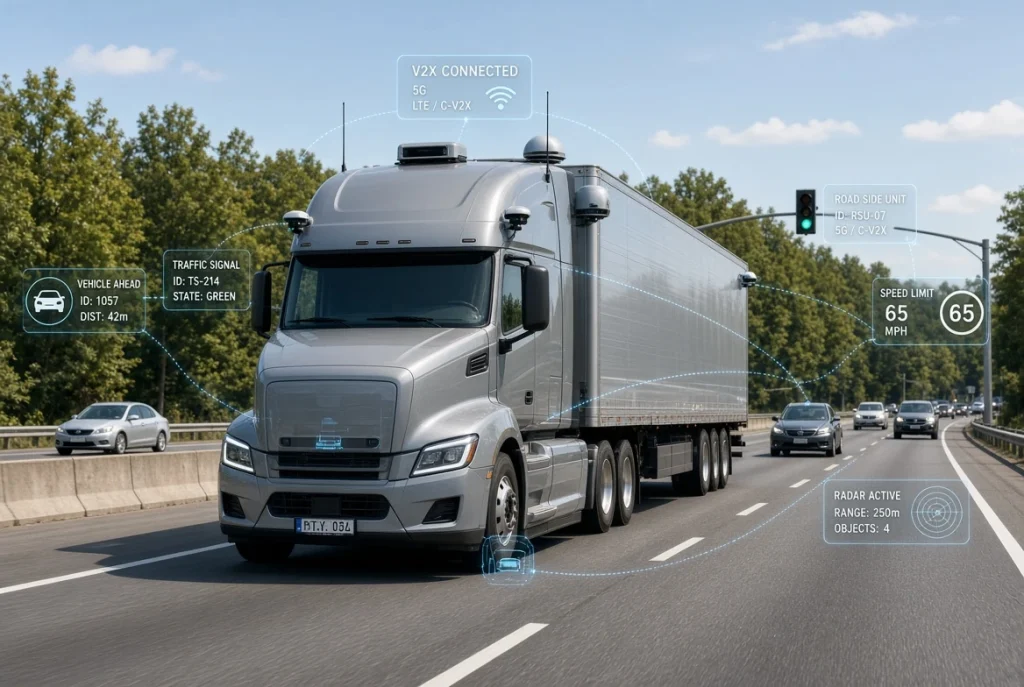

V2X technology (Vehicle-to-Everything) allows a truck to communicate in real time with traffic lights, curve-warning signs, smart roadsides, and other vehicles, delivering alerts before a driver could see or feel the hazard themselves.
The U.S. Department of Transportation (USDOT), through the Federal Highway Administration (FHWA), has already committed more than $100 million in grants to accelerate deployment nationwide, while in Washington, the state Department of Transportation (WSDOT) runs an active Cooperative Automated Transportation program that specifically explores smart truck parking pilots and truck platooning along the I-5 corridor.
What V2X Technology Is, and Why It’s Aimed at Trucks First
V2X stands for Vehicle-to-Everything, an umbrella term covering several types of communication: vehicle-to-vehicle (V2V), vehicle-to-infrastructure (V2I), vehicle-to-pedestrian (V2P), and vehicle-to-network (V2N). In practice, a truck equipped with V2X can receive automatic warnings about red lights, safe curve speeds, road work ahead, or the position and speed of another nearby truck — all before the driver could perceive that risk on their own.
According to the FHWA, this technology is a core component of the “Safe System Approach” adopted under USDOT’s National Roadway Safety Strategy, launched in January 2022 to address the country’s roadway death crisis.
For freight transport specifically, the promise of V2X goes beyond crash avoidance: the American Trucking Associations (ATA) — the trade group representing more than 37,000 trucking companies nationwide — states that V2V connectivity between trucks allows a lead truck and a following truck to share braking and acceleration data almost instantaneously, enabling faster reaction times than a human driver or even a standalone radar sensor could achieve.
Federal Backing: Concrete Funding to Speed Up Deployment
The push behind V2X technology in the United States isn’t just a statement of intent. The FHWA launched the “Saving Lives with Connectivity: Accelerating V2X Deployment” program, which awarded a first round of $40 million in grants in 2023 and added another $60 million in 2024, distributed to Arizona, Texas, and Utah to serve as national deployment models.
One of the projects funded under this program is the “Texas TRUST Project,” led by the Texas A&M Transportation Institute with $19.2 million from USDOT, which is deploying V2X technology in the Houston area for use cases including smart signal timing, flood warnings, wrong-way driving detection, and emergency vehicle priority — applications that are also relevant to long-haul freight.
Washington: The Official “Cooperative Automated Transportation” Program
In Washington, WSDOT runs a dedicated program called Cooperative Automated Transportation, led by program manager Ted Bailey. According to official information published by WSDOT itself, the program is actively exploring pilot projects for truck parking and interstate truck platooning, while also working to identify the barriers and strategies needed to scale up field deployments and preserve radio spectrum space for public safety uses.
That work builds on investments already underway along the I-5 corridor: in 2025, WSDOT rolled out a real-time truck parking information system at rest areas along the corridor, including Gee Creek north of Vancouver, with plans to add more locations through 2026. While not V2X technology in the strict sense, it belongs to the same family of cooperative, intelligent systems designed to give drivers real-time information before they need it.
The Technical Battle Behind the Scenes: C-V2X vs. DSRC
For more than two decades, the short-range communication technology chosen for vehicle use in the United States was DSRC (Dedicated Short-Range Communications), operating in the 5.9 GHz band reserved by the Federal Communications Commission (FCC) since 1995 specifically for transportation safety applications. In recent years, however, the FCC moved toward a newer standard, C-V2X (Cellular Vehicle-to-Everything), which leverages cellular network infrastructure and advanced protocols like 5G to support a broader ecosystem of vehicles and infrastructure, with greater capacity to handle simultaneous data transmissions.
The ATA, the leading national voice for the freight trucking sector, was an active participant in this regulatory debate: for years it argued for keeping the full 5.9 GHz spectrum dedicated to transportation safety, and in 2018 explicitly highlighted that assisted truck platooning systems were already being successfully tested on U.S. roads using V2V communication. The FCC ultimately adopted rules consolidating spectrum use around C-V2X, setting a timeline for the gradual phase-out of the older DSRC technology.
What Concrete Benefits This Could Bring to Freight Transport
According to FHWA technical documentation, examples of V2X applications already in development or testing across various states include warnings tied to intersections, red lights, safe curve speeds, and unintended lane departure — all high-risk situations for a heavy vehicle given its longer braking distance and reduced maneuverability.
For a trucking company or an owner-operator, the benefits industry sources point to include:
- Faster-than-human reaction times: according to the ATA, synchronized braking and acceleration between connected trucks enables shorter reaction times than a driver — or even a standalone radar sensor — could achieve.
- Lower fuel consumption while platooning: synchronized driving between trucks reduces aerodynamic drag on the following vehicle, which can translate into fuel savings on long-haul routes.
- Advance infrastructure information: early warnings about road work, traffic signals, and traffic conditions before a driver can see them visually.
The Challenges Still Standing in the Way of Mass Adoption
V2X technology still faces structural obstacles to large-scale deployment. WSDOT’s own Cooperative Automated Transportation program identifies “identifying barriers and strategies to increase field deployments” as one of its central tasks — a sign that the physical infrastructure, meaning traffic lights and roadsides equipped with communication units (RSUs), remains limited outside of pilot corridors.
Add to that the technological transition from DSRC to C-V2X, which requires defining common interoperability standards among truck manufacturers, road infrastructure providers, and fleet operators — a process the FHWA manages through its own “V2X Hub,” an open-source software platform designed to let jurisdictions across the country exchange V2X messages regardless of which specific protocol each local system uses.
Frequently Asked Questions
What does V2X stand for? Vehicle-to-Everything. It’s a set of technologies that lets a vehicle communicate with other vehicles, with road infrastructure (traffic lights, signs), with pedestrians, and with data networks in real time.
Does Washington have an official V2X program for trucks? Yes. WSDOT operates the Cooperative Automated Transportation program, which specifically explores pilot projects for truck parking and interstate truck platooning, while also working to reduce barriers to deployment.
What’s the difference between DSRC and C-V2X? DSRC is the short-range communication technology originally used for vehicle safety applications since the 1990s. C-V2X is a newer standard that leverages cellular networks and protocols like 5G to support a broader communication ecosystem with greater data capacity. The FCC decided to consolidate use of the 5.9 GHz spectrum around C-V2X, with a phased timeline for retiring DSRC.
How much federal funding has gone toward V2X technology? The FHWA awarded $40 million in 2023 and another $60 million in 2024 through its “Saving Lives with Connectivity: Accelerating V2X Deployment” program, on top of smaller individual grants funded separately across various states.
 Business hours: Monday to Friday from 8:00 AM to 5:00 PM. California time