 Hable con un agente al (888) 572-7520
  Enviar mensaje a un agente

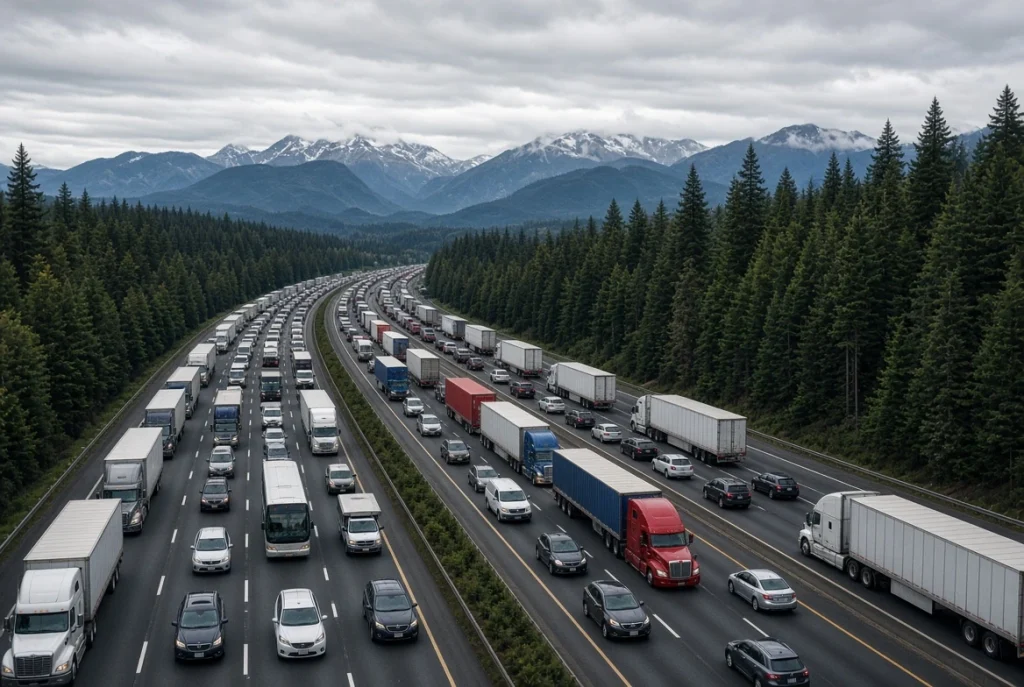

The worst truck bottlenecks in Washington in 2026 is the Interstate 5 bridge over the Columbia River (the “I-5 Bridge”), connecting Vancouver, Washington, with Portland, Oregon: it’s the most congested corridor in the state and in Oregon, and the fifth-worst on the entire West Coast, according to the American Transportation Research Institute (ATRI).
Adding to that structural delay, 2026 brought an unusual overlap of active road construction in the Puget Sound area — including closures on I-5, I-405, and I-90 — along with progress on the SR 167 Completion Project, which aims to finish new direct connections between I-5 and the ports of Seattle and Tacoma only by 2030.
What a “Bottleneck” Means for Freight Transport, and How It’s Measured
The American Transportation Research Institute (ATRI), the official research arm affiliated with the American Trucking Associations, has published its annual list of the 100 worst truck bottlenecks in the United States for 15 years running. The analysis is based on billions of anonymized GPS speed records from real trucks — not general traffic estimates — at more than 325 freight-critical locations nationwide, making it one of the industry’s most trusted benchmarks for quantifying the real impact of congestion on freight movement.
According to the 2026 edition of that report, released in February, average truck speeds during rush hour dropped to 33.2 mph nationally, 2.8% slower than the previous year, and congestion delays combined amount to the equivalent of 436,000 drivers sitting idle for an entire year.
Washington’s Worst Bottleneck: The I-5 Bridge Over the Columbia River
The most critical point for freight traffic passing through Washington is the Interstate 5 bridge over the Columbia River, connecting Vancouver, Washington, with Portland, Oregon. According to figures released by the office of Congresswoman Marie Gluesenkamp Pérez, who represents southwest Washington, this bridge is rated the worst truck bottleneck in Washington and Oregon, and the fifth-worst on the entire West Coast. The structure carries 131,747 vehicles daily and an average of $132 million worth of freight, with seven to ten hours of congested traffic per day and a crash rate more than three times higher than the state average.
The solution underway is the Interstate Bridge Replacement Program, a binational project between Washington and Oregon that has already secured $2.099 billion in federal funding. Until that new bridge is completed, this corridor will remain, according to official data itself, the point of greatest friction for any truck connecting Washington to the rest of the West Coast heading south.
Puget Sound: A Season of Overlapping Construction
Beyond the I-5/Columbia corridor, summer 2026 brought a specific development that worsened congestion across the greater Seattle area: the Washington State Department of Transportation (WSDOT) itself warned of an unusual overlap of major road construction projects in Puget Sound starting August 7, 2026, generating simultaneous delays across several key corridors.
Among the closures and restrictions active during that period, WSDOT documented: northbound I-405 closed between Southport Drive and Coal Creek Parkway for an entire weekend, northbound I-5 reduced to two lanes over the Ship Canal Bridge through the end of 2026 due to reconstruction work, heavy congestion on local Kirkland streets stemming from those closures, and additional delays on I-90 tied to the simultaneous closure of SR 202 and SR 520. The agency itself recommended drivers plan for trips up to 45 minutes longer than usual during those dates.
The I-5 Corridor Between Tacoma and Seattle: The Axis That Never Lets Up
Even outside periods of exceptional construction, the stretch of I-5 between Tacoma and Seattle — passing through Fife, Tukwila, and Sea-Tac Airport before reaching downtown Seattle — is one of the state’s most structurally congested corridors. It’s also the route that directly connects the Seattle-Tacoma port complex to the rest of the interstate network, making it especially sensitive for freight tied to international trade.
According to a freight mobility study from Clark County, published in 2025, even corridors beyond the immediate Seattle-Tacoma area — including this southern stretch of I-5 — show truck traffic patterns distinct from general traffic: the morning truck peak occurs later than the general peak (between 9 and 11 a.m.), while the afternoon truck peak occurs earlier than the general afternoon peak — a pattern that reflects how carriers try to dodge part of rush-hour congestion, not always successfully.
What Washington Is Doing to Reduce These Bottlenecks
WSDOT isn’t standing still on this problem. The Puget Sound Gateway Program is the state’s most ambitious infrastructure initiative specifically aimed at freight mobility: it combines roadway and bridge projects to complete missing links in the state’s freight network, including a new direct connection between I-5 and the Port of Tacoma, a new SR 99 bridge over SR 509, and a new SR 509 expressway with direct access to Sea-Tac Airport. The entire program has an estimated completion date of 2028.
In parallel, the SR 167 Completion Project is moving forward, which will build six miles of new tolled highway between Puyallup and the Port of Tacoma, with the explicit goal of completing new connections to I-5 and the ports of Seattle and Tacoma. This project, however, won’t be finished until 2030, meaning several more years of active construction and detours in the area.
WSDOT itself confirms that, facing budget constraints for pavement preservation, the agency systematically prioritizes heavy freight routes over other roads, since they deteriorate faster and require more costly rehabilitation: roughly half of the National Highway Freight Program investments allocated to Washington between 2021 and 2025 went exclusively to roadway and bridge preservation on the I-5 and I-90 corridors.
Why This Matters for Any Trucking Company Operating in Washington
A freight planning study by WSDOT estimated that a 20% increase in congestion would cost the state 27,250 jobs and $3.3 billion in economic output per year. For a trucking company or an individual owner-operator, the impact of congestion isn’t abstract: it translates into higher fuel consumption, fewer productive driving hours within the legal hours-of-service limit, missed delivery windows, and less operational predictability on every trip that crosses these corridors.
Frequently Asked Questions
What is the worst truck bottleneck in Washington? The Interstate 5 bridge over the Columbia River, between Vancouver (Washington) and Portland (Oregon). It’s the worst in Washington and Oregon, and the fifth-worst on the entire West Coast, according to data cited by the office of Congresswoman Marie Gluesenkamp Pérez.
What project aims to fix congestion at the I-5 bridge over the Columbia? The Interstate Bridge Replacement Program, a binational project between Washington and Oregon that has already secured $2.099 billion in federal funding.
What construction caused the most congestion in the Seattle area during 2026? An overlap of construction projects starting in August 2026 on I-405, I-5 (with reduced lanes over the Ship Canal Bridge through year-end), SR 202, and SR 520, according to official WSDOT alerts.
When will the main projects aimed at reducing freight congestion in Washington be completed? The Puget Sound Gateway Program has an estimated completion date of 2028, while the SR 167 Completion Project — which connects directly to the ports of Seattle and Tacoma — won’t be finished until 2030.
 Business hours: Monday to Friday from 8:00 AM to 5:00 PM. California time