 Hable con un agente al (888) 572-7520
  Enviar mensaje a un agente

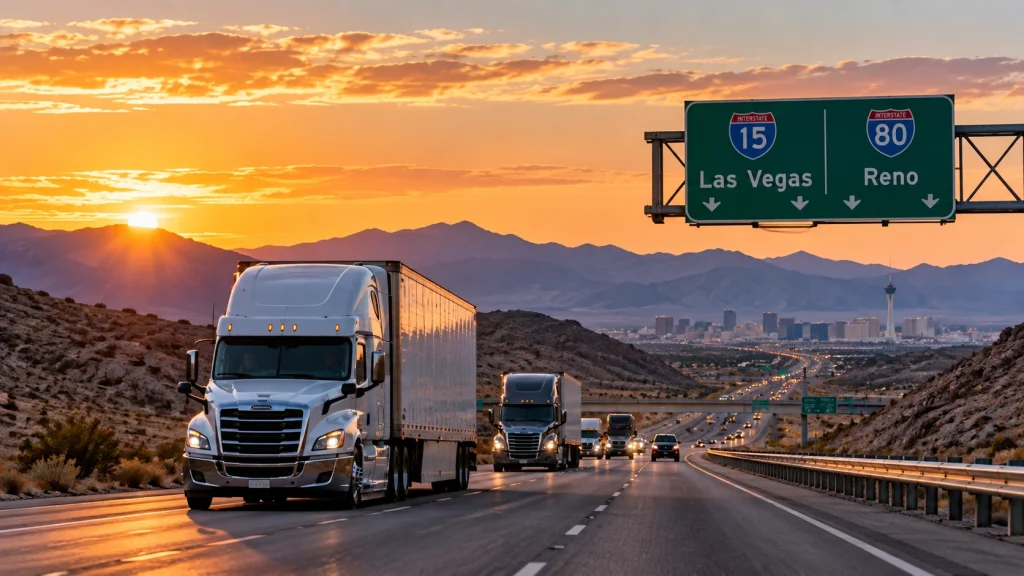

Nevada is looking to strengthen its position as one of the major freight transportation links in the western United States. The Federal Highway Administration (FHWA) approved the updated State Freight Plan during the summer of 2026, outlining a strategy to improve mobility and safety along corridors heavily used by commercial transportation, including Interstates 15 and 80 and other major routes across the state.
Nevada’s location explains much of that strategy. The state sits between major international ports on the West Coast and inland U.S. markets. According to the Nevada Department of Transportation (NDOT), I-80 carries significant transcontinental freight traffic across northern Nevada, while I-15 plays a central role in the south. Nevada also serves as a freight consolidation and distribution point and as a first or last fueling stop before commercial vehicles cross the border with California.
Trucking is particularly important in Southern Nevada. NDOT reports that more than 92% of Southern Nevada’s goods are transported by truck, with a significant share of that freight moving along I-15. The corridor connects Las Vegas with California and, to the north, with Utah and other western U.S. markets.
More Infrastructure for Truck Drivers
The updated plan goes beyond identifying major freight corridors. Planned investments include projects that directly affect truckers’ daily operations, from additional parking infrastructure to technology that provides information about available spaces and systems that can weigh trucks while they remain in motion.
Nevada’s Freight Investment Plan includes a Truck Parking Availability System (TPAS) at five locations along I-80, with an estimated investment of $7.6 million for federal fiscal year 2029. The program also calls for similar systems at six locations along I-15.
Truck parking shortages are an issue Nevada has identified for years. State studies have found significant parking deficits in areas including Clark County and Reno-Sparks, as well as along sections of I-15, I-80, US 93 and US 95. NDOT now plans to expand and improve those facilities while integrating communication systems that can help drivers determine where parking spaces are available.
Technology will also be incorporated into truck weight enforcement. The program includes Weigh-in-Motion facilities, which can measure vehicle weight while trucks are moving, at I-80 locations including Garson/Verdi and Elko/Osino. Each facility represents an estimated $2.5 million investment under NDOT’s program.
Truck Climbing Lanes
Another important element for heavy trucks is the addition of truck climbing lanes, designed to help commercial vehicles travel more efficiently on steep grades.
The program includes a northbound climbing lane on US 93, with a projected investment of $9.5 million, as well as two additional sections of the same highway with truck lanes in both directions. A project on US 95 is also included, with an estimated investment of $4.655 million. Nevada Department of Transportation
These improvements are particularly important in a state where long distances, desert corridors and mountainous terrain are part of everyday commercial trucking routes.
I-11: A Corridor Looking Toward Mexico and Canada
Nevada’s strategy also has a long-term dimension. NDOT plans to continue transforming the US 95 corridor into I-11, with the broader vision of developing a major north-south trade route that could eventually help connect Mexico and Canada through Nevada.
That does not mean a continuous I-11 currently runs across the entire state. The project involves the gradual expansion of a corridor Nevada considers strategically important for its future integration into western North America’s transportation network.
While that broader planning continues, the state is already investing in existing segments. Construction began in May on the I-11 SafeTech Corridor Project, an approximately $22 million initiative that is adding traffic-management technology along roughly five miles of I-11/US 95 between Summerlin Parkway and the interchange known as the Spaghetti Bowl in Las Vegas. The project includes systems capable of providing real-time information on traffic speeds, lane use and incidents.
I-15 Remains a Priority
I-15 will continue to be one of Nevada’s priority freight corridors. During August and September, NDOT conducted a public outreach process to study potential improvements between the Nevada-California state line and the Sloan Interchange, south of Las Vegas.
The study is evaluating current and future traffic needs, safety conditions and possible alternatives to improve mobility along that section. For freight transportation, the corridor is especially important because it serves as a major gateway for trucks traveling between Nevada and California.
The updated Nevada Freight Plan is intended to bring these investments together under a broader strategy. FHWA approved the plan in the summer of 2026 with the goal of improving freight mobility, safety and sustainability while strengthening the infrastructure Nevada needs to diversify its economy.
For truck drivers, that planning translates into practical improvements: more truck parking, real-time information about available spaces, dedicated lanes for heavy vehicles, weigh-in-motion systems and upgrades along some of Nevada’s busiest freight corridors.
Before traveling through Nevada, particularly with oversize or overweight loads, carriers can check current road conditions and restrictions through NVRoads. NDOT recommends reviewing information specifically for commercial vehicles and oversize loads before beginning a trip.
 Business hours: Monday to Friday from 8:00 AM to 5:00 PM. California time