Llame al (888) 572-7520 para hablar con un agente

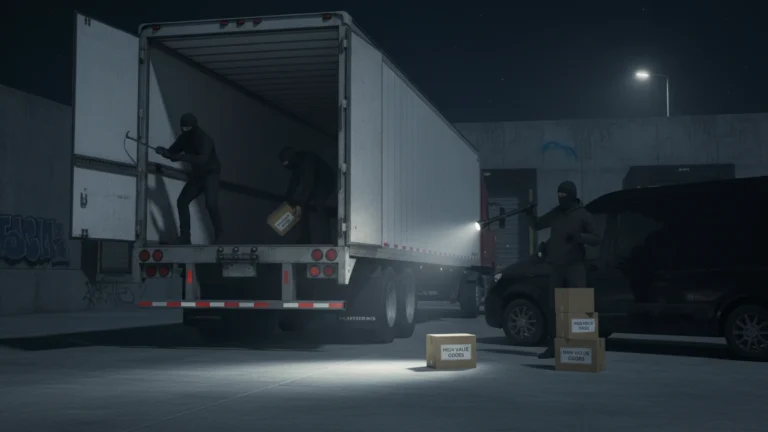
Cargo theft has moved from being an industry nuisance to a national concern. The American Trucking Associations (ATA) warned Congress that the crime is draining billions from the U.S. supply chain, disrupting logistics operations, endangering drivers, and increasingly intersecting with organized crime and national security threats—prompting renewed calls for stronger federal penalties and coordinated enforcement.

Cargo theft has become one of the most pressing challenges facing the U.S. trucking industry, pushing the issue firmly onto the federal agenda. The American Trucking Associations (ATA) urged lawmakers to impose tougher sanctions and adopt a coordinated national response, arguing that cargo theft now represents a serious economic, operational, and national security problem rather than a localized criminal activity.

Testifying before a House Judiciary Subcommittee, ATA President and CEO Chris Spear outlined the structural damage cargo theft is inflicting on the U.S. supply chain. According to the association, theft-related losses amount to millions of dollars every day, costs that ultimately ripple through the economy and reach consumers in the form of higher prices for food, household goods, and essential products.

An Economic Burden Passed on to Consumers

ATA emphasized that cargo theft is not confined to trucking balance sheets. Each stolen load triggers a chain reaction of financial consequences, including insurance claims, shipment delays, replacement costs, and administrative burdens. These expenses accumulate quickly and are absorbed across the supply chain, driving up operational costs for carriers and shippers alike.

As Spear told lawmakers, there is a direct connection between cargo theft and what Americans pay at the checkout counter. When criminal networks siphon money out of the logistics system, those losses do not disappear—they are redistributed throughout the market, placing additional pressure on consumers already facing elevated costs of living.

From Opportunistic Crime to Organized, High-Tech Theft

According to ATA, cargo theft has evolved dramatically in recent years. What was once largely opportunistic crime has transformed into a highly organized, technology-driven operation. Traditional theft at truck stops and distribution centers now coexists with sophisticated schemes involving cyber fraud, identity theft, and falsified shipping documents.

This form of strategic theft relies on digital tools, stolen credentials, and coordinated networks that can redirect freight without ever physically touching a truck. ATA noted that many of these operations have international links, making them harder to trace and dismantle using traditional law enforcement methods.


Small Carriers Face Disproportionate Risk

The burden of cargo theft falls especially hard on small and mid-sized trucking companies, which make up the vast majority of U.S. motor carriers. Most operate fleets of fewer than ten trucks, limiting their ability to invest in advanced cybersecurity systems, real-time monitoring technologies, or specialized risk management teams.

ATA warned that this imbalance leaves smaller operators particularly vulnerable to criminal groups that possess far greater resources, technical expertise, and coordination capabilities. For many carriers, a single major theft incident can jeopardize their financial stability.

Operational Disruptions Across the Supply Chain

Beyond financial losses, ATA highlighted the operational consequences of cargo theft. Each incident can result in missed delivery windows, broken contracts, supply shortages, and strained relationships between shippers and carriers. Insurance premiums continue to rise, and carriers are often forced to reroute freight or alter operations to mitigate risk.

In an economy that depends on reliable and timely freight movement, these disruptions undermine efficiency and resilience across the entire logistics network.

A Growing National Security Concern

ATA also framed cargo theft as a national security issue, noting that proceeds from stolen freight often fund broader criminal enterprises. According to the association, revenues from cargo theft can flow into drug trafficking, money laundering, and organized crime operations, some of which have international reach.

In certain cases, federal investigations have linked stolen cargo to cartel-related financial networks, reinforcing ATA’s position that cargo theft extends well beyond property crime and demands a federal-level response.

Limits of Local Enforcement

One of ATA’s central arguments is that state and local law enforcement agencies often lack the resources, jurisdiction, and intelligence-sharing capabilities needed to pursue cargo theft cases that cross state or national borders. While many investigations begin locally, they frequently stall once crimes move beyond regional boundaries.

ATA maintains that only the federal government has the constitutional authority and operational capacity to investigate and dismantle interstate and transnational theft rings effectively.

Legislative Path Forward

To address the crisis, ATA called on Congress to advance the Combating Organized Retail Crime Act, a bipartisan proposal designed to strengthen legal frameworks, enhance enforcement tools, and improve coordination among federal, state, and local agencies. The legislation would place the Department of Homeland Security (DHS) at the center of a unified national strategy against cargo theft.

For ATA, the conclusion is unequivocal: cargo theft is no longer a niche industry problem. It is a nationwide threat to economic stability, supply chain integrity, and public safety. Without tougher penalties and a cohesive federal response, the association warns that cargo theft will continue to grow, placing increasing strain on America’s transportation infrastructure and the consumers who depend on it.

Facebook
Twitter
LinkedIn
Cargo Theft

ATA Calls for Tougher Penalties Against Cargo Theft

Cargo theft has moved from being an industry nuisance to a national concern. The American Trucking Associations (ATA) warned Congress that the crime is draining billions from the U.S. supply chain, disrupting logistics operations, endangering drivers, and increasingly intersecting with organized crime and national security threats—prompting renewed calls for stronger federal penalties and coordinated enforcement.

Read More »

Leave a Reply

Your email address will not be published. Required fields are marked *

Business hours: Monday to Friday from 8:00 AM to 5:00 PM. California time
Leave your number and a member of our company will contact you
Horario de atención: Lunes a viernes de 8.00 AM a 5.00 PM. Hora california

Deje su número y un miembro de nuestra empresa se pondrá en contacto con usted

Privacy summary

This website uses cookies so that we can offer you the best possible user experience. Cookie information is stored in your browser and performs functions such as recognizing you when you return to our website or helping our team understand which sections of the website you find most interesting and useful.

More information about the privacy policy: Privacy Policy

More information about the terms of use: Terms of use 

More information about the disclaimer: Disclaimer 

More information on acceptable use policies: Acceptable Use Policies