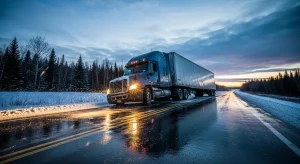
The companies are joining forces to make self-driving trucks a reality, but can it happen in the short term? Are they safe for other drivers? For now, the companies' stocks are soaring.
Aurora, Continental, and NVIDIA have announced a long-term strategic partnership to deploy driverless trucks at scale, leveraging NVIDIA’s next-generation DRIVE Thor system-on-a-chip (SoC). NVIDIA’s DRIVE Thor and DriveOS will integrate with Aurora’s SAE Level 4 autonomous driving system, which Continental plans to mass-produce starting in 2027.

Scaling Up Driverless Trucks
Aurora’s mission is to deliver the benefits of self-driving technology safely, swiftly, and broadly, transforming transportation to become safer, more accessible, and more efficient. The Aurora Driver is a versatile self-driving system capable of operating multiple vehicle types, from freight-hauling trucks to passenger ride-hailing vehicles. This technology underpins Aurora’s driver-as-a-service offerings for trucking and ride-hailing.
“Delivering a single driverless truck will be a monumental achievement, but deploying thousands will change the way we live,” said Chris Urmson, CEO and co-founder of Aurora. “NVIDIA’s leadership in accelerated computing strengthens our ecosystem of partners and enhances our ability to deliver safe, reliable driverless trucks at scale.”
“Developing, industrializing, and manufacturing powerful self-driving hardware at commercial scale demands unique expertise,” said Aruna Anand, President & CEO of Continental North America. “Our groundbreaking collaboration with Aurora and NVIDIA positions Continental at the forefront of autonomous trucking and brings value to our business.”
“The combination of NVIDIA’s automotive-grade DRIVE Thor platform with Aurora’s advanced self-driving trucking technology and Continental’s manufacturing expertise will help shape the future of autonomous trucking, improving road safety and operational efficiency,” added Rishi Dhall, NVIDIA’s vice president of automotive.

Final Validation for April Launch
Aurora is in the final stages of validating the Aurora Driver for driverless operations on public roads. This system is equipped with advanced sensors, including lidar, radar, and cameras, enabling safe operation at highway speeds.
Aurora uses verifiable AI and its Safety Case framework to ensure the system can quickly adapt to new environments while meeting regulatory and public trust standards. The company plans to launch its driverless trucking service in Texas in April 2025.
NVIDIA’s DRIVE Thor will power the Aurora Driver’s primary computer using a dual SoC configuration with DriveOS. Built on NVIDIA’s Blackwell architecture, DRIVE Thor accelerates critical inference tasks to help autonomous vehicles understand and navigate their surroundings. As Continental and Aurora prepare for high-volume production in 2027, initial production samples of DRIVE Thor are expected by mid-2025.

Manufacturing Innovation
Continental, a global leader in automotive supply with €41.4 billion in 2023 sales, is developing a cost-efficient and reliable version of Aurora Driver hardware for mass production. The company is also creating a secondary system to ensure operational safety if the primary system fails.
Prototypes of this hardware kit will undergo testing in the coming months. Continental will integrate DRIVE Thor and DriveOS into the Aurora Driver’s main computer, manufacturing the hardware kit for integration into customer trucks by Aurora’s OEM partners.
At CES 2025 in Las Vegas, Continental is showcasing an early prototype of the Aurora Driver hardware alongside Volvo’s VNL Autonomous, the flagship of its autonomous platform designed for seamless Aurora Driver integration.

What to Expect in 2025
CES 2025 highlights other major players in autonomous driving, including Plus, Volvo Group, Waymo, WeRide, and Zoox. These companies are moving beyond proof-of-concept phases and transitioning to scalable autonomous driving solutions.
2025 is set to be a pivotal year for the industry, with several companies, including Aurora and Gatik, signaling large-scale autonomous trucking deployments. Meanwhile, ride-hailing with autonomous vehicles continues to gain traction. Aurora’s dual focus on trucking and ride-hailing positions it uniquely in the U.S. market.

Frozen Roads After Bomb Cyclone: Black Ice, Record Snow and High Risk for Trucks
Frozen roads continue to disrupt freight transportation following the impact of a powerful bomb cyclone, leaving behind black ice, highway shutdowns, power outages, and dangerous winter driving conditions stretching from the Gulf Coast to New England.

Lunar New Year 2026: Ancient Traditions, Renewed Energy, and Massive Celebrations
Lunar New Year 2026 begins on February 17 under the sign of the Fire Horse and is marked by spiritual rituals, family reunions, and large-scale celebrations in both China and the United States, especially in California.

Freedom 250 Grand Prix: How Logistics and Transportation Will Power the Race in Washington
The first-ever IndyCar street race in Washington, D.C., scheduled for August 21–23, will headline the United States’ 250th anniversary celebrations — and it will trigger a massive transportation, freight, and urban logistics operation behind the scenes.

Groundhog Day: What It Means for Trucking When “Phil Sees His Shadow”
The forecast from America’s most famous groundhog is calling for more winter — and that’s an important signal for the trucking industry and cold-season route planning

Love on the open road: the best dating apps for truckers
If you’re looking for someone to go the long haul with, here are the best dating apps for truck drivers. They say love is everywhere…

The most congested cities in the U.S. and the world in 2025
The annual TomTom Traffic Index produces a ranking of the most congested cities in the world. The annual TomTom Traffic Index presents an analysis of