 Hable con un agente al (888) 572-7520
  Enviar mensaje a un agente

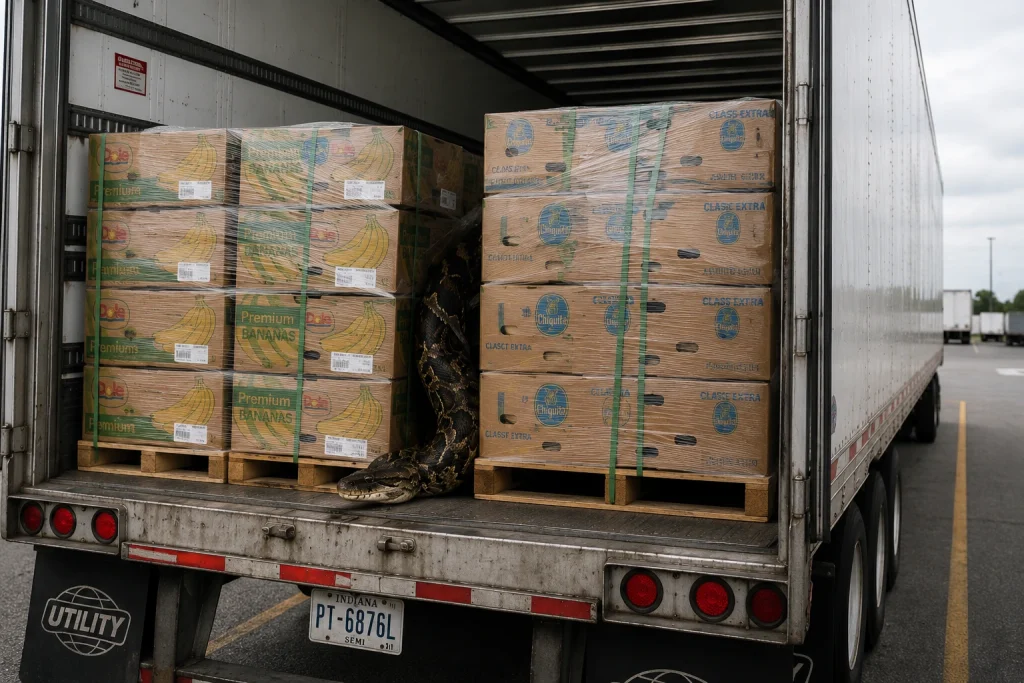

Burmese pythons have once again become one of Florida’s biggest environmental concerns. The recent confirmation of breeding populations in new areas of the state has raised alarms among scientists working to slow the expansion of one of the most destructive invasive species in North America.
Native to Southeast Asia—including Myanmar (formerly Burma), Thailand, Laos, Cambodia, and Vietnam—the Burmese python (Python bivittatus) arrived in Florida decades ago through the exotic pet trade. Escaped and intentionally released snakes eventually established a thriving population in the Everglades, where they have caused severe ecological damage.
Today, however, scientists are increasingly concerned not only about their presence in South Florida but also about the appearance of new breeding populations far beyond their original range.
Can Burmese pythons hide inside trucks?
Yes. Wildlife biologists consider accidental transportation by vehicles to be one of the most plausible ways these snakes appear far from known populations.
Burmese pythons rely on excellent camouflage and naturally seek dark, sheltered, undisturbed places. This behavior allows them to hide inside cargo trailers, construction equipment, machinery, building materials, or underneath the chassis of vehicles operating near wetlands and other suitable habitats.
If a truck leaves an area where pythons are present while one remains concealed onboard, the snake could emerge hundreds of miles away, potentially establishing a new invasion site.
Scientists refer to these long-distance movements as human-assisted dispersal or jump dispersal—relocations that occur through human activity rather than the snake’s natural movement.
The discovery raising concerns in Florida
Concern has grown following the confirmation of breeding Burmese pythons in Charlotte County, outside the species’ long-established core range in South Florida.
For researchers, finding reproducing snakes so far from established populations strengthens the possibility that some individuals were accidentally transported by people or vehicles, in addition to cases involving illegal releases.
This type of dispersal allows the species to bypass natural barriers and colonize new habitats much faster than it could on its own.
A highly successful invasive predator
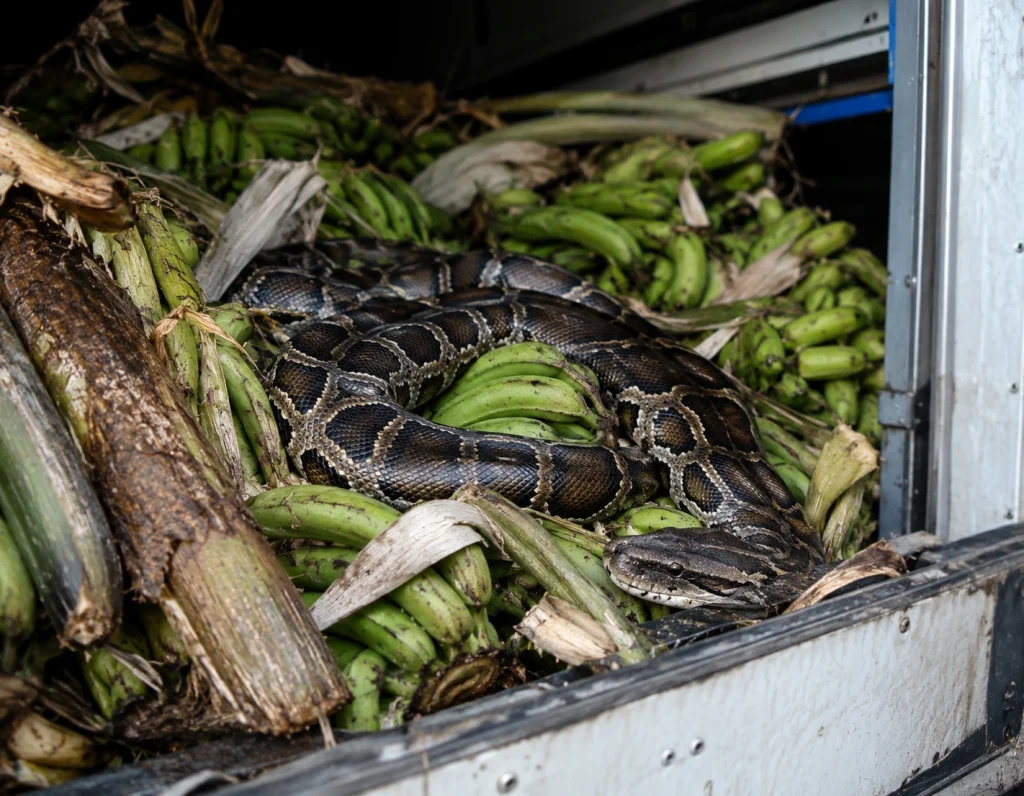
The Burmese python is considered one of the most problematic invasive species in the United States.
Adults can exceed 16 feet (5 meters) in length and prey on mammals, birds, and reptiles. Research conducted in the Everglades has documented dramatic declines in raccoons, opossums, rabbits, and several other native mammals following the snake’s expansion throughout the ecosystem.
Its remarkable reproductive capacity further increases the challenge.
A single female can lay 40 to more than 80 eggs in one breeding season, allowing populations to grow rapidly whenever the species reaches suitable habitat.
Is there a risk for the trucking industry?
Wildlife experts emphasize that finding a python on a truck is not a common occurrence, but they acknowledge that it is a real possibility for vehicles operating in areas where established populations exist.
For that reason, transportation companies and truck drivers are encouraged to perform visual inspections before leaving wetlands or heavily vegetated areas, particularly in South Florida.
Recommended inspection points include:
- The cargo compartment.
- Transported equipment and machinery.
- The underside of the trailer and chassis.
- Materials stored outdoors before loading.
Detecting a concealed snake before departure could prevent the species from being unintentionally introduced into another region.
Could Burmese pythons spread beyond Florida?
Although climate conditions limit the species’ long-term survival across much of the United States, scientists caution that human transportation can move individual snakes into new locations where some populations could become established if environmental conditions are favorable.
As a result, every new detection outside known infestation areas triggers a rapid response from wildlife management agencies, whose goal is to remove the animals before they reproduce.
For the trucking industry, the takeaway is straightforward: trucks are not responsible for Florida’s python invasion, but they can unintentionally become a means of spreading one of North America’s most damaging invasive species.
In a state where freight transportation moves millions of tons of cargo every year, a simple inspection before leaving a loading site could help prevent these giant snakes from reaching new destinations.
 Business hours: Monday to Friday from 8:00 AM to 5:00 PM. California time