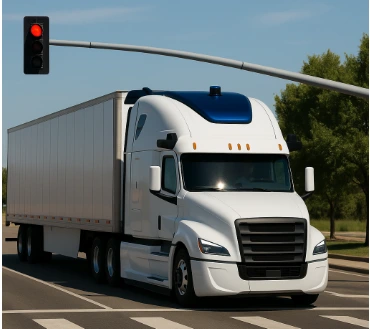
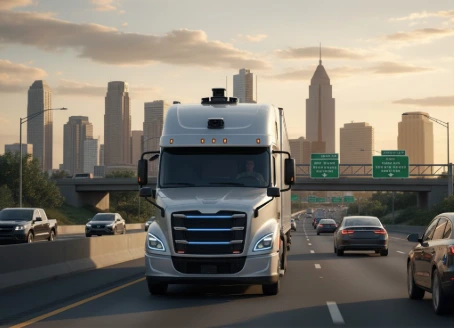
The recent federal probe into Tesla’s vehicles reportedly running red lights has reignited a key question: How safe are autonomous driving systems for highway freight transport? In a world where “smart fleets” promise efficiency and savings, safety is once again taking center stage.
The U.S. National Highway Traffic Safety Administration (NHTSA) announced a new investigation into roughly 2.88 million Tesla vehicles equipped with the company’s Full Self-Driving (FSD) software. The inquiry follows more than 50 reports of traffic violations, including at least six crashes involving vehicles entering intersections against red lights.
The complaints describe several serious issues:
Failing to stop completely at red lights
Ignoring traffic signals entirely
Making unsafe lane changes into oncoming traffic
Failing to reliably recognize road signs
Tesla maintains that FSD is not a fully autonomous system — drivers must supervise and remain ready to intervene at any moment. Similar concerns have previously surrounded Tesla’s Autopilot, a Level 2 advanced driver-assistance system involved in multiple fatal crashes linked to software faults or driver inattention. Critics have also accused Tesla of delayed reporting of safety incidents, a potential breach of U.S. regulatory requirements.

Could the Same Happen with Autonomous Freight Trucks?
To evaluate that risk, it’s useful to compare the operational and technical challenges of Tesla’s passenger vehicles with those of future self-driving freight trucks.
1. Operational Complexity
Freight trucks operate on diverse routes — highways, rural roads, steep grades, and complex intersections. Their sensors must interpret large overhead signs, long-distance signals, intense headlights, and adverse weather. Each factor increases the chance of perception errors.
2. Vehicle Size and Weight
A truck’s massive inertia means that a late braking response or small miscalculation can have far more catastrophic results. Heavier loads amplify the distance and force needed to stop safely.
3. Sensor Design and Redundancy
True safety requires multiple redundant sensors (LIDAR, radar, cameras, ultrasonic) with internal diagnostics and “safe degradation” modes if a component fails. Cross-verification between sensors helps reduce the likelihood of a single-point failure.
4. Higher Safety Standards
Autonomous freight vehicles will likely face stricter certification and testing requirements than consumer cars. Third-party audits, transparent validation protocols, and ongoing performance reporting are essential before granting full commercial operation.
5. Human Oversight and Remote Supervision
Many pilot programs envision remote operators or onboard supervisors to handle critical moments. Transitions between autonomous and manual control must be seamless and predictable.
Realistic Risks for the Freight Industry
Even with advanced systems, it’s not impossible for an autonomous truck to misread a red light or ignore a signal due to sensor failure, data-fusion errors, or flawed prediction models. The more robust the system design — with overlapping sensors and anomaly detection — the lower the risk, but never zero.
Key risks include:
Cargo loss or damage from high-speed collisions
Legal liability disputes among fleet owners, system developers, and insurers
Public trust erosion if serious incidents occur, slowing regulatory approval
Supply chain disruptions from delayed or unreliable freight operations
Are Autonomous Freight Trucks Safe Today?
Not yet — at least not with the current generation of technology. Today’s systems remain in an experimental or early-commercial phase, and recent Tesla incidents highlight the urgency of stronger oversight.
Before autonomous freight trucks can safely operate at scale, the industry must ensure:
Public testing and validation protocols
Independent safety audits
Clear accountability for system failures
Transparency about system limitations and human intervention needs
Built-in redundancy and safe fallback modes
Autonomous trucking may indeed represent the future of logistics — but only if that future is built on uncompromising safety, rigorous regulation, and full public confidence.

Common DOT Violations and How to Avoid Them
Common Department of Transportation (DOT) violations for truck drivers in Texas and California and how to avoid them.

New World Screwworm Cases Rise in Texas as Origin Remains Unknown
Uncertainty surrounds the spread of the New World screwworm in Texas; experts still don’t know how it entered the U.S.

Cyclospora Outbreak: How to Protect Your Health on the Road
The Cyclospora outbreak has already sickened more than 1,400 people in states including Michigan, Ohio, Illinois, Indiana, New York, North Carolina, and Texas. For truck drivers, recognizing the symptoms and preventing dehydration could make the difference between a safe trip and an unexpected stop.

NHTSA Seeks to Explore the Elimination of Steering Wheels in Driverless Vehicles
The changes proposed by the NHTSA could pave the way for cybertaxi models.

Shipowners Reassess Hormuz Transits as Security Risks Intensify
Shipowners’ willingness to continue transiting the Strait of Hormuz remains uncertain.

California DMV Orders 11,000 Drivers to Retake License Exam, Sparking Confusion
The California Department of Motor Vehicles (DMV) has sent letters. The move has sparked confusion and speculation.