Dangerous winter roads, truck accidents, multi-vehicle pile-ups, and low visibility are back in the spotlight after a major crash in Indiana. A pile-up involving more than 30 vehicles, including at least 10 semi trucks, left several people injured and reignited the debate over how to drive safely on snow- and ice-covered highways.
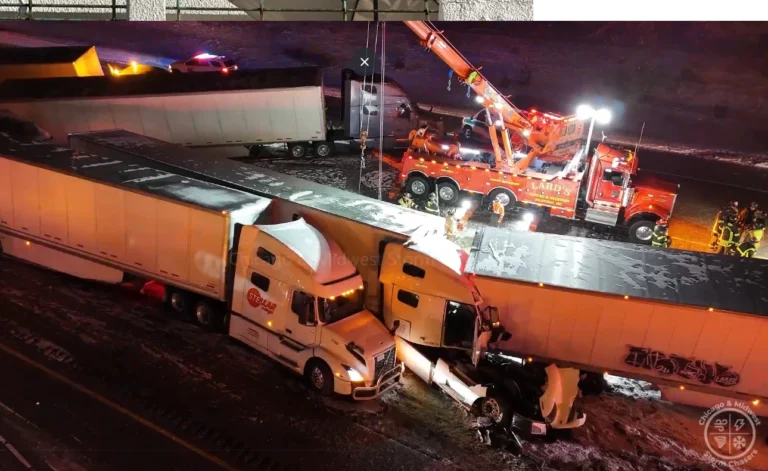
A powerful winter storm and near-zero visibility conditions triggered a massive multi-vehicle pile-up along eastbound Interstate 80 near Elkhart County, Indiana.
The crash involved more than 30 vehicles, including at least 10 semi trucks, and left multiple people injured, many of whom were transported to nearby hospitals for treatment.
The incident occurred on the eastbound lanes of the Indiana Toll Road, near mile marker 94, approximately two miles east of Elkhart. According to authorities, the first collisions were reported around 3:51 p.m. local time, when the storm drastically reduced visibility and turned the roadway into an extremely slick surface.
Indiana State Police Sergeant Ted Bohner said the initial crash involved three vehicles. That first impact quickly set off a chain reaction of secondary collisions in the same area, ultimately blocking all eastbound lanes.
The closure lasted for several hours as emergency crews worked to rescue trapped drivers, remove wrecked vehicles, and clear the roadway.
When troopers arrived on the scene, they encountered a chaotic landscape: semi trucks and passenger vehicles scattered across the highway, some positioned sideways across multiple lanes. At least one vehicle crossed the median and ended up in a ditch on the north side of the westbound lanes.
Authorities confirmed multiple injuries, though none were believed to be life-threatening. One of the most serious cases involved a semi-truck driver who remained trapped inside the cab for several hours before being extricated by rescue teams and transported to a local hospital.

Credit: Chicago & Midwest Storm Chasers
Why These Crashes Multiply in Winter
Pile-ups become far more common during the winter months. The combination of snow, ice, strong winds, and reduced visibility creates conditions where even a minor mistake can trigger a devastating chain reaction.
In this case, heavy snowfall severely limited drivers’ ability to see what was happening ahead. When one vehicle suddenly slows down or loses control, those following behind have only seconds to react. On icy pavement, that reaction time is often not enough.
Commercial trucks make these scenarios even more dangerous. A fully loaded semi can weigh up to 80,000 pounds. That mass requires significantly more distance to stop and more room to maneuver. On ice or packed snow, even a slight correction can result in a skid or jackknife.
The Invisible Threat: A False Sense of Control
One of the biggest dangers of winter driving is psychological. Many drivers believe they can “handle it” because they have experience, a large vehicle, or advanced driver-assistance systems. But on frozen pavement, physics always wins.
Black ice is one of the most dangerous hazards. It forms when temperatures hover around freezing and creates a nearly invisible layer of ice that looks like wet pavement. Drivers often don’t realize they’ve lost traction until it’s too late.
Add stress, fatigue, and pressure to stay on schedule, and the risk of human error increases dramatically. In the freight industry, these factors often combine, creating a perfect storm for serious crashes.
Key Safety Tips for Driving in Snow, Ice, and Low Visibility
Following the Indiana crash, road safety experts emphasized several basic but critical measures that can save lives.
Slow down significantly.
There is no truly “safe speed” on snow or ice, but the slower you go, the more time you have to react.
Increase your following distance.
On dry pavement, three seconds of distance is recommended. In winter conditions, that should be doubled or even tripled.
Avoid sudden braking, acceleration, and sharp turns.
Abrupt movements are the leading cause of loss of control. Every maneuver should be smooth, gradual, and planned in advance.
Do not use cruise control.
When traction is lost, cruise control can make a skid worse rather than better.
Check tires, brakes, and lights before departure.
Proper tread depth and correct tire pressure are essential for traction. Headlights should always be on to improve visibility.
Plan your trip ahead of time.
Checking weather forecasts, road conditions, and closures can make the difference between a safe trip and a dangerous one. If a severe storm is expected, staying put is often the smartest choice.
Know when to stop.
Sometimes the safest decision is to pull over and wait out the storm. Arriving late is always better than not arriving at all.
** MASSIVE 30-CAR PILEUP NEAR SOUTHBEND/ELKHART, INDIANA! **
— Chicago & Midwest Storm Chasers (@ChicagoMWeather) January 14, 2026
Massive pileup on the Indiana Toll Road (I-80/90) near Elkhart, IN, involving semis, cars, and police vehicles. The crash is tied to the intense lake-effect snow,w causing whiteout conditions and slick roads. Expect… pic.twitter.com/fzi9ajzQ5T
Shared Responsibility and the Critical Role of Insurance
Winter safety does not rest solely on the driver’s shoulders. It also involves trucking companies, public agencies, and, critically, the insurance system that supports the entire logistics chain when high-impact events like this occur.
For carriers, this is not just about preventing accidents. It’s about comprehensive risk management. Pressuring drivers to meet schedules during severe storms not only increases the likelihood of crashes but also drives up insurance premiums, deductibles, litigation costs, and operational losses. A single multi-vehicle pile-up can generate millions of dollars in claims, from property damage and bodily injury to supply chain disruptions.
Preventive maintenance, winter-rated tires, well-functioning braking systems, and legally mandated rest periods are not just best practices. They are key factors insurers consider when underwriting policies, setting premiums, and determining coverage terms. Fleets that invest in prevention tend to face fewer claims and better insurability conditions.
For drivers, understanding their insurance policies is just as important as knowing how to drive in snow. Coverage for collisions, third-party liability, medical expenses, temporary disability, and total loss can be the difference between a manageable recovery and a prolonged financial crisis.
Public authorities also play a critical role. Proper signage, early warnings, and preventive closures don’t just save lives. They reduce the scale of accidents and the volume of insurance claims that follow. Every timely road closure can prevent a multi-million-dollar pile-up.
A Warning That Should Not Be Ignored
The massive crash on Indiana’s I-80 is more than a breaking news headline. It is a direct warning to the transportation industry and the insurance sector alike.
This was not an isolated incident. Every winter, dozens of highways across the United States become high-risk zones due to the combination of ice, wind, and low visibility.
In these conditions, no driver has full control of their vehicle. Physics sets the rules, and no technology, experience, or horsepower can completely override them. That’s why prevention is not just a driving strategy. It is a financial, legal, and operational one.
For insurers, these events mean spikes in claims, complex investigations, liability disputes, and multi-million-dollar payouts. For companies, they mean service disruptions, asset losses, lawsuits, and rising premiums. For drivers, they can translate into months or even years of physical and financial recovery.
The difference between a close call and a tragedy often has less to do with the weather and more to do with the decisions made beforehand: whether to depart or wait, whether to slow down, whether to stop in time, whether the vehicle is properly maintained, and whether the right coverage is in place.
In winter, driving cautiously is not just about road safety. It’s about protecting lives, livelihoods, and the future of an entire industry.

Dangerous Roads: Massive Indiana Crash Involving More Than 10 Semi Trucks Raises Red Flags
Dangerous winter roads, truck accidents, multi-vehicle pile-ups, and low visibility are back in the spotlight after a major crash in Indiana. A pile-up involving more than 30 vehicles, including at least 10 semi trucks, left several people injured and reignited the debate over how to drive safely on snow- and ice-covered highways.

Jerome Powell under investigation as tensions between Trump and the Fed escalate
The investigation into Powell has raised global concerns over a potential threat to the independence of the U.S. central bank. In the new episode of

Road Alert: 25 States Under Extreme Driving Conditions
Snow, ice, strong winds, and low visibility are keeping major highways under active travel advisories. The alert now affects 25 states and calls for extra caution, especially among truck drivers and freight carriers operating along key corridors.

Human Trafficking: A Nationwide Call to Action on America’s Roads
Human trafficking is the focus of a nationwide awareness week aimed at educating truck drivers, motor carriers, law enforcement, and the public about human trafficking, how to spot the warning signs, and what to do if someone may be in danger.

TAA Compliance: When Safety Complaints Turn Into Six-Figure Losses
STAA compliance is no longer a technical detail for fleet owners—it is a financial, legal, and insurance exposure. A recent enforcement action in Texas shows how mishandling safety complaints can lead to termination claims, retaliation findings, and six-figure penalties, and what carriers must do to avoid becoming the next case

U.S. labor market raises red flags on Wall Street
The U.S. labor market closed 2025 with clear signs of weakening, as evidenced by the latest employment data released in December. In the latest episode