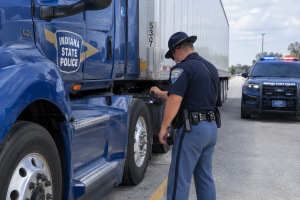
Major enforcement actions across the U.S., including speeding, CDL fraud, and chain violations
Colorado launches Speed Enforcement Program
The Colorado Department of Transportation (CDOT) has decided to launch a Speed Enforcement Program to combat one of the state’s biggest problems—and one of the most dangerous driving behaviors that puts thousands of lives at risk: speeding.
Beginning March 1, state law enforcement agencies will start issuing warnings to drivers who exceed posted speed limits in the northbound I-25 work zone between Mead and Berthoud. CDOT states that warnings will be issued for at least 30 days before civil penalties begin.
To implement the program, safety cameras will be installed in work zones along high-risk corridors where speeding is often a serious issue. The goal is to help prevent crashes and save lives. Violations will be mailed to the vehicle’s registered owner as a one-time warning.
CDOT stated that the initiative will increase safety for officers and motorists while reducing the need for roadside stops. It will also help ease traffic congestion and serve as a strong deterrent against speeding.
Federal Motor Carrier Safety Administration identifies 550 centers violating CDL safety training rules
The Federal Motor Carrier Safety Administration (FMCSA), through its federal operation targeting fraudulent truck driver training programs, identified 550 centers that were violating safety regulations.
From vocational training centers to churches, the undercover operation resulted in 109 training providers voluntarily withdrawing from the Training Provider Registry (TPR). Violations included schools using false addresses, lacking qualified instructors, and failing to meet hazardous materials training requirements.
According to FMCSA data, California had the highest number of training providers (31) at risk of having their TPR approval revoked, followed by Illinois with 28 providers. Texas ranked third with 25 proposed removals.
Other states with between 10 and 15 proposed revocations included Alabama, Florida, Georgia, Indiana, Kansas, Kentucky, North Carolina, Maine, Michigan, Missouri, Ohio, Oregon, and Utah.
According to a recent joint statement from the U.S. Department of Transportation and FMCSA, new regulatory initiatives regarding commercial driver’s license (CDL) training are forthcoming.
Oregon fines dozens of commercial vehicles in chain enforcement operation
The Oregon Department of Transportation (ODOT) conducted a chain enforcement operation that resulted in dozens of citations issued to commercial vehicle drivers.
The Lake of the Woods Highway operation was carried out by the Commerce and Compliance Division on OR 140 to ensure commercial vehicles were prepared for extreme weather conditions.
The six-and-a-half-hour operation resulted in six warnings and 33 citations, including 29 citations for failing to use chains when required. The fine can reach up to $880, as the penalty amount was increased by the Oregon Legislative Assembly in 2021.
ODOT stated that delays caused by trucks failing to comply with this law result in losses to the transportation industry and other road users totaling more than $8 million per year.
“Experienced drivers already know that all commercial vehicles with a gross weight over 10,000 pounds must carry chains whenever road conditions require them or when snow zone signs are posted,” ODOT said.

Frequently Asked Questions About Trucking in Washington
100 questions and answers for truck drivers operating in the state of Washington.

Washington updates its freight corridors: how truck navigation will change on I-5, I-90, and other key routes.
The State of Washington is updating its planning for the state’s most important freight corridors with a clear goal: improving commercial truck traffic, strengthening supply

Washington speeds up new logistics hub development to strengthen freight transportation and trade with Canada
Washington is expanding its network of logistics hubs through investments in ports, highways, and distribution centers to streamline freight transportation.

Washington Commercial Vehicle Laws: What Truckers Must Know
Washington combines state requirements with numerous federal regulations that apply to commercial transportation

Your Truck Was Declared a Total Loss: Who Decides What It Is Really Worth in Washington?
The accident may be over in seconds. The dispute over what the vehicle is actually worth can last much longer. Since 2026, Washington has introduced a new tool to resolve certain valuation disputes between policyholders and insurance companies.

Why Some Washington Carriers Are Harder to Insure
Accidents, maintenance, drivers, and safety records can complicate a carrier’s risk profile. What Washington truckers should review before insurance renewal.