 Hable con un agente al (888) 572-7520
  Enviar mensaje a un agente


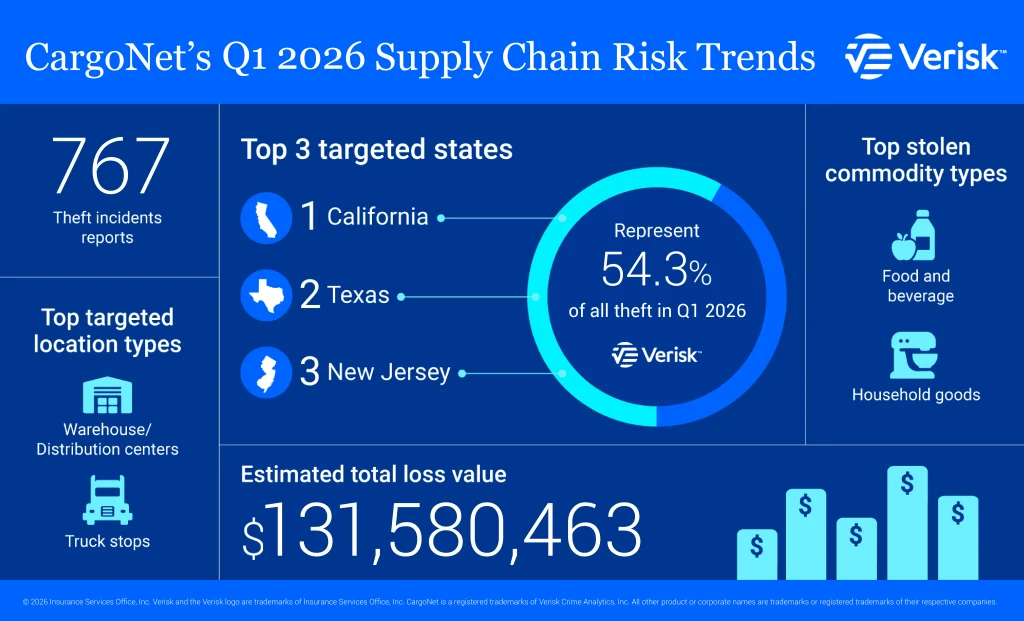
Verisk CargoNet released its first-quarter 2026 report on cargo theft in the freight transportation sector. The results showed that during the first three months of 2026, cargo thefts declined compared to the fourth quarter of 2025; however, the value of the stolen goods remained unchanged.
The company, a leader in cargo theft prevention and recovery, recorded 767 supply chain crime incidents across the United States and Canada during the first quarter of 2026, representing a 5.3% decrease compared to the first quarter of 2025 and a 12.2% drop compared to the fourth quarter of 2025.
But the problem persists. Organized crime groups are carrying out a greater number of thefts, adapting their tactics to the anti-theft measures the industry has implemented, changing the locations and types of cargo they target, and devising new fraud methods to deceive carriers. Despite the decline in the number of incidents, estimated losses reached $131.58 million, a figure that remained virtually unchanged compared to the first quarter of 2025.
First-Quarter 2026 Cargo Theft Report
Verisk CargoNet’s analysis points to a clear pattern during the first quarter of the year: a reduction in activity by domestic criminal organizations, particularly in Texas and the Southeast, alongside sustained or increasing activity by organized crime groups linked to California and the New York City metropolitan area. This shift is reflected not only in where cargo thefts are occurring, but also in what is being stolen and how.
Among the eight states with the highest number of cargo thefts, most recorded year-over-year declines, with two notable exceptions:
- California increased from 255 to 277 incidents.
- New Jersey surged from 27 to 59 incidents (an increase of 119%).
Meanwhile, Texas recorded a decline from 102 to 80 incidents, equivalent to a 22% drop compared to 2025. According to the Verisk CargoNet report, the opportunistic thefts that were once common along the Dallas–Fort Worth and Houston logistics corridors appear to be giving way to more targeted operations in other parts of the country.
Regarding the types of cargo targeted, personal care and beauty products experienced the highest increase during the first quarter, rising 178% to 50 incidents, driven mainly by cosmetics and fragrances, particularly in the northeastern United States.
Food and beverages once again remained the leading theft category, with 144 incidents. Beverage thefts declined, while seafood thefts increased significantly.
Finally, construction materials dropped from 21 incidents to 8, a category historically dominated by domestic groups operating seasonally in North Texas.
Keith Lewis, Vice President of Operations at Verisk CargoNet, stated that transnational organized crime groups are increasingly becoming the dominant force in cargo theft, showing a clear preference for goods that can be easily sold through online resale channels.
Beware of these cargo theft tactics
The report explains that the most significant tactical development in the first quarter of 2026 was the evolution of identity-based theft schemes. Although anti-fraud solutions implemented across the industry have proven effective, criminal networks continue to look for ways to bypass those controls.
Verisk found that, in order to evade anti-fraud tools, criminal networks have largely turned to impersonating legitimate carriers and logistics brokers through two primary methods:
- Credential theft – Through advanced phishing campaigns and remote-access trojans, criminals compromise corporate email accounts, internet phone systems, and industry applications used by carriers and brokers to locate shipments and verify identities. This allows criminal networks to operate as though they were the legitimate carrier.
- Direct acquisition of transportation companies – Criminal networks are purchasing legitimate carriers through social media, peer-to-peer marketplaces, and specialized brokerage services. These transactions remain common and are largely unregulated.
Verisk CargoNet expects impersonation-based fraud and the misuse of legitimate carrier identities to remain central elements of cargo theft in the coming quarters. In addition, current patterns suggest that organized groups will continue prioritizing high-value goods that are easy to redistribute, while concentrating their activities in major logistics hubs that enable rapid movement and resale.

 Business hours: Monday to Friday from 8:00 AM to 5:00 PM. California time