 Hable con un agente al (888) 572-7520
  Enviar mensaje a un agente



Florida’s long-awaited changes to its traffic and transportation laws will finally take effect on October 1, bringing new provisions covering crashes, license plates and vehicle-related procedures for drivers in general, along with specific licensing and fuel tax requirements for commercial carriers.
The legislation approved by the Florida Legislature covers several areas of the state’s transportation system and includes provisions that will have a particular impact on trucking companies and commercial drivers.
One of the most significant changes is the replacement of the previous motor carrier registration system with a licensing system. Certain carriers operating qualified motor vehicles in Florida will be required to be properly licensed under the International Fuel Tax Agreement (IFTA) and display the required fuel tax decals, unless an exemption applies.
A copy of the license must be available in each vehicle, although it may be presented electronically.
For fleets, the new law also reorganizes procedures involving credentials, decals and compliance with fuel tax requirements.
More Fuel Tax Procedures Go Digital
Starting October 1, 2026, unless the Department authorizes another method, renewal orders for fuel tax decals must be submitted electronically through the state’s designated online system.
The same applies to fuel-use tax returns. Under the new law, those returns must also be filed electronically through the platform designated by the Department.
For trucking companies, that makes it especially important to review who is responsible for managing fleet credentials, keep track of expiration dates and make sure the company has access to the online accounts used to complete these filings.
The law also maintains temporary fuel-use permits. Under the statute, a carrier that does not have the required credentials may obtain a temporary fuel-use permit for a vehicle in circumstances allowed under Florida law.
Crash Reporting Threshold Rises From $500 to $2,000
Another change that could directly affect professional drivers involves traffic crashes.
Until now, Florida law set a threshold of $500 in apparent property damage for triggering the requirement to immediately report a crash to law enforcement. Beginning in October, that threshold will increase to $2,000.
Crashes involving injury or death must still be immediately reported to law enforcement regardless of the amount of property damage. When a crash involves only property damage, the specific immediate-reporting requirement is triggered when the apparent damage reaches at least $2,000.
There is, however, an important distinction: the new threshold does not mean drivers can simply leave the scene of a minor crash.
Florida law continues to require drivers involved in crashes resulting in property damage to stop and comply with their legal obligations, including providing their name, address and vehicle registration number. When required, drivers must also show their driver’s license.
For truck drivers, company procedures and insurance requirements also remain relevant regardless of whether a crash reaches the new $2,000 state reporting threshold.
More Official Notices May Arrive by Email
SB 488 also expands the circumstances in which the Florida Department of Highway Safety and Motor Vehicles (FLHSMV) may use email instead of traditional mail to communicate with drivers and vehicle owners.
The legislation allows email to be used for various administrative notices, including certain communications involving licenses and registrations. It also allows orders involving cancellations, suspensions, revocations or disqualifications to be delivered electronically.
For drivers and trucking companies, that makes it increasingly important to keep the email address registered with the state up to date and to regularly check for official communications.
Are License Plate Frames Allowed?
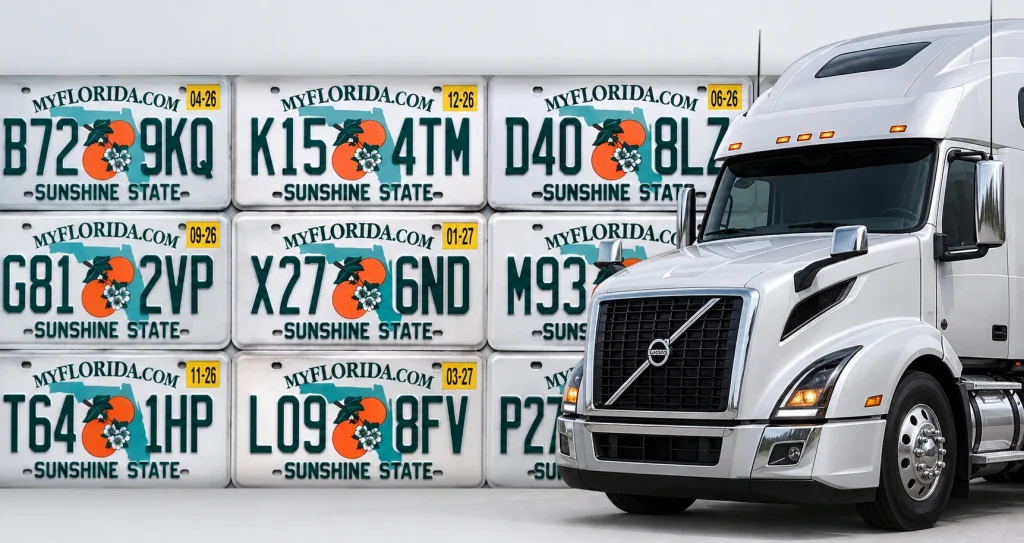
The new law also clarifies that using a license plate frame or decorative border is not prohibited as long as it does not interfere with the legibility of the plate or cover information that is legally required to remain visible.
The clarification is part of the same SB 488 legislation taking effect October 1.
For truck owners who use dealership frames, company-branded frames or other decorative accessories around their license plates, the key issue remains visibility: the frame cannot obscure information that Florida law requires to be clearly displayed.
What Trucking Companies Should Review Before October 1
With the new law about to take effect, fleets operating in Florida should review their licensing and fuel tax decal procedures, make sure they are prepared to handle required renewals and filings electronically, and verify that their contact information with the state is current.
Drivers should also be familiar with the new $2,000 threshold for immediately reporting property-damage crashes to law enforcement, while understanding that the change does not eliminate the legal obligations that apply after a crash.
The Florida Senate provides access to SB 488’s legislative history, analyses and full text. The provisions governing motor carrier licensing and fuel tax decals can also be reviewed directly in the Florida Statutes, Chapter 207.
If you need comprehensive assistance, contact us and we can take care of it for you.
 Business hours: Monday to Friday from 8:00 AM to 5:00 PM. California time