 Hable con un agente al (888) 572-7520
  Enviar mensaje a un agente



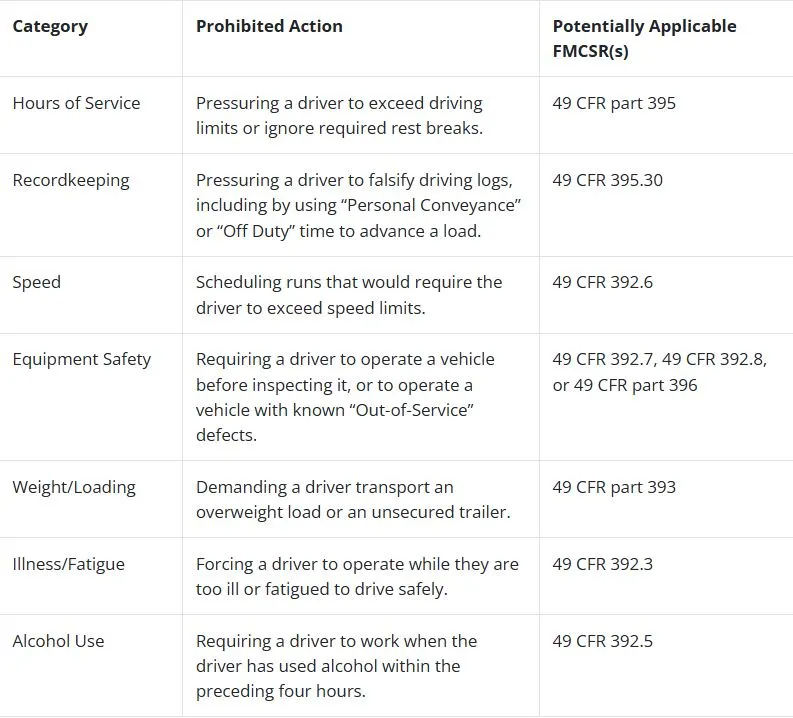
The Federal Motor Carrier Safety Administration (FMCSA) recently updated its guidance on how to respond to cases of coercion involving commercial drivers being pressured to violate safety regulations. Presented in a question-and-answer document titled “Frequently Asked Questions: Prohibited Coercion of Commercial Motor Vehicle Drivers,” the new guidance is intended to help drivers understand how coercion may occur and what steps to take if they encounter such situations.
At a time when the trucking industry has faced increasing fraud and manipulation of hours-of-service regulations, the FMCSA updated its information as part of a broader effort to combat these illegal practices.
A few weeks ago, authorities exposed the chameleon carrier network known as “Super Ego,” a case that generated widespread attention across media outlets throughout the United States. With growing reports of fraud, driver pay cuts, and irregularities in log records, the FMCSA is seeking to take the necessary measures to put an end to these practices.
Next week, the International Roadcheck inspection event will take place, with special emphasis on detecting falsified records of duty status (RODS), including manipulation or alteration of electronic logging devices (ELDs).
In 2025, falsification of records of duty status was the second most common driver violation, with 58,382 cases reported. In addition, five of the ten most frequent violations were related to hours-of-service compliance or ELD usage, according to data from the Commercial Vehicle Safety Alliance (CVSA).
Fraud involving electronic logging devices (ELDs) or hours-of-service records is illegal under any circumstances. Motor carriers do not have the legal authority to pressure or force drivers to exceed HOS limits or alter their ELD records — a lesson the FMCSA is determined to reinforce.

FMCSA Coercion Rule 49 CFR 390.6
The FMCSA’s updated guidance explains that the “coercion rule” is intended to protect commercial motor vehicle drivers from pressure exerted by motor carriers, shippers, receivers, freight brokers, and their representatives to violate the Federal Motor Carrier Safety Regulations (FMCSRs).
The regulation states that coercion exists when a driver is threatened with the loss of business, employment, or work opportunities, or when adverse employment actions are taken, for the purpose of forcing the driver to violate the FMCSRs or punishing the driver for refusing to do so.
The FMCSA describes coercion as a sequence of events as follows:
- The request: a carrier, shipper, or agent asks the driver to perform a task that violates a safety regulation.
- The objection: the driver informs the requester that the task cannot be completed without violating the regulations.
- The threat or retaliation: the company or agent makes a direct or implied threat related to employment or future work opportunities in order to pressure the driver, or retaliates against the driver for refusing to commit the violation.
The FMCSA emphasizes that the threat does not need to be carried out; simply making the threat may be sufficient to constitute coercion.
Acts or threats of coercion may include:
- Termination: firing or threatening to fire the driver.
- Withholding work: denying future loads, reducing miles, or threatening to do so.
- Financial penalties: threatening to cut driver pay, withhold bonuses, or impose fines.
- Scheduling retaliation: assigning less desirable routes, refusing to schedule a driver for several days, relocating the driver to a less convenient location as punishment, or threatening similar actions.
What to Do in Cases of Coercion
“Coercion occurs at the moment a threat is made,” the FMCSA states in rule 49 CFR 390.6. In these situations, drivers should maintain detailed records, such as copies of ELD messages, text messages, or emails that verify acts of coercion by companies or agents. Drivers may also write their own account of what happened and email it to themselves in order to create a timestamped record.
Drivers must file a complaint with the FMCSA within 90 calendar days from the date of the incident. Complaints should be submitted through the National Consumer Complaint Database (NCCDB) or to the FMCSA Division Administrator for the state in which the driver works, according to the agency.
For more information, drivers may contact the FMCSA information line at 1-800-832-5660 or visit the agency’s official FAQ website.
 Business hours: Monday to Friday from 8:00 AM to 5:00 PM. California time