The safety of American highways is no longer just about pavement quality, visible signage, or driver discipline. In today’s digital age, cybersecurity has become a critical factor in protecting the systems that support transportation.
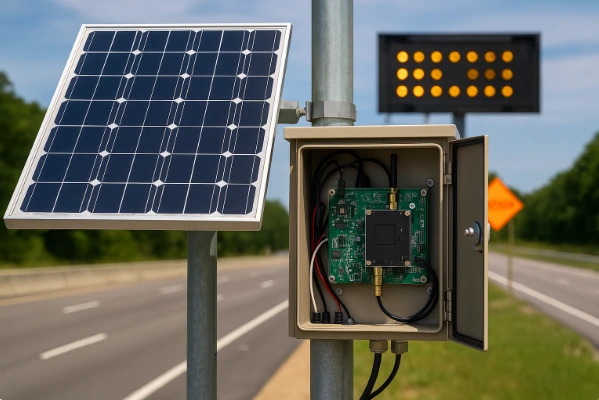
A recent U.S. Department of Transportation (DOT) warning has raised alarms across the industry: solar-powered highway equipment may contain hidden cellular radios, posing risks of espionage, data manipulation, and threats to the safe operation of America’s roads.
Where Were the Devices Found?
According to the DOT’s Federal Highway Administration, the suspect components may be embedded in various types of roadside infrastructure, including:
- Highway weather stations, which provide critical data on snow, storms, and visibility.
- Digital signage systems, which guide truckers and motorists through detours, lane closures, and traffic conditions.
- Electric vehicle (EV) chargers on interstates, an increasingly common part of the highway network.
Investigations revealed that certain imported inverters and battery management systems contained undocumented cellular radios. These devices could transmit data secretly, without the knowledge of state or local operators.
Risks for Truck Drivers
For professional truckers, who rely on this infrastructure every day, the implications are serious:
- False or manipulated data: Compromised weather stations could send incorrect road condition reports, influencing driving decisions and putting lives at risk.
- Tampered signage: Digital boards showing lane closures or detours could be altered, causing traffic chaos or even accidents.
- Interference at EV chargers: As heavy-duty fleets move toward electrification, sabotage at charging stations could create large-scale logistical problems.
Cyber-espionage: The location and movement of fleets could be tracked without authorization, jeopardizing cargo security and company operations.
An International Challenge
The geopolitical angle cannot be ignored. Much of the solar infrastructure deployed in the U.S. comes from foreign suppliers, particularly China. Washington has repeatedly voiced concerns about the potential for “backdoors” in imported technology that could enable surveillance or remote control.
This is not the first time a critical sector has faced this dilemma. Similar concerns led to restrictions on telecom giants Huawei and ZTE. Now, the same scrutiny has shifted to transportation and energy infrastructure, sectors directly tied to daily life and the strategic logistics backbone of the American economy.
DOT’s Response
The Department of Transportation has directed state and local operators to take immediate action:
- Inspect existing solar-powered highway equipment.
- Scan batteries, inverters, and energy management systems for hidden radios.
- Suspend or remove suspect components until their safety can be verified.
The goal is to prevent unauthorized transmissions that could compromise the integrity of highway systems.
What It Means for the Trucking Industry
For truck drivers and freight companies, this development highlights a new reality: the highways of tomorrow are built not only with concrete and steel but also with connected technology. While this connectivity brings advantages, it also introduces risks that must be managed.
“Highway cyber-espionage” is a new term, but it’s already making its way into logistics discussions. Just as fleets are protected against cargo theft, they may soon need safeguards against digital threats in roadside infrastructure.
This situation also raises tough questions about trust in international suppliers. Should the U.S. manufacture its own solar infrastructure for highways? How can agencies audit thousands of miles of already-installed equipment?
A Red Flag for Truckers
Although it may seem like a technical issue, the DOT’s warning is directly relevant to those who keep America’s freight moving. Manipulation of highway systems could have consequences as serious as a crumbling bridge or a poorly maintained road.
For truckers, awareness is the first line of defense:
- Stay alert to road signs that don’t match real conditions.
- Report anomalies in digital stations or signage.
- Push for state agencies to guarantee the safety of connected infrastructure.
The U.S. freight system is too vital to be exposed to invisible risks. The challenge is no longer just keeping roads free of potholes—it’s keeping them free of hidden radios.

The meaning of Hanukkah and how to celebrate it on the road
Hanukkah is a celebration of resilience and hope, and here are some ways you can take this on the road. December is one of the

Waymo under investigation for potential safety risk in school zones
A recent wave of videos has shown that some Waymo vehicles are not complying with safety regulations in school zones. The autonomous vehicle company Waymo,

Don’t Blame the Snow: The Real Causes Behind Winter Truck Accidents
Don’t Blame the Snow: Why Most Winter Truck Accidents Are Preventable

Mexico aligns with U.S. as new tariffs target Asian imports
Mexican lawmakers gave their final approval to the new tariffs on Asian imports, largely aligning themselves with the United States’ efforts to tighten trade barriers

Seven charged in New York CDL fraud case involving DMV employees
A group of DMV employees in New York allegedly manipulated the process of obtaining commercial driver’s licenses by allowing applicants who never showed up to

Transportation Seeks Proposals to Rebuild the American Legion Memorial Bridge
Transportation seeks proposals to rebuild the American Legion Memorial Bridge, repeating the call for proposals to address the most critical freight chokepoint on the East Coast. The initiative aims to attract ideas, financing models, and private-sector innovation to modernize a corridor that today imposes millions in delays on the trucking industry.