 Hable con un agente al (888) 572-7520
  Enviar mensaje a un agente

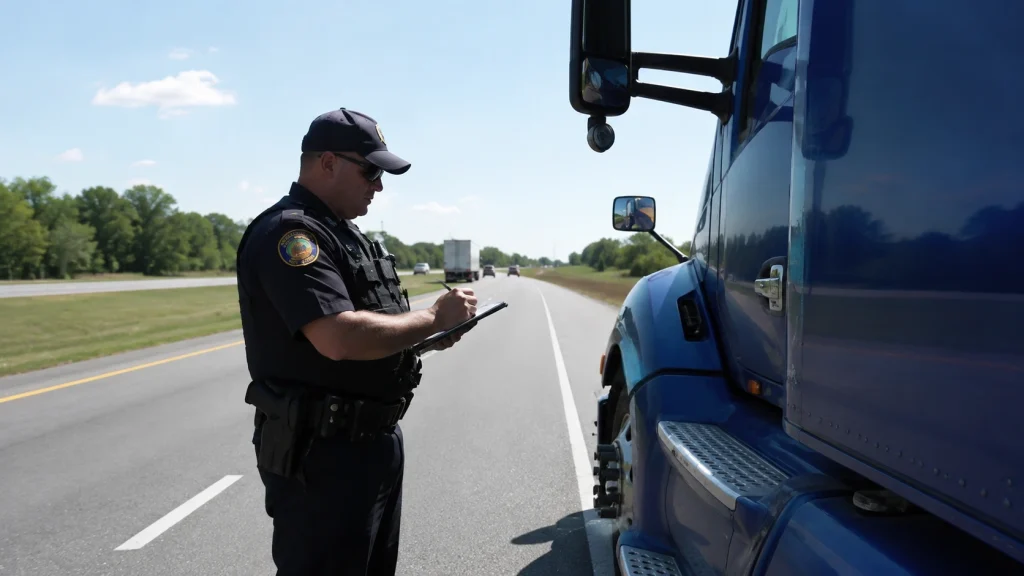

Federal enforcement efforts targeting the trucking industry continue to expand across the United States. After launching its first phase in Florida, the federal government broadened Operation Highway Shield, a joint initiative led by the U.S. Department of Transportation (USDOT) and the Department of Homeland Security (DHS), to include Illinois, Indiana, Iowa, and Ohio—four states that serve as major freight transportation corridors.
The first phase of the operation took place in Florida in March, where authorities conducted more than 3,300 roadside inspections, placed 176 drivers out of service, identified 54 English Language Proficiency violations, made 35 criminal arrests, and detained 42 individuals for federal immigration violations.
According to the Department of Transportation, the Florida operation served as the foundation for expanding the program into additional states with heavy commercial trucking activity.
The second phase was carried out between July 28 and July 30, with inspectors from the Federal Motor Carrier Safety Administration (FMCSA) working alongside Immigration and Customs Enforcement (ICE), Homeland Security Investigations (HSI), and state highway patrol agencies.
According to USDOT, inspectors completed 3,487 roadside inspections during the three-day operation, resulting in 766 drivers and commercial vehicles being placed out of service for safety-related violations.
Authorities also detained 51 individuals who were unlawfully present in the United States, including 21 commercial drivers operating with non-domiciled Commercial Driver’s Licenses (CDLs) issued by California and New York.
In addition, law enforcement officers made 86 arrests involving offenses such as road rage and domestic violence, issued 36 violations for failing federal English Language Proficiency (ELP) requirements, and recovered nearly $1 million in stolen cargo.
A nationwide enforcement strategy
🚨RESULTS ARE IN🚨
— Secretary Sean Duffy (@SecDuffy) August 4, 2026
DAY 1 OF “OPERATION HIGHWAY SHIELD” in Indiana, Illinois, Iowa, and Ohio — cracking down on illegal alien truckers:
❌ About 800 unsafe truckers off the road
❌ 36 English proficiency violations
❌ 51 illegal immigrants holding non-domiciled CDLs detained,… pic.twitter.com/wf11A9pnGD
For the federal government, Operation Highway Shield is part of a broader effort to improve highway safety while combating fraud within the commercial trucking industry.
U.S. Transportation Secretary Sean P. Duffy said the partnership with DHS is designed to “secure America’s highways, eliminate fraud, and restore integrity to the trucking industry.” He added that the administration will continue increasing enforcement against drivers and carriers that fail to meet federal operating requirements.
Homeland Security Secretary Markwayne Mullin said the operation removed more than 800 high-risk drivers and vehicles from U.S. highways, citing immigration violations, regulatory noncompliance, and licensing issues among the reasons for enforcement actions.
FMCSA Administrator Derek Barrs added that the initiative also targets fraudulent CDL training schools, manipulated hours-of-service records, and other illegal practices that undermine commercial vehicle safety.
English proficiency remains a major focus

One of the primary objectives of the operation was enforcing English Language Proficiency (ELP) requirements.
Federal regulations have long required commercial drivers to read traffic signs, understand official instructions, and communicate effectively with law enforcement officers during roadside inspections and emergency situations.
During this second phase, 36 drivers received violations for failing to meet those standards, reflecting the administration’s renewed emphasis on enforcing existing English-language requirements for commercial drivers.
More inspections and stricter enforcement
Operation Highway Shield is one of several enforcement initiatives launched during 2026 to strengthen oversight of the commercial trucking industry.
Earlier this year, FMCSA conducted Operation SafeDRIVE, which resulted in nearly 2,000 drivers and commercial vehicles being removed from service for various safety violations. The agency also announced a joint investigation with Homeland Security targeting suspected fraud at Commercial Driver’s License (CDL) training schools.
The Department of Transportation further reported that, since President Trump’s April 2025 Executive Order aimed at restoring integrity to the trucking industry, federal authorities have placed 26,000 drivers out of service for failing English language requirements, shut down 8,000 fraudulent driving schools, and revoked more than 30,000 improperly issued commercial driver’s licenses obtained without adequate verification, according to official figures.
What it means for trucking companies
Regardless of the political debate surrounding these initiatives, one message is clear for the trucking industry: federal roadside enforcement is becoming more frequent and increasingly coordinated across multiple agencies.
Today’s roadside inspections may include verification of a driver’s CDL, vehicle registration, electronic logging device (ELD) records, hours-of-service compliance, mechanical condition, English language proficiency, and—when federal authorities are involved—additional immigration-related verification.
For fleet owners and independent owner-operators, that means placing even greater emphasis on driver qualification files, license verification, recordkeeping, vehicle maintenance, and full compliance with federal regulations before every trip.
As inspections continue to expand nationwide, prevention remains the most effective way to avoid out-of-service orders, fines, operational delays, and costly disruptions. Maintaining proper insurance coverage also remains a critical part of protecting any trucking business against unexpected risks.
 Business hours: Monday to Friday from 8:00 AM to 5:00 PM. California time