 Hable con un agente al (888) 572-7520
  Enviar mensaje a un agente


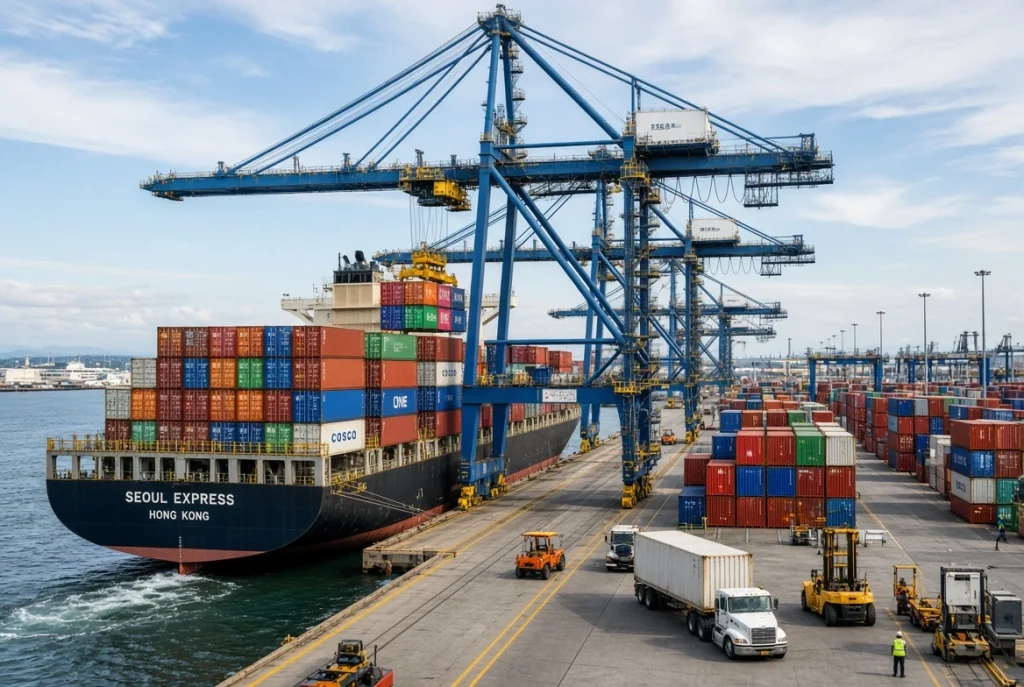
Trade with Asia is, literally, the engine driving truckers’ work in Washington: according to the Northwest Seaport Alliance’s (NWSA) 2025 Annual Trade Report, Asia accounted for 90.5% of all cargo volume passing through the ports of Seattle and Tacoma that year, with China as the most important trading partner.
That extreme dependence turns any change in U.S. tariff policy toward Asia into a direct shock to a drayage trucker’s daily work: when the volume of containers arriving from across the Pacific falls, the number of available loads to haul falls at the same time.
In January 2026, the NWSA’s combined container volume fell 13.9% year over year, while the market share held by the Northwest ports relative to the entire West Coast dropped to just 6.5% in May 2026, compared with 10.6% in 2019.
Why Washington Depends So Heavily on Trade with Asia
Washington is, as the NWSA itself describes it, one of the most trade-dependent states in the country. The alliance, which jointly manages maritime cargo operations at the ports of Seattle and Tacoma, maintains regular weekly services with key markets in Asia, Europe, Latin America, and Oceania. However, Asia overwhelmingly dominates that traffic, accounting for 90.5% of all trade volume measured in TEUs (twenty-foot equivalent units) during 2025.
The ten leading trading partners by container volume include China, Japan, Vietnam, South Korea, Taiwan, Thailand, Indonesia, Malaysia, India, and the Philippines—a list that is almost entirely Asian.
That geographic concentration is not an abstract statistic for a drayage trucker: it means that the amount of work available in any given week depends largely on the trade-policy decisions the United States makes regarding a handful of countries.
The Direct Impact of Tariffs on Truckers’ Daily Work
During 2025, the escalation of tariffs between the United States and China—which reached levels of 145% on Chinese products, with Chinese retaliatory tariffs of 125%—created a chain of effects that port officials themselves described as a direct threat to truckers’ jobs.
As Washington Senator Patty Murray stated at the time: “Less cargo at our ports means fewer goods for our truckers to move, and that ultimately means empty shelves for our retailers and American consumers.”
In 2025, Port of Seattle Commissioner Ryan Calkins projected a container-volume decline of up to 40% as a result of the tariff dispute, warning that the impact “would spread throughout the economy” of port communities.
Jeff Bellerud, then the NWSA’s chief operating officer, was even more direct about who would feel the impact first: “One of my concerns is that the local trucking community is going to be the first to be affected by these changes” in cargo volumes.
Why the Impact Takes Several Weeks to Arrive
One factor that makes it more difficult for a drayage trucker to plan work is the time lag between a tariff decision and its actual effect at the port. According to the NWSA, typical transit times from Asia range from two to four weeks, and can be even longer from Vietnam. This means that a ship arriving in Seattle or Tacoma today likely departed its origin port before the latest trade-policy change was announced.
As a result, the effects of a tariff increase—or a trade truce—can take four to six weeks to fully appear in the number of containers available for pickup and, consequently, in each trucker’s actual workload.
Frontloading: Work Peaks Followed by Sharp Declines
Another pattern that directly undermines work predictability is known as “frontloading,” or the acceleration of imports. When a new tariff is expected, many importers rush their orders in to bring them into the country before the measure takes effect. This creates an artificial volume spike followed by a sharp decline once the window closes.
The NWSA documented this phenomenon in its 2025 report: heavy imports recorded in anticipation of tariffs, combined with uncertainty surrounding port and rail labor negotiations in Canada, helped keep volumes high in 2024. This was followed by a 5.5% decline in total annual volume in 2025 compared with the previous year.
The same pattern occurred again in January 2026. The NWSA’s combined container volume fell 13.9% year over year, to 228,166 containers from 264,869 in the same month of 2025. The alliance attributed the decline to frontloaded shipments that had artificially inflated the previous year’s figures.
Washington Is Losing Ground to Other West Coast Ports
Beyond short-term volatility, there is a structural trend concerning truckers who depend on port work in Washington: the market share held by the region’s ports has been steadily declining. According to data from the Pacific Merchant Shipping Association, the combined share of West Coast container-import traffic handled by the Port of Oakland and the NWSA’s ports of Seattle and Tacoma fell from 10.6% in May 2019 to just 6.5% in May 2026.
During that same period, Southern California ports maintained a much more stable share of that traffic, capturing a significant portion of the frontloaded orders linked to tariff threats, while the NWSA failed to gain a comparable share.
For a Washington-based drayage trucker, this structural trend is more concerning than tariff-related volatility: it means a smaller and declining share of the total trade entering the United States through the West Coast, even in scenarios where total national volume does not fall.
How Washington’s Port Industry Responded
In response to this dependence and volatility, the NWSA itself publicly acknowledged the scale of the challenge. Amid the 2025 tariff escalation, the alliance confirmed that it had received reports from importers who had paused most of their shipments from China, while exporters had canceled orders to Chinese markets altogether.
According to the industry publication SupplyChainBrain, some products reached the docks and were later removed after the sale was canceled. This generated significant additional costs for both exporters and the truckers who had to move the cargo back and forth even though the final sale had not been completed.
In response, NWSA commissioners traveled to Vietnam and South Korea in an effort to rebuild trade relationships and diversify the origins of cargo arriving in Washington, seeking to reduce the region’s extreme dependence on a single trading partner.
What This Means for an Owner-Operator or Trucking Company
For any trucker who depends on drayage freight in Washington, this dynamic creates several concrete operational risks: weeks of intense work followed by weeks with very little available freight, difficulty forecasting revenue more than a month in advance, and structural exposure to trade-policy decisions made in Washington, D.C.
These decisions have a direct and measurable impact on the number of containers available for pickup in Seattle and Tacoma. As Mark McCullough, CEO of logistics company Gebrüder Weiss North America, emphasized, many drayage operators are small businesses that “simply are not prepared to withstand” several consecutive weeks without work.
Frequently Asked Questions
What percentage of Washington’s port trade comes from Asia?
According to the Northwest Seaport Alliance’s annual report, 90.5% of the total cargo volume measured in TEUs that passed through the ports of Seattle and Tacoma in 2025 originated in Asia.
Why do tariffs affect drayage truckers first?
When the volume of containers arriving at the port falls, the number of loads available for pickup by truckers also drops directly and immediately. Other port workers may have alternative sources of income or greater contractual stability.
How long does it take for a tariff change to affect a trucker’s daily work?
It can take between four and six weeks, because ships typically take two to four weeks to travel from Asia, followed by the additional time required to process and distribute the cargo once it arrives at the port.
 Business hours: Monday to Friday from 8:00 AM to 5:00 PM. California time