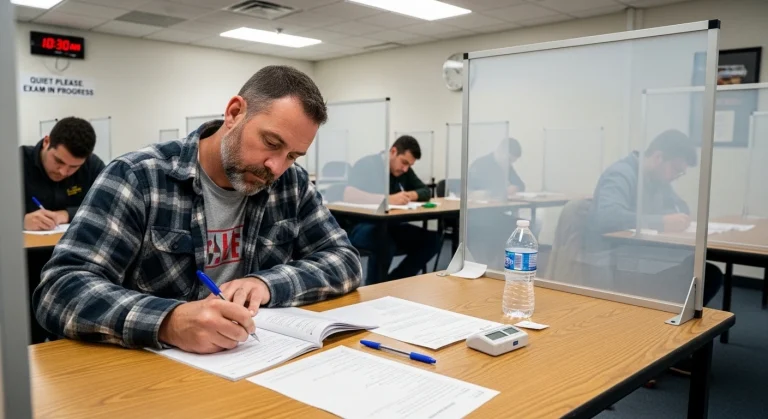
A federal audit found that nearly 20% of Illinois’ non-domiciled CDLs may not comply with federal standards. The state has 30 days to correct the issues or risk losing $128 million in highway funding.
A review conducted by the Federal Motor Carrier Safety Administration (FMCSA) placed Illinois’ commercial driver licensing program under scrutiny after identifying compliance failures in the issuance of non-domiciled Commercial Driver’s Licenses (CDLs).
The audit, part of a nationwide initiative led by the U.S. Department of Transportation (USDOT), found that approximately 20% of non-domiciled CDLs issued by Illinois may have been granted in violation of federal requirements.
Key compliance concerns
According to preliminary findings, investigators identified two main categories of irregularities:
- Licenses that remained valid after the driver’s lawful presence had expired.
- Cases where immigration status may not have been properly verified prior to issuance.
Non-domiciled CDLs are designed for drivers who do not hold permanent U.S. residency but are legally authorized to operate commercial vehicles under specific conditions. However, strict federal documentation and verification standards must be followed.

30-day deadline and funding risk
Following the audit, Illinois was formally notified that it has 30 days to bring its program into compliance. If corrective measures are not implemented, the state could lose up to $128 million in federal highway funding.
Required actions include:
- Temporary suspension of new non-domiciled CDL issuance.
- Identification of all active licenses that fail to meet federal standards.
- Revocation and potential reissuance of eligible licenses.
- A full internal audit to identify administrative errors, system flaws, training deficiencies, and oversight weaknesses.
The possible withholding of funds represents a serious financial concern, as these federal dollars are critical for road maintenance and infrastructure improvements.
.
Part of a broader national review
Illinois is not alone. Federal authorities have also identified compliance concerns in states including California, New York, and Pennsylvania as part of this broader enforcement effort.
The review aligns with federal directives focused on strengthening highway safety, tightening CDL issuance standards, and reinforcing eligibility verification procedures nationwide.
English Language Proficiency enforcement
In parallel, the USDOT announced updated guidance reinforcing the federal English Language Proficiency (ELP) requirement for commercial drivers.
Under the revised enforcement framework, drivers who do not meet minimum English competency standards may be placed out of service until compliance is demonstrated. The measure is aimed at improving safety during inspections and ensuring clear understanding of traffic signs and regulations.
Impact on freight and logistics
For the transportation industry, the potential revocation of a significant number of CDLs could affect short-term driver availability, especially amid sustained freight demand.
Motor carriers, logistics operators, and insurers should review driver documentation, monitor regulatory updates, and prepare for possible operational adjustments.
Beyond the political debate, the core issue centers on regulatory compliance and roadway safety. The outcome of Illinois’ response could set an important precedent for CDL oversight across the United States.

How Trump’s Multi-Billion-Dollar Plan Aims to Rebuild America’s Critical Bridges
The Trump Administration will allocate $3 billion to repair and modernize critical bridges across the U.S., where more than 220,000 structures currently require major maintenance or replacement.

Geotab ranks FIFA 2026 host cities by transportation readiness
Geotab analyzed data to assess how prepared the host cities of the 2026 World Cup are for the surge in transportation demand that the tournament will generate this summer.

U.S. Supreme Court allows negligent hiring lawsuit against freight brokers to proceed
The decision establishes that logistics companies and freight brokers may face lawsuits under state laws for accidents involving the carriers they hire.

Waymo Vehicle Recall Raises New Questions About Autonomous Driving Safety
Waymo has recalled nearly 3,800 autonomous vehicles in the United States after braking failures were detected on flooded streets, reigniting concerns about whether artificial intelligence is truly prepared to operate safely under real-world traffic and extreme weather conditions.

The recovery of rates injects optimism into the transport sector
The exodus of carriers and the rebound in demand are projected to cause cost increases of up to 17% year-on-year in 2026. Fleet profitability is returning. What is expected for the rest of the year?

The hidden cost of potholes: accidents, repairs, and billions in damage
Potholes in the United States generate approximately $3 billion annually in vehicle repair costs and lost productivity for drivers.