 Hable con un agente al (888) 572-7520
  Enviar mensaje a un agente

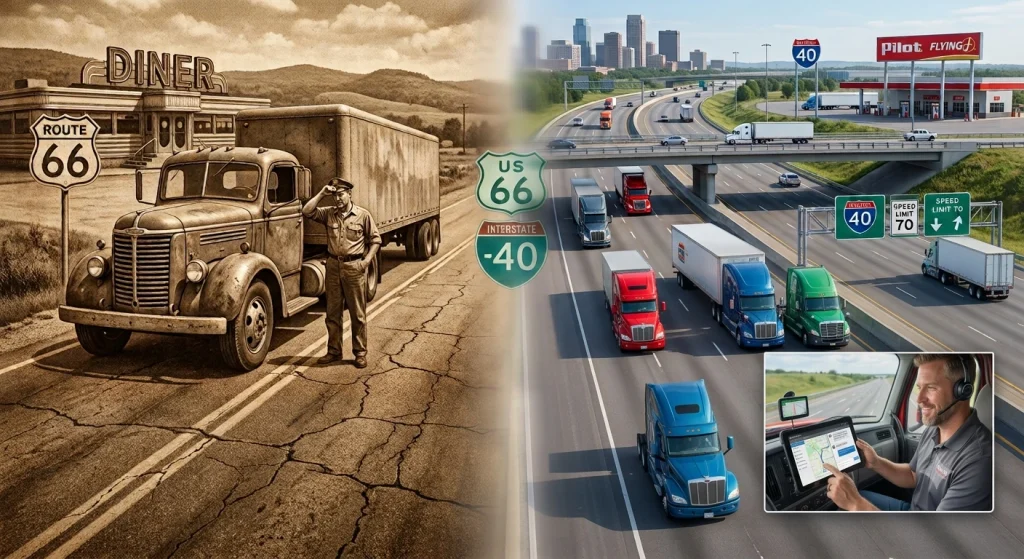

The roar of a diesel engine at night is the heartbeat of commerce on this country’s highways. Today, hooking up a trailer in Chicago and delivering it to Los Angeles in a couple of days is a matter of logistics and discipline. However, there was a time when completing that same trip was a true odyssey of survival for the pioneers of transportation.
The evolution of highways in the United States is not just an engineering story. It’s the chronicle of how the trucking profession went from a high-risk adventure to becoming the backbone of the American economy. Along this journey, the transition from the old federal highways to the Interstate System changed everything.
That pioneering asphalt
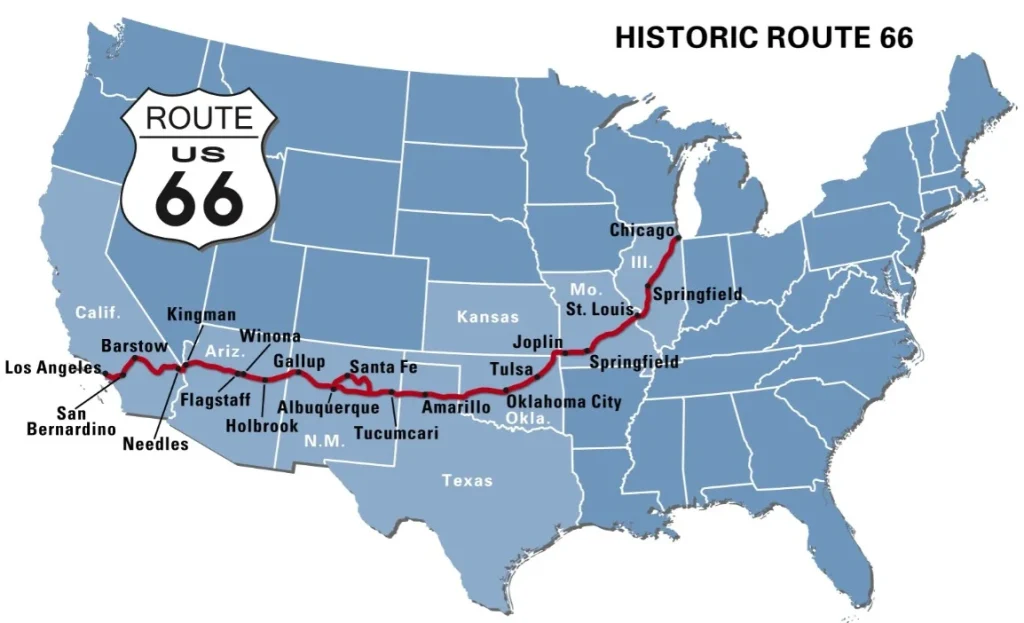
Before the great four-lane divided highways crisscrossed the nation, freight transport relied on a barely connected network. The legendary US 66, opened in 1926, along with the Lincoln Highway (US 30) and US 1 on the East Coast, were the first arteries that linked production centers with consumers.
For mid-20th-century truckers, these routes were synonymous with extreme skill. According to the archives of the American Trucking Associations (ATA), trucks of that era operated on narrow, two-lane roads, often unpaved in rural areas. Crossing mountain passes with steep inclines and sharp curves required immense physical strength and absolute mechanical knowledge.
Route 66 wasn’t a tourist postcard; it was the workplace of thousands of truckers. Passing through towns meant dealing with traffic lights, railroad crossings, and pedestrian crossings. The danger of head-on collisions was a daily reality due to the lack of separation between lanes of traffic. Even so, these roads allowed for the birth of the first interstate trucking companies in the country.
The Eisenhower Revolution
The landscape changed drastically in 1956 with the signing of the Federal Highway Aid Act, championed by President Dwight D. Eisenhower. This project gave rise to the National System of Interstate and Defense Highways. Inspired by the efficiency of the German Autobahn, the U.S. government understood that the nation’s future depended on fast and safe transportation.
For the transportation sector, the benefits of this new network can be precisely quantified in three key areas:
- Travel Times and Logistical Efficiency
According to historical data from the Federal Highway Administration (FHWA), the design of the interstates eliminated the mandatory stops of the old routes. Grades were strictly limited (generally to a maximum of 6%), and sharp turns were eliminated.
This allowed for consistent cruising speeds. A cross-country trip that previously took more than a week on the old federal highways was reduced to less than half the time. Hours of service (HOS) efficiency improved substantially, enabling precise logistics planning for fleets.
- Reduced Operating Costs
Carriers felt the immediate relief in their wallets. Constant speeds on interstate highways dramatically reduced wear and tear on brakes, transmissions, and tires compared to the constant stop-and-go of traditional roads.
Studies by the American Transportation Research Institute (ATRI) show that fuel consumption per mile traveled decreased significantly thanks to the flat, flowing design of modern highways. Fewer stops translate directly into a lower cost per mile (CPM) and higher profit margins for independent operators and large fleets.
- Safety and Highway Services
The physical separation of lanes with medians and the standardization of emergency shoulders transformed highway safety. The rate of fatal freight accidents decreased significantly by avoiding the head-on collisions typical of two-lane highways.
Furthermore, planned exits allowed for the emergence of modern truck stops. Chains like Pilot Flying J and Love’s developed alongside the interstates, offering drivers essential services such as secure parking, showers, certified scales, and 24-hour repair shops.
Historic Routes: Much More Than Nostalgia
With the arrival of giants like I-40, I-80, and I-95, the old federal highways lost their long-distance traffic. Route 66, for example, was officially decommissioned from the federal system in 1985. However, it would be a serious mistake for any trucker to think that these historic routes no longer have a use in the modern business.
Today, older highways serve three critical operational functions for the transportation industry:
- Detour and relief routes: When extreme winter weather conditions block critical sections of I-80 in Wyoming or serious accidents paralyze I-40, adjacent state and federal routes become the only escape corridors to avoid disrupting the supply chain.
- Last-mile logistics and regional connectivity: Interstates connect major metropolitan areas, but agricultural, mining, and industrial communities in the Deep North rely exclusively on secondary routes. The transport of grain, local machinery, and regional distribution moves along the routes of older highways.
- Oversize loads: Many modern interstate structures, such as pedestrian bridges or low-clearance overpasses, restrict the passage of oversized loads. Heavy-duty route planners frequently use the routes of older highways due to the lack of low bridges on certain open rural sections. The Teamsters union has repeatedly stated that maintaining these secondary roads is vital to the safety of local drivers who operate outside the major highway system. The routes of the past aren’t dead; they’ve been repurposed as the capillary support system of the vast national network.
Knowing the history of the roads we travel helps us appreciate the technology and infrastructure we work with today. The next time you set your cruise control on a straight, safe interstate, remember that you’re driving on the legacy of those men and women who forged the path with the steering wheel on the demanding routes of the last century. The business has changed, but the pride of moving the nation remains undiminished with every mile traveled.
 Business hours: Monday to Friday from 8:00 AM to 5:00 PM. California time