 Hable con un agente al (888) 572-7520
  Enviar mensaje a un agente

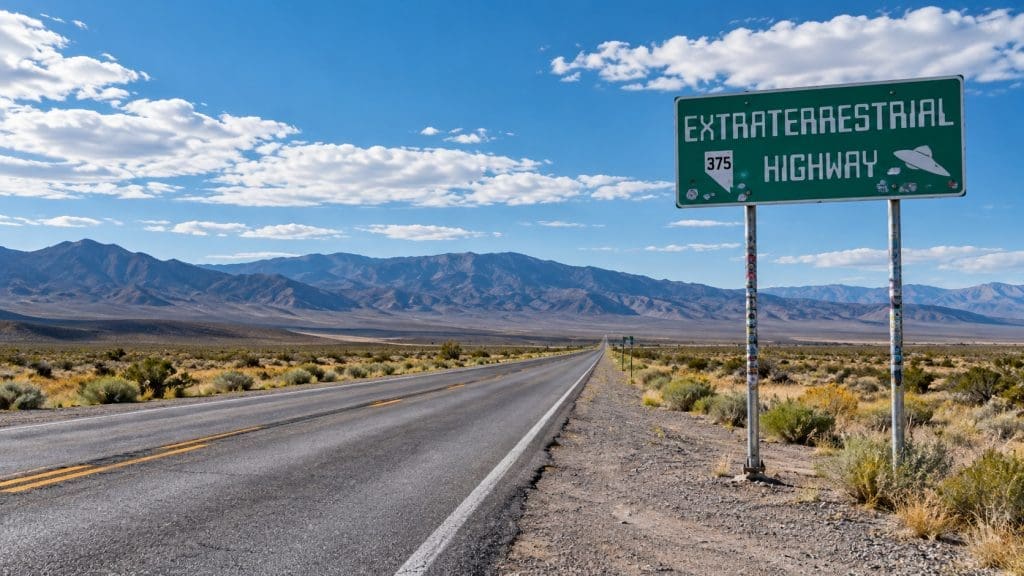

Nevada is unlike almost any other state for drivers traveling America’s highways. Its vast deserts, rugged mountains, nearly abandoned towns, and seemingly endless roads have inspired decades of stories about ghostly encounters, mysterious lights, and vehicles disappearing into the darkness.
For truck drivers crossing the state, especially at night, the landscape can be as breathtaking as it is unsettling. Some stretches of highway are so remote that the nearest city lights are miles away, and the horizon seems to go on forever.
But behind the legends are real historical events, remarkable geographical features, and genuine driving hazards that every motorist should know about.
The Extraterrestrial Highway Near Area 51
Nevada has a highway with a name straight out of a science fiction movie: the Extraterrestrial Highway.
Officially known as State Route 375, the road runs through a remote desert region near Area 51, the U.S. military installation that has fueled decades of rumors about unidentified flying objects and secret government experiments.
In 1996, Nevada officially designated this stretch of road the Extraterrestrial Highway, capitalizing on the popularity of alleged UFO sightings in the area.
Since then, the highway has become a destination for road-trippers, mystery enthusiasts, and curious drivers eager to explore one of the country’s most unusual places.
One of its best-known stops is Rachel, a tiny community home to the Little A’Le’Inn, a quirky establishment offering food, lodging, and plenty of alien-themed decorations.
Tourists, motorcyclists, and long-distance travelers stop here to grab a meal, take a break, and swap stories.
Some visitors claim to have spotted unexplained lights in the night sky. These accounts have become part of the local folklore, although there is no verifiable evidence connecting them to extraterrestrial activity.
For drivers, the real challenge of State Route 375 is far more down-to-earth: long isolated stretches, limited services, and wildlife crossing the roadway.
The Mysterious Black Truck That Haunts the Desert

Ghost trucks are a recurring theme in highway horror stories.
One version tells of a massive black semi-truck that suddenly appears in a driver’s rearview mirror during a late-night trip.
According to the tale, the truck approaches without its headlights on, blasts its powerful air horn, and then vanishes without a trace.
Some versions portray the truck as a menacing presence. Others give it a surprisingly protective role, claiming it appears just as a driver is about to fall asleep behind the wheel.
There are no reliable historical records establishing this story as a traditional Nevada legend. Instead, it appears to be a broader highway ghost story that fits naturally into the eerie isolation of the state’s desert roads.
What is very real, however, is the danger of driver fatigue.
On a dark highway with little traffic and miles of repetitive scenery, drowsiness can seriously impair reaction time and judgment.
The Federal Motor Carrier Safety Administration (FMCSA) warns professional drivers about the risks of fatigue and emphasizes the importance of adequate rest.
Behind the story of the mysterious black truck lies a warning every trucker understands: no delivery is worth pushing through exhaustion.
I-80 Crosswinds and the So-Called “Devil’s Gusts”
Interstate 80 is one of Nevada’s most important east-west freight corridors. Connecting communities such as Elko, Winnemucca, and Reno, it serves as a major transportation route between California and the rest of the country.
Along certain stretches, particularly through valleys and mountain passes, strong crosswinds can pose a serious threat to large commercial vehicles.
The danger increases for empty or lightly loaded trailers, which present a large surface area to the wind without enough weight to provide stability.
Some highway tales attribute sudden desert gusts to supernatural forces, although there is insufficient documentation to establish the so-called “devil’s gusts” as a recognized traditional Nevada legend.
The actual explanation lies in the state’s weather patterns and terrain, where winds can intensify as they funnel through natural corridors.
For truck drivers, the danger is anything but imaginary.
High-wind restrictions, weather advisories, and visibility conditions should always be checked before traveling through exposed areas.
The state’s official Nevada 511 service provides updates on road conditions, traffic incidents, and travel restrictions.
The Donner Party Tragedy and the Mountains That Still Challenge Drivers
Long before modern trucks and interstate highways, pioneers traveling west toward California had to cross wilderness where a single winter storm could become a matter of life and death.
One of the most infamous episodes was the Donner Party, a group of emigrants who headed west in 1846 and became trapped by heavy snowfall in the Sierra Nevada near present-day Donner Lake, California.
Food shortages and extreme temperatures claimed numerous lives. Some survivors eventually resorted to cannibalism to stay alive.
Today’s I-80 passes through the same general mountain corridor used by generations of travelers heading to California, although it does not follow the Donner Party’s exact route.
Truckers crossing from Nevada into California through Donner Pass now benefit from modern highway infrastructure, but they still face a challenge those pioneers knew all too well: severe Sierra Nevada winter storms.
Heavy snowfall, icy pavement, truck restrictions, and chain requirements can make winter travel extremely difficult.
The Donner Party tragedy remains one of the most dramatic reminders of what can happen when travelers underestimate mountain weather.
Black Rock Desert: Where a Vehicle Broke the Sound Barrier
Northern Nevada is home to the Black Rock Desert, a vast desert landscape internationally known for hosting the Burning Man festival.
But this remarkable place also made motorsports history.
On October 15, 1997, British driver Andy Green piloted the ThrustSSC to an average speed of 763.035 miles per hour, approximately 1,228 kilometers per hour.
It was the world’s first officially recognized supersonic land speed record, achieved in a vehicle powered by two jet engines.
The record, recognized by Guinness World Records, was set on the exceptionally flat surface of an ancient dry lakebed, which provided the enormous open space needed to reach such extraordinary speeds.
Although the Black Rock Desert may look like an endless highway without boundaries, it is neither a public freeway nor a place where ordinary drivers can safely attempt extreme speeds.
Ground conditions can change dramatically after rainfall, and certain areas can become hazardous for conventional vehicles.
Nevada also has a strong off-road culture, with desert racing, modified vehicles, and recreational driving playing an important role in the state’s automotive identity.
However, these activities are entirely separate from commercial trucking and the traffic regulations governing vehicles on public highways.
Nevada: Where Highway Legends Meet Real-World Dangers
Nevada’s highways have one defining characteristic that sets them apart from roads in many other states: isolation.
On some routes, drivers can travel considerable distances without encountering a gas station, restaurant, or major town.
That remoteness helps explain why stories about mysterious lights, ghost trucks, and strange nighttime encounters have become part of the imagination of travelers crossing the desert.
But isolation also makes careful planning essential.
Carrying enough fuel, inspecting the vehicle, checking weather forecasts, and taking proper rest breaks are especially important when traveling through remote desert regions.
Drivers planning a trip through Nevada can check official traffic and road conditions through Nevada 511, the state’s highway information service.
Because beyond the aliens, ghost stories, and desert legends, Nevada’s highways still offer something that modern technology has never completely eliminated: the feeling of driving through one of America’s most remote and unpredictable landscapes.
And the best way to enjoy the journey? Make sure you’re always properly insured.
 Business hours: Monday to Friday from 8:00 AM to 5:00 PM. California time