 Hable con un agente al (888) 572-7520
  Enviar mensaje a un agente



The spread of the New World screwworm in Texas has raised health and economic concerns across the United States, as authorities and experts continue trying to determine how the parasite managed to enter the country after nearly five decades without any reported cases in livestock.
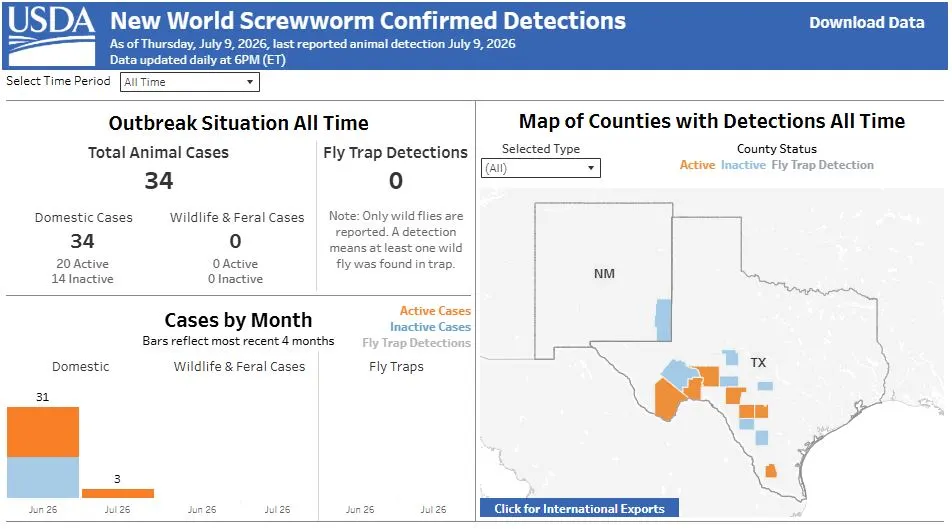
The first case was confirmed in early June in a calf from Zavala County. Since then, the number of infected animals has risen to 32, including cattle, sheep, and goats. Of those, 14 cases have already been declared inactive after successful treatment. Most cases are concentrated in South Texas, although the detection of an infected dog in New Mexico has raised new questions about the true extent of the outbreak.
Uncertainty Over the Spread of the New World Screwworm
While U.S. Secretary of Agriculture Brooke Rollins blamed the Joe Biden administration’s immigration policies for the spread of the parasite into Texas and Central America, Democratic lawmakers rejected that claim and urged officials to avoid spreading information without evidence, noting that there is no proof that migrants introduced the New World screwworm into the United States.
Kevin Esch, Executive Vice President of animal health company Zoetis Inc., said that many of the current theories are based on speculation. Experts believe it is still impossible to determine with certainty how the parasite entered the United States. However, identifying the source of the outbreak will be critical to eradicating the pest, a process that could take several years.
Experts consider it unlikely that the pest crossed the border on its own, since adult screwworm flies can travel only relatively short distances. One of the strongest hypotheses is that the parasite entered through infected animals transported by people, although authorities are also examining the possibility that it arrived through wildlife or pets that were not inspected.
Nevertheless, Esch cautioned that a natural migration of the pest cannot be completely ruled out. Meanwhile, Alec Gerry, a professor of entomology at the University of California, Riverside, explained that the first infected animals in Texas were too young to have crossed the border themselves, suggesting they became infected within the state through contact with other domestic animals or wildlife.
Amid concerns that the New World screwworm could continue spreading undetected, the U.S. Department of Agriculture (USDA) has established quarantines across areas covering more than a dozen counties in South Texas. In addition, several states have restricted the entry of livestock originating from the region, while federal authorities are working with the Department of Homeland Security to strengthen border surveillance using drones, artificial intelligence, and wildlife monitoring programs.

Active New World Screwworm Cases in the United States
The USDA’s Animal and Plant Health Inspection Service (APHIS) has developed a dashboard that provides an up-to-date overview of confirmed New World screwworm cases in animals, as well as detections of wild screwworm flies in the United States.
The dashboard tracks individual animal cases by county and state, animal type and species, confirmation date, and case status under two categories:
Active animal cases – Cases in which disease mitigation measures are still being carried out until the affected animal is free of New World screwworm (NWS) myiasis. These measures include treatment and ongoing care of the wounds caused by the infestation.
Inactive animal cases – Cases in which mitigation measures are no longer required. This occurs when the animal has fully recovered, the myiasis has been resolved, and treatment has been completed, or when appropriate actions have been taken to prevent further spread.
APHIS notes on its website that although individual animal cases may be classified as inactive, actively infested areas may still exist until additional conditions required for releasing an infested zone have been met.
 Business hours: Monday to Friday from 8:00 AM to 5:00 PM. California time