 Hable con un agente al (888) 572-7520
 Enviar mensaje a un agente


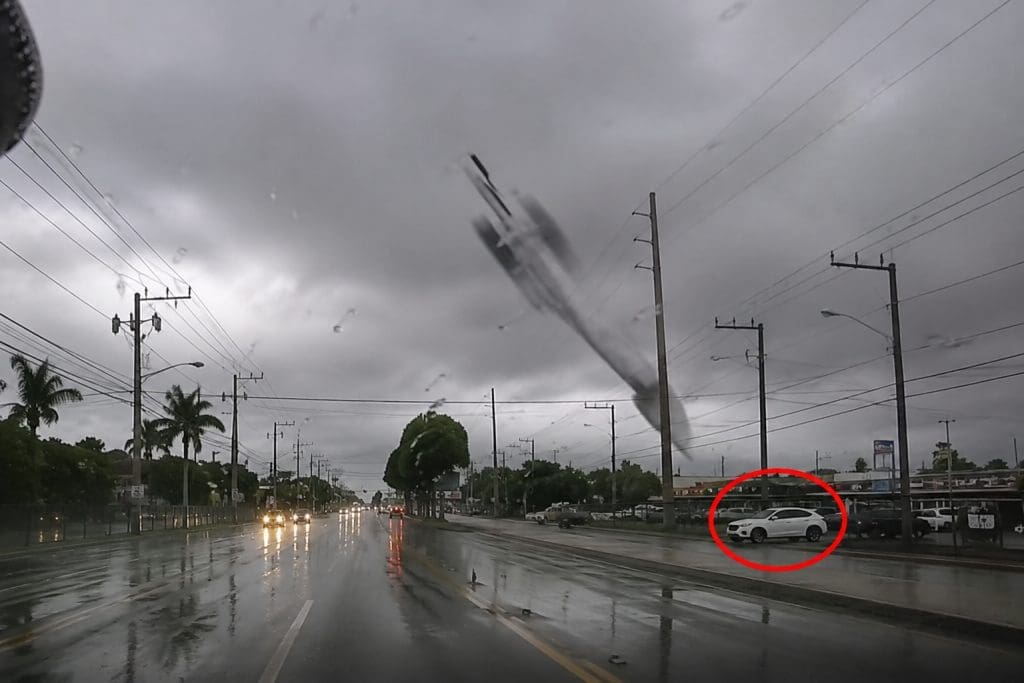

The deadly plane crash in Palm Beach, Florida, on Sunday has brought renewed attention to an unusual but potentially devastating danger for motorists and truck drivers: aircraft crashing onto public roads.
While some pilots deliberately attempt emergency landings on highways, other crashes occur when an aircraft loses control and strikes vehicles or roadway infrastructure.
The Learjet 60 crash killed all nine people aboard and injured a driver on South Military Trail in Greenacres, Palm Beach County. The impact left a crater in the pavement, sparked a fire, and forced hundreds of nearby residents to evacuate.
Motorist Injured
Palm Beach County District 3 Commissioner Joel Flores confirmed that a motorist traveling southbound on South Military Trail was injured when the force of the aircraft’s impact triggered the airbags in his vehicle.
The driver received medical attention and was reported to be in stable condition, according to Flores, who spoke during a news conference alongside local officials and representatives of the National Transportation Safety Board (NTSB).
The aircraft crashed between Cresthaven Boulevard and 10th Avenue North, near vehicles traveling along the roadway. The force of the impact damaged the asphalt, scattered aircraft debris, and ignited a fire.
All nine people aboard the aircraft were killed. The jet had departed Austin, Texas, bound for the Bahamas and encountered adverse weather conditions before the crash.
The NTSB is leading the investigation and will determine the probable cause of the accident.
Why Do Some Aircraft End Up on Roads and Highways?
Highways can become an emergency landing option when an aircraft experiences mechanical failure or loses engine power without sufficient altitude to reach an airport.
Under certain circumstances, a highway may offer a long, paved, relatively level surface. However, it also presents obstacles that can turn an emergency landing into a deadly accident.
Moving vehicles, bridges, road signs, utility poles, and power lines pose serious hazards to both the aircraft and people traveling on the ground.
Not every aircraft crash involving a roadway is an attempted emergency landing. Some planes strike roads or highways after losing control during takeoff, approach, or flight.
The distinction matters: in one scenario, a pilot intentionally selects a roadway as a last resort. In the other, the crash location is determined by the trajectory of an aircraft that can no longer be controlled.
BREAKING: A Learjet 60 has reportedly crashed in West Palm Beach, Florida. https://t.co/coLyl5t2NI
— Breaking Aviation News & Videos (@aviationbrk) November 1, 2026
The Risks for Motorists and Truck Drivers
An aircraft crash on a roadway can have consequences extending far beyond the initial impact.
Drivers may be exposed to flying debris, fires, fuel spills, and secondary collisions. Even vehicles that are not directly struck by an aircraft can sustain damage.
The Palm Beach accident illustrates this danger. The injured motorist was not aboard the jet but was driving along the roadway when the crash occurred.
For truck drivers, an unexpected aircraft impact presents additional hazards because commercial vehicles are heavier, require longer stopping distances, and are more difficult to maneuver around sudden obstacles.
During emergencies involving aircraft, drivers should avoid approaching the crash site, comply with road closures, and remain clear of fires, fuel spills, and scattered wreckage.
Palm Beach Crash Disrupts Traffic and Nearby Communities
The Learjet 60 crash also disrupted traffic and daily life for nearby residents.
The impact created a crater on South Military Trail, forcing authorities to restrict access while investigators examined the wreckage and recovery crews worked at the scene.
Rain complicated recovery operations, and officials needed to assess the structural condition of the pavement before determining when the roadway could reopen.
Approximately 600 residents were evacuated from surrounding areas. As of Monday, residents of roughly 77 mobile homes remained displaced, while some local businesses continued to experience access restrictions.
Palm Beach County declared a local emergency to coordinate assistance for affected families and businesses.
Aircraft Crashes Involving Roads and Highways in the United States
The Palm Beach tragedy is not the first time an aircraft has crashed onto a road used by cars and commercial trucks. Previous incidents across the United States have involved commercial airliners, private jets, and smaller aircraft.
Washington, 1982: Boeing 737 Strikes a Bridge
On January 13, 1982, Air Florida Flight 90 crashed shortly after taking off from Washington National Airport.
The Boeing 737 struck the 14th Street Bridge, hitting vehicles traveling across the structure before plunging into the icy Potomac River.
The accident killed 78 people, including aircraft occupants and motorists on the bridge. Investigators identified problems involving ice accumulation and engine operation during takeoff.
🇺🇲 DRONE FOOTAGE: reportedly shows a large crater in the roadway as emergency crews surround the crash site in Palm Beach County.#FloridaPlaneCrash #WestPalmBeach #SouthFlorida #PrivateJetCrash #BusinessJetCrash #Learjet60 #PlaneCrash #AviationAccident #9Dead #DeadlyCrash https://t.co/pVkJzl6044
— VIRAL VOLT (@ViralVolT1) November 2, 2026
Detroit, 1987: Airliner Crashes Near Interstate 94
On August 16, 1987, Northwest Airlines Flight 255 crashed shortly after departing Detroit Metropolitan Airport.
The McDonnell Douglas MD-82 failed to gain sufficient lift, struck obstacles, and crashed near Middlebelt Road and Interstate 94.
A total of 154 people aboard the aircraft and two motorists on the ground were killed. A young girl was the only survivor from the plane.
Investigators determined that the aircraft had taken off without the proper flap and slat configuration, which is essential for generating lift at low speeds.
Florida, 2024: Private Jet Crashes onto I-75
On February 9, 2024, a Bombardier Challenger 600 attempted an emergency landing on Interstate 75 near Naples, Florida, after its crew reported losing power in both engines.
The aircraft struck vehicles and a highway barrier before catching fire.
Both pilots were killed, while three other people aboard survived. The accident temporarily shut down a section of one of Southwest Florida’s major transportation corridors.
The incident demonstrated how an aviation emergency can become a serious highway accident within seconds.
Highways as a Last Resort
These accidents highlight two different scenarios: aircraft that unintentionally crash onto roads and pilots who attempt to use highways for emergency landings when no other viable option remains.
In both situations, motorists and commercial drivers face dangers they have little opportunity to anticipate.
For trucking and logistics companies, these incidents can also lead to extended highway closures, detours, delivery disruptions, and damage to critical transportation infrastructure.
The Palm Beach tragedy is another reminder that an aviation emergency can quickly become a roadway safety crisis. Investigators must now establish why the Learjet 60 crashed, while the injured motorist illustrates the immediate danger such accidents pose to people traveling on the ground.
Major Aircraft Accidents Involving Roads Around the World
Several major aviation disasters have involved aircraft striking roads, bridges, or vehicles, sometimes causing fatalities among people who were not aboard the planes.
TAM Airlines Flight 3054 — July 17, 2007, São Paulo, Brazil
An Airbus A320 failed to stop while landing at Congonhas Airport. The aircraft overran the runway, crossed Washington Luís Avenue, and crashed into a building. A total of 199 people died, including 187 aboard the aircraft and 12 on the ground.
TransAsia Airways Flight 235 — February 4, 2015, Taipei, Taiwan
An ATR 72-600 lost control shortly after takeoff following an engine failure and crew errors. The aircraft’s wing struck a taxi traveling along the elevated Huandong Viaduct before the plane crashed into the Keelung River. Forty-three people were killed.
Northwest Airlines Flight 255 — August 16, 1987, Detroit, United States
A McDonnell Douglas MD-82 took off without the correct flap and slat configuration. The aircraft lost lift and crashed near Interstate 94 and Middlebelt Road, striking vehicles. The accident killed 156 people, including two motorists on the ground.
Air Florida Flight 90 — January 13, 1982, Washington, D.C., United States
A Boeing 737 failed to gain sufficient altitude after takeoff in icy conditions. It struck vehicles on the 14th Street Bridge before crashing into the Potomac River. Seventy-eight people died, including four motorists traveling across the bridge.
Private Jet Crash on Interstate 75 — February 9, 2024, Naples, Florida
A Bombardier Challenger 600 lost power in both engines while approaching Naples Airport. The pilots attempted to land on I-75, where the aircraft struck vehicles and a highway barrier before bursting into flames. Both pilots were killed.
Southern Airways Flight 242 — April 4, 1977, New Hope, Georgia, United States
A Douglas DC-9 suffered damage to both engines during a severe hailstorm. The crew attempted an emergency landing on a road in New Hope, where the aircraft struck vehicles, trees, and buildings. Seventy-two people died, including nine on the ground.
LAPA Flight 3142 — August 31, 1999, Buenos Aires, Argentina
A Boeing 737 scheduled to fly from Jorge Newbery Airport to Córdoba failed to become airborne because its flaps were incorrectly configured.
The aircraft broke through the airport perimeter, crossed Costanera Rafael Obligado Avenue, and struck vehicles traveling through the area before colliding with road construction equipment and a gas installation.
The resulting crash and fire killed 65 people, including two occupants of a car.
 Business hours: Monday to Friday from 8:00 AM to 5:00 PM. California time