 Hable con un agente al (888) 572-7520
  Enviar mensaje a un agente



The trucking industry has a well-known saying: “Not every mile driven is a paid mile.” Even if a driver covers a certain distance according to the truck’s odometer, the carrier may use an entirely different system to calculate payroll.
The differences between mileage calculation methods are one of the most common sources of confusion and disputes among drivers, especially those who are new to the industry or changing employers.
Why Are There Different Ways to Measure Miles?
Carriers need a standardized way to calculate trips before they begin. If they paid solely based on the truck’s odometer, every trip would vary because of accidents, detours, traffic, construction zones, or even navigation mistakes.
That’s why several mileage calculation methods were developed to establish a “standard” trip distance. The problem is that some methods reflect the real route much more accurately than others.
1. Map Miles (HHG Miles): The Least Driver-Friendly Method
HHG Miles (Household Goods Miles) were originally developed decades ago to calculate costs for military household moves. Over time, they began to be used in other areas of the trucking industry.
The concept is simple: it calculates the shortest legal distance between the ZIP code of the origin and the ZIP code of the destination.
In practice, however, this method has several limitations:
- It doesn’t account for mandatory detours.
- It ignores truck restrictions.
- It doesn’t consider low bridges.
- It overlooks traffic conditions and common commercial routes.
- It may calculate routes that an 80,000-pound truck cannot legally or safely travel.
As a result, paid miles can end up 10% to 15% lower than the miles actually driven, depending on the trip.
For that reason, many drivers consider HHG Miles the least favorable method when they’re paid strictly by the mile.
2. Practical Miles: The Industry Standard
Today, most large U.S. fleets use the Practical Miles system.
These miles are calculated using specialized routing software such as PC*Miler and Intelliroute, both designed specifically for commercial trucking.
Instead of searching for the shortest route, these programs calculate the most practical and efficient route for a heavy commercial vehicle.
Among the factors they consider are:
- Truck-approved highways
- Weight restrictions
- Bridge clearances
- Commercial truck access
- Interstate highways
- The safest and most efficient routing options
For example, in many cities the software will route a truck around the metro area using a beltway instead of sending it through downtown traffic.
Although that route may be slightly longer, it is generally the most practical option for a commercial truck.
Practical Miles are typically 3% to 6% lower than actual odometer miles, making them much closer to reality than HHG Miles.
That’s why Practical Miles are widely considered the fairest and most balanced payroll standard in the trucking industry.
3. Hub Miles: The Truck’s Actual Miles
Hub Miles, also known as Actual Miles, represent the exact distance recorded by the truck’s odometer.
Years ago, this was measured with a mechanical hubodometer mounted on the wheel hub. Today, the truck’s electronic systems perform that function.
Hub Miles include every mile the truck actually travels, including:
- Accident detours
- Construction reroutes
- Searching for truck parking
- Entering and leaving truck stops
- Navigation errors
- Any other vehicle movement
In other words, they represent the actual miles driven.
Ironically, Hub Miles are rarely used to calculate driver pay.
The reason is straightforward: carriers believe many of those extra miles are outside the planned route and may result from circumstances unrelated to the original trip.
Instead, Hub Miles are primarily used for:
- Vehicle maintenance
- Equipment wear tracking
- Fuel records
- IFTA reporting
- Fleet management
How Much Money Can a Driver Lose?
The difference can be substantial.
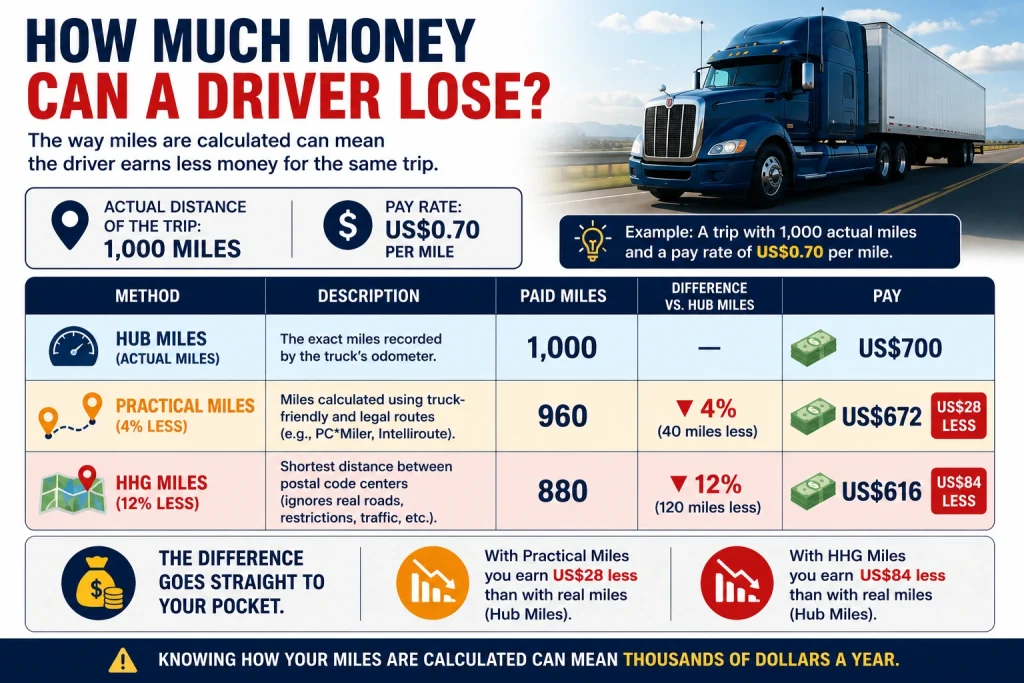
Let’s assume a trip with an actual distance of 1,000 miles and a pay rate of $0.70 per mile.
| Method | Paid Miles | Pay |
|---|---|---|
| Hub Miles | 1,000 | US$700 |
| Practical Miles (4% less) | 960 | US$672 |
| HHG Miles (12% less) | 880 | US$616 |
In this example:
- Being paid using Practical Miles means earning US$28 less than if every actual mile were paid.
- Being paid using HHG Miles reduces earnings by US$84 compared to actual odometer miles.
Over dozens of trips throughout the year, that difference can add up to thousands of dollars.
What Should Drivers Check Before Accepting a Job?
Many job ads promote an attractive pay-per-mile rate, but they don’t always explain which mileage system is used to calculate payroll.
Before signing an employment agreement, drivers should ask:
- Is pay based on Practical Miles or HHG Miles?
- What routing software does the company use?
- How are mandatory detours caused by weather or accidents handled?
- Are there additional payments for delays, waiting time, or extraordinary routing?
The answers to these questions make it much easier to compare job offers accurately.
What Should Companies That Hire Transportation Services Check?
Drivers aren’t the only ones who should understand mileage calculations. Companies that hire trucking services should also know which mileage method is being used to quote a load, since it can directly affect transportation costs and relationships with carriers.
When requesting a freight quote, it’s worth asking whether the trip is based on Practical Miles, HHG Miles, or another routing method.
It’s also advisable to ask which routing software the carrier uses and how it accounts for mandatory detours, tolls, truck restrictions, or unusual operating conditions. Understanding these factors helps companies compare freight quotes more accurately, avoid billing discrepancies, and reduce disputes between shippers, brokers, and carriers.
The Bottom Line: Understanding How Miles Are Calculated
In U.S. trucking, the pay-per-mile rate is only part of the equation. Equally important is understanding how those miles are calculated.
While Hub Miles reflect every mile the truck actually travels, Practical Miles estimate the most efficient commercial route and have become the industry standard for driver pay. HHG Miles, meanwhile, are still used in some situations, but they often create the largest gap between miles driven and miles paid.
For drivers—especially owner-operators and company drivers who are paid by the mile—understanding these differences can have a significant impact on annual earnings.
 Business hours: Monday to Friday from 8:00 AM to 5:00 PM. California time