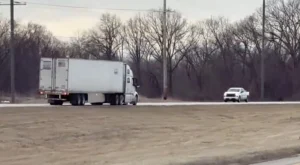
A new legislation was proposed to penalize brokers who hire carriers with a history of violations.
On December 18, Republican Representative John Moolenaar of Michigan introduced H.R. 6884, a bill aimed at increasing the accountability of freight brokers and transportation intermediaries in their carrier selection practices by imposing a 10% penalty on those who contract with companies that have three or more violations within a five-year period.
The initiative, titled the “Patrick and Barbara Kowalski Transportation Broker Safety Act,” follows the deaths of two Michigan residents in a 2022 crash involving a carrier with multiple violations on its record. According to Moolenaar, the tragedy was preventable, and the legislation seeks to ensure that safety is taken seriously by all contractors in the freight transportation industry.
Transportation Broker Safety Act
The bill authorizes the Federal Motor Carrier Safety Administration (FMCSA) to investigate brokers after a crash and to impose operational requirements on those who have acted with “reckless disregard for safety” when hiring a carrier involved in an accident. It also directs that the civil penalties collected be used to fund projects and infrastructure that enhance roadway safety.
If enacted and enforced, the revenue generated could be substantial, as most mid- to large-sized motor carriers have accumulated three or more violations in their public records. In addition, while the FMCSA’s CSA system currently displays only three years of history, the bill proposes evaluating a broader five-year period for the purpose of applying penalties.
However, the initiative has drawn criticism. Chris Burroughs, president of the Transportation Intermediaries Association (TIA), described the bill as “well-intentioned” but warned that it could ultimately be counterproductive. He said it would place brokers in an untenable position by forcing them to oversee safety across the trucking industry and significantly increasing their exposure to litigation nationwide.
The debate emerges amid increased use by brokers of carrier verification platforms, driven by a rise in fraud within freight markets. While the legislation could benefit small carriers and owner-operators with clean safety records, it could also incentivize the hiring of companies with limited public data, introducing additional risks.
An uncertain legislative path
Burroughs also highlighted the limitations of the current safety rating system, noting that more than 92% of carriers lack a safety rating and that the FMCSA has not conducted compliance reviews for the vast majority of them. These shortcomings are compounded by inconsistencies and inaccuracies in CSA data, which, in TIA’s view, make shifting enforcement and oversight responsibilities to brokers impractical and likely ineffective.
Moreover, the bill faces an uncertain legislative path, as it was referred to the House Committee on Transportation and Infrastructure without any co-sponsors, potentially hindering its progress. Nonetheless, the proposal revives debate over the role of intermediaries in roadway safety and the need to modernize federal systems for evaluating and transparently reporting regulatory compliance in the trucking industry, an issue gaining importance amid growing commerce and mounting pressure to improve safety on U.S. highways.

States with the most truck drivers in the U.S.
These are the states with the highest number of truck drivers in the United States. The trucking industry employs approximately 3.6 million truck drivers across

Lawmakers propose 10% penalty for brokers hiring high-risk carriers
A new legislation was proposed to penalize brokers who hire carriers with a history of violations. On December 18, Republican Representative John Moolenaar of Michigan

Severe Flooding and Travel Chaos in Southern California
A powerful atmospheric river is driving Severe Flooding and Travel Chaos in Southern California, with torrential rain triggering mudslides, emergency evacuations, and widespread road closures. Major highways such as Interstate 15 were shut down as floodwaters and debris inundated roads and bridges, stranding holiday travelers and disrupting regional transportation.

The Department of Transportation’s “naughty list”
The United States Department of Transportation continues to expand its “naughty list,” now including California, New York, and Colorado. The U.S. Department of Transportation (DOT)

Gas prices at lowest during the holiday season
Data by the American Automobile Association shows that December has been the cheapest month of the year for gas prices. The magic of Christmas has

Accident rates rise nearly 30% in winter holiday travel
The month of December becomes one of the most congested of the year, making the risk of an accident more volatile. Winter is the most