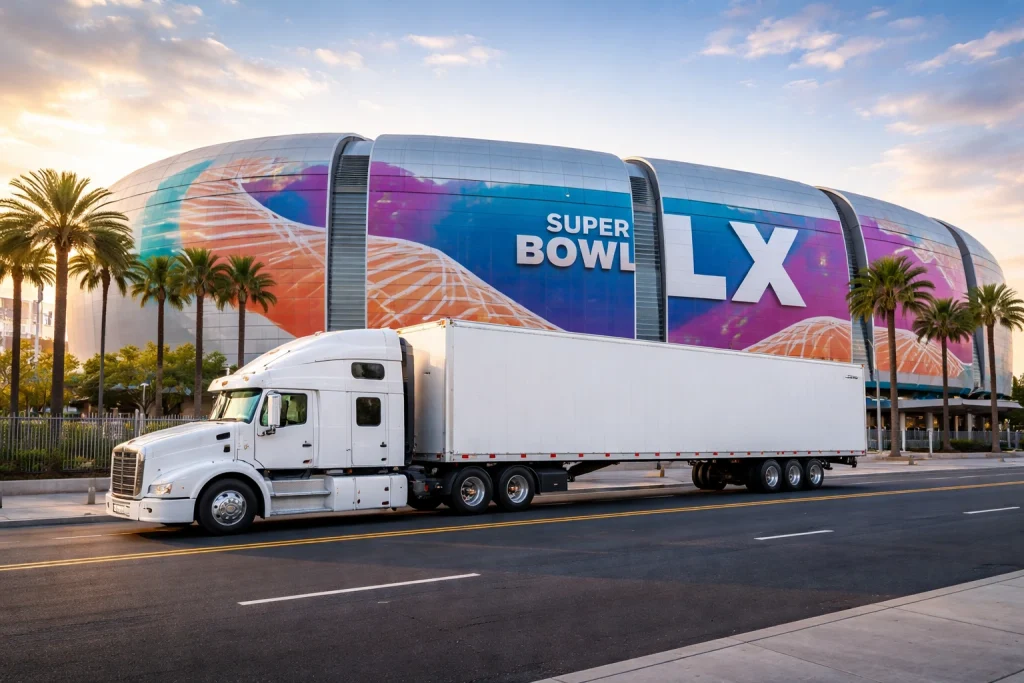
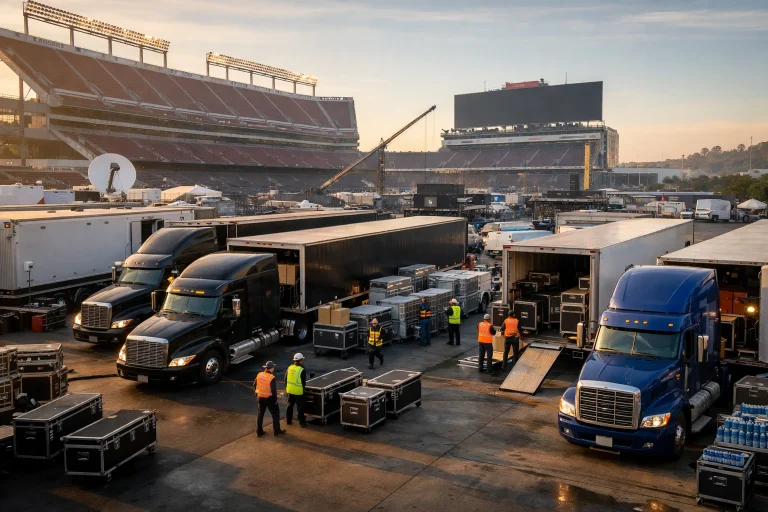
Super Bowl LX, featuring the New England Patriots and the Seattle Seahawks, is far more than the NFL’s championship game. It involves one of the most complex logistics operations in the world, with hundreds of trucks, ultra-precise technical production, layered security controls, and an industrial-scale deployment that turns Levi’s Stadium into a temporary city for 72 hours.
On Sunday, February 8, Super Bowl LX will bring together the New England Patriots and the Seattle Seahawks at Levi’s Stadium in California. While millions of fans watch the game on television, an extraordinary logistics machine is operating behind the scenes—one comparable to a highly complex industrial operation.
Beyond the final score, the Super Bowl has become a case study in logistics, transportation, risk management, and operational coordination, where every minute, every truck, and every access point is planned with precision.
The Earn Your Sunday Tour has arrived at the Super Bowl Experience 📍 A season of hard work has led to this - you’ve earned this Sunday #SBLX pic.twitter.com/285gSkFD4y
— Lowe's (@Lowes) February 4, 2026
Trucks and Transportation: The Physical Backbone of the Super Bowl
An event of this scale requires intensive ground logistics. For Super Bowl LX, between 400 and 500 trucks are mobilized, directly or indirectly, entering the stadium and surrounding areas during different phases of the operation.
Key vehicle categories include:
Trucks carrying structures, stages, and technical supports for the halftime show
Specialized broadcast and television production units equipped with satellite technology, cameras, servers, and data systems
Refrigerated vehicles for food and beverage supply
Trucks for fencing, perimeter control, and security signage
Transportation for official merchandise and sponsor materials
Units carrying sports equipment, locker room setups, and technical gear
Truck movements are managed under strictly regulated time windows, with special permits and a strong emphasis on overnight operations. The goal is to minimize urban disruption and ensure that every load arrives, is unloaded, and departs according to a meticulously timed logistics schedule.

Halftime Show: High-Precision Logistics in Minutes
One of the most critical moments of the entire operation is the setup of the halftime show, headlined this year by Bad Bunny. The show’s infrastructure must be assembled and dismantled in less than eight minutes during halftime.
This requires:
Dozens of mobile platforms custom-designed for the event
Highly trained technical crews operating with pit-crew precision
Pre-event logistics rehearsals, conducted without spectators and timed to the second
Simultaneous coordination among engineering, sound, lighting, and security teams
From an operational standpoint, this is a high-precision logistics exercise where any deviation can impact the continuity of the live broadcast.
Television Production and Global Broadcast
The Super Bowl is one of the most watched events on the planet. To make this possible, between 70 and 100 audiovisual production trucks are deployed, functioning as mobile technical control centers.
From these units, teams manage:
Live high-definition broadcast feeds
Instant replays and real-time analysis
Specialized cameras and multi-camera configurations
Satellite connections and redundant data links
These production hubs require temporary power infrastructure, backup networks, and contingency systems, effectively turning the stadium into a global logistics and technology node broadcasting to more than 180 countries.
Security and Access Control: Mission-Critical Logistics
Security is another core pillar of the operation. The system is organized in layered perimeters, with differentiated access controls based on user type:
Players and coaching staff
Logistics providers and operational personnel
Accredited media
Performers and production teams
VIP guests and public officials
Coordination involves the NFL, local and state law enforcement, and federal agencies. From a logistics perspective, this structure allows every movement to be tracked and controlled—from truck arrivals to the exit of technical crews—reducing operational risk and ensuring full traceability.
On-Field Context and Game Stakes
On the field, Super Bowl LX features two historic franchises. The Patriots are chasing their seventh championship, which would make them the most decorated team in NFL history. The Seahawks, meanwhile, are aiming for their second Vince Lombardi Trophy in their fourth Super Bowl appearance.
Young quarterback Drake Maye could become one of the youngest quarterbacks to win a Super Bowl, while Seattle is relying on a well-established defense and a game-control-oriented tactical approach.
Much More Than Football
Super Bowl LX shows that major sporting events are also high-exposure logistics operations, where transportation, security, technology, and risk management are just as critical as athletic performance.
For sectors such as transportation, trucking, insurance, infrastructure, and logistics, the Super Bowl offers a clear example of how rigorous planning and precise execution allow a global-scale event to run without disruption—even under extreme time constraints, pressure, and public visibility.

Commercial Driver’s License (CDL) in Washington: A Guide for Truck Drivers
For those looking to work as professional drivers in the state of Washington, obtaining a Commercial Driver’s License (CDL) is one of the most important

The Growth of Intermodal Transport in Washington: The New Inland Hub Gets Moving
The Tri-Cities Inland Logistics Hub and a new rail link in Pasco are driving intermodal transport growth in Washington.

The Main Truck Bottlenecks in Washington in 2026
The I-5 bridge over the Columbia River is the worst truck bottlenecks in Washington and Oregon.

Guide to Permits for Oversize Vehicles in Washington
Transporting an oversize vehicle, machinery, or load on Washington state highways can require a special size and weight permit. Learn when a permit for oversize load is needed.

High-Value Cargo Leaving Washington Ports: Why a Standard Policy May Not Be Enough
Electronics, machinery, industrial components, and other goods can concentrate hundreds of thousands of dollars in a single trailer. For carriers operating out of Seattle and Tacoma, knowing the true value of what they are hauling can be just as important as knowing the route.

Florida Highways for Truck Drivers: How the State’s Road System Works
Florida organizes its highway network into seven FDOT districts, along with Florida’s Turnpike. Here’s how the system works and what this division means for truck drivers and motor carriers.