 Hable con un agente al (888) 572-7520
  Enviar mensaje a un agente

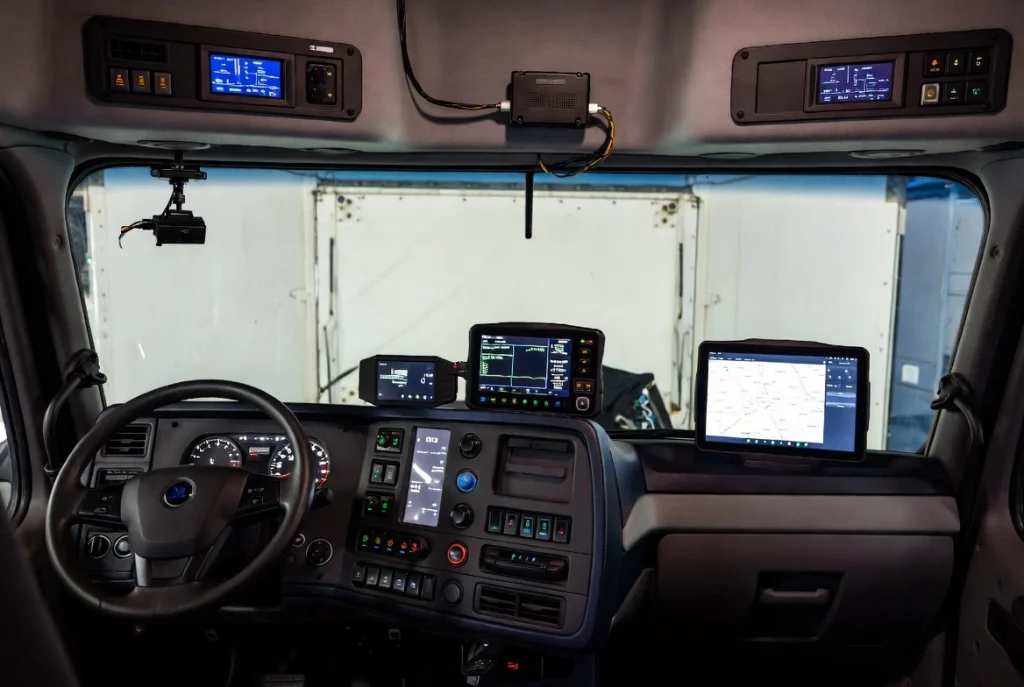

Today, trucking insurers use telematics in trucking to observe, in real time, how each driver operates and how each unit performs: speed, harsh braking, rapid acceleration, idle time, Hours of Service (HOS/ELD) compliance, GPS location, driver distraction, and seatbelt use. In Washington, sharing this data with your insurer can lower your premium by 5% to 20%, depending on the provider and how fully the system is adopted.
What Is Telematics in trucking, and Why Does Your Insurer Care?
Telematics combines GPS, vehicle sensors, and increasingly, AI-powered cameras facing both the road and the driver. For decades, trucking insurers priced policies using blunt inputs: years in business, claims history, fleet size, and zip code. That approach can’t tell an insurer whether your drivers brake hard at intersections or whether someone’s been on their phone at highway speed.
Today, underwriters use telematics to see actual driving behavior instead of relying solely on paper history. That lets them separate a fleet that genuinely drives carefully from one that just looks safe on paper.
The Data Points Insurers Are Watching Today
These are the metrics most commonly used by insurance carriers to calculate risk and set premiums:
- Speed and speeding patterns: how a truck’s speed compares to posted limits across different route segments.
- Harsh braking and rapid acceleration: treated as near-misses; a driver who brakes hard repeatedly is statistically more likely to be tailgating, which raises rear-end collision risk.
- Aggressive cornering: maneuvers that signal less careful handling, especially with heavy loads.
- Idle time: engine running without the vehicle moving, tied to operational efficiency.
- Hours of Service (HOS) via ELD: compliance with FMCSA driving and rest-period limits.
- GPS location and route consistency: typical routes versus deviations that can flag risk.
- Phone use / distracted driving: detected by AI-powered, driver-facing cameras.
- Seatbelt use: automatically verified by some camera-based systems.
- Vehicle maintenance data: engine vibration, brake wear, tire pressure, captured through onboard sensors.
- Driver and fleet safety scores: a composite score pulling all of the above together, which many insurers now ask to see directly.
These data points go well beyond simple mileage tracking — they point to specific behaviors that predict claims more accurately than a traditional driver profile ever could.
The Washington Context: What You Need to Know about telematics in trucking
For an owner-operator or small fleet running in Washington, one distinction matters most:
- If your operation is strictly intrastate (never crosses Washington’s borders), the WUTC (Washington Utilities and Transportation Commission) sets your insurance minimums, safety standards, and permitting requirements.
- If you operate interstate (for example, the I-5 corridor connecting Seattle, Tacoma, and Vancouver, WA, or cross-border runs through Blaine), FMCSA federal rules apply.
Either way, insurers writing policies in Washington increasingly value telematics data shared voluntarily by the insured. Newer trucks equipped with ADAS features — automatic emergency braking, lane-departure warnings — can qualify for additional discounts over older units without that technology. Driver experience also matters: many insurers won’t quote fleets with an average driver experience below two or three years, unless telematics data backs up a track record of safe driving.
How Much You Can Save by Sharing Telematics Data
The exact numbers vary by insurer and telematics provider, but the most commonly cited 2026 industry benchmarks are:
- 5% to 15% premium reduction for sharing basic telematics data (speed, braking, following distance, HOS).
- 15% to 20% reduction when a dash cam is added and documented driving data is shared.
- Operators who build a clean CDL record over five years, maintain documented inspections, and install collision-warning technology can realistically cut their total rate by 30% to 50% from their first-year baseline.
- Paying annually instead of on a monthly installment plan can add another 10% to 15% in savings, independent of telematics.
Which Platforms Insurers Actually Look At
The telematics and AI-video platforms most frequently referenced by insurers and freight brokers are Samsara, Motive, Lytx, and Netradyne. These systems generate “safety score” reports that many insurance companies accept as direct support when setting or renewing a premium — and the footage can also help exonerate a driver when video shows they weren’t at fault in an incident.
Frequently Asked Questions
Do I have to share telematics data with my insurer? No, but skipping it generally means missing out on safe-driving discounts and being evaluated only on the traditional risk profile.
What happens if the telematics system logs a negative event? Most insurers evaluate trends over time, not a single incident. A sustained pattern of harsh braking or speeding carries more weight than one isolated event.
Does telematics replace the ELD? No. The ELD logs Hours of Service as required by the FMCSA. Telematics is a broader system that can include the ELD alongside GPS, driving-behavior sensors, and cameras.
Is telematics worth it for a single-truck owner-operator, or only for large fleets? Yes, it’s worth it either way. A basic setup — location, speed, and a driving score — is already enough to support your risk profile with an insurer, even without the advanced features larger fleets use.
 Business hours: Monday to Friday from 8:00 AM to 5:00 PM. California time