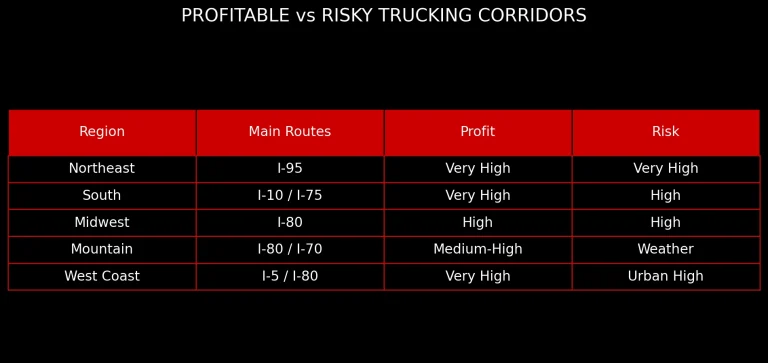
The most profitable routes and the most dangerous routes for truck drivers in the United States handle the nation’s highest freight volumes while also exposing drivers to elevated risks, heavy congestion, extreme weather, and constant pressure on delivery schedules.
In freight transportation, choosing the right route can mean the difference between a smooth, efficient run and a day filled with delays, detours and elevated risk exposure. Across the United States, the very corridors that generate the strongest revenue for drivers are often the same ones where the probability of incidents increases.
The reason is simple: where freight concentrates, traffic follows.
Highways that connect ports, distribution centers, rail hubs and major metropolitan markets become essential arteries of the national economy. But that operational intensity also brings congestion, permanent construction zones, complex traffic patterns and accumulated fatigue.
Understanding which routes are the most profitable — and why they also rank among the most dangerous — is critical for fleets, dispatchers, insurers and independent operators.
The corridors that move the most money
I-95
The backbone of the East Coast, linking high-consumption markets from Florida to New England. Imports, retail, foodservice, parcel freight and urban distribution guarantee consistent demand.
The challenge: it cuts through some of the densest metro areas in the country.
I-10
Running from the Southeast to California across the Gulf region, I-10 is powered by petrochemicals, international trade and port traffic. It offers steady, often premium-paying freight.
Yet cities like Houston and Phoenix add daily operational pressure.
I-80
A coast-to-coast giant, essential for manufacturing freight and intermodal movement. It enables long hauls with dependable demand.
At the same time, drivers face some of the toughest winter conditions in the nation.
I-40
A bridge between the Atlantic and Pacific supply chains, heavily used for agricultural goods, consumer products and regional distribution.
I-75
Vital for moving food and retail shipments from the South into the Midwest.
I-35
The spine of central U.S. commerce, fundamental for manufacturing, energy transport and agricultural freight.

Where risk intensifies
Danger does not always come from poor pavement. More often, it comes from volume and complexity.
Urban congestion
Entering or exiting Houston, Atlanta, New York or Chicago means dealing with passenger vehicles, tight merges, aggressive lane changes and unpredictable slowdowns.
Extreme weather
In states such as Wyoming, Montana and Colorado, crosswinds, snow and ice can quickly transform a profitable lane into a technical driving challenge.
Infrastructure under repair
Large portions of the interstate system operate in a near-constant state of improvement. Narrow lanes, temporary alignments and sudden braking leave little margin for error.
Mixed traffic environments
Cars, last-mile vans and heavy trucks compete for limited space, increasing mental workload for professional drivers.
The trucker’s constant dilemma
High-demand corridors pay well because they connect strategic economic centers. But they also concentrate:
- higher crash probability
- less predictable transit times
- physical and mental wear
- appointment pressure.
That is why planning has become just as important as driving skill.
What fleets evaluate today
Carriers and logistics operators are incorporating more data into route assignment decisions than ever before:
✔ incident history
✔ truck parking availability
✔ time-of-day patterns
✔ scheduled construction
✔ weather exposure
✔ transit reliability.
The mission is not simply to arrive — it is to arrive without surprises.
Profit versus exposure
For many owner-operators, avoiding these corridors is not realistic. Contracts, brokers and reload opportunities are concentrated there.
The strategy therefore becomes risk management, not risk avoidance.
That means adjusting departure times, building buffers, relying on daily traffic intelligence and using advanced driver-assistance technologies.
A defining reality of modern trucking
The map of revenue in American freight mirrors the map of operational stress. As e-commerce expands and delivery speed becomes more competitive, these routes will only grow more crowded.
Competitive advantage will belong to those who understand the terrain best.
Because in the United States, the most profitable highways are often the ones that demand the highest level of preparation.

Love at first truck: trucker’s love stories
To celebrate love, we have gathered truckers’ love stories that show how feelings can cross highways —literally— and remain strong despite obstacles. Love is one

Can love survive the open road? The realities of dating as a trucker
Although one might think that love and trucking don’t always go hand in hand, for many truckers they can be compatible, despite the obstacles. A
The Most Profitable — and Most Dangerous — Routes for Truck Drivers in the United States
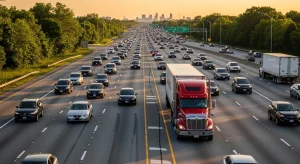
The most profitable routes and the most dangerous routes for truck drivers in the United States handle the nation’s highest freight volumes while also exposing drivers to elevated risks, heavy congestion, extreme weather, and constant pressure on delivery schedules.

Taking your love on the road: how to have a romantic road trip for Valentine’s Day
Whether you’re a truck driver looking to combine work and pleasure, or simply hoping to enjoy a new experience with your partner, here’s what you

Final rule on Non-Domiciled CDLs issued by the Department of Transportation
FMCSA concludes a comprehensive review of regulations applicable to Non-Domiciled CDL holders. After several months, the Federal Motor Carrier Safety Administration (FMCSA) has completed its
Truck drivers and brain fatigue: what happens to the mind after 10 hours behind the wheel
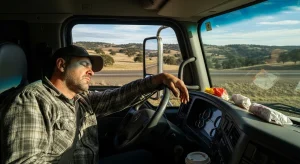
Fatigue in truck drivers, long haul mental health risks and the hidden neurological effects of extended attention, microsleeps and altered time perception.