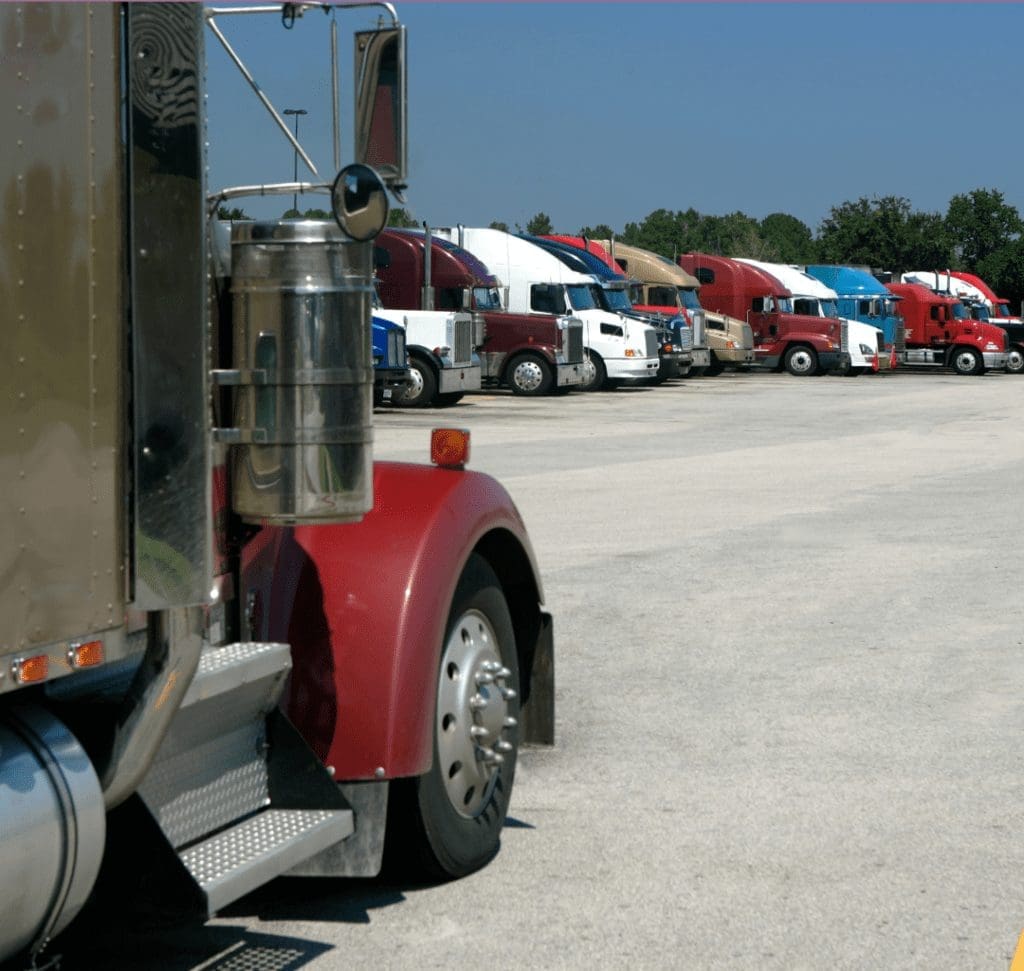
The truck parking problem is costing the trucking industry $100 billion in productivity.
A recent report published by Truck Parking Research reveals a harsh truth about the lack of truck parking: this issue results in an annual loss of $100 billion in productivity.
Although the United States has a total of 23.4 million suitable truck parking spaces, 98% of them are private and not publicly accessible, according to data provided by Truck Parking Research. The figures presented in the report highlight the difficult reality that truck drivers face every day. With more than 2.4 million truckers across the country needing a place to rest daily, options are almost nonexistent, and the losses keep growing.

The numbers behind the truck parking shortage
The report by Truck Parking Research compares the number of official parking spaces to the number of trucks that need to rest daily. The result: 1.7 million drivers, approximately 70% of those on the road are forced to park in unsafe or inappropriate locations, such as road shoulders or unauthorized areas.
“These figures reflect systemic inefficiency,” declared Truck Parking Research. When a truck cannot find an appropriate parking space, the driver doesn’t simply give up, they’re forced to resort to alternatives that come at a high cost. A driver who spends 56 minutes per day just looking for parking loses $105 each day. However, time isn’t the only issue. The study found that, on average, drivers waste:
- 56 minutes per day searching for parking
- 15 extra miles of driving daily
- 2 hours parked in unsuitable locations
- $380 per trucker per day
- $37.7 billion annually in additional miles driven while searching for parking
- Over $82 billion annually in lost productivity due to suboptimal parking locations
On the human side, the cost is equally devastating. The analysis reveals that the stress caused by the search for parking contributes to the industry’s 75% annual driver turnover rate, costing companies an average of $8,200 in recruitment and training per driver.
In addition, the study mentions that 66% of all trucks parked in areas with little or no security are vulnerable to cargo theft, resulting in losses valued at $733 million, adding further financial strain to the industry.

Turning a problem into opportunity: how to address the parking shortage
Despite the challenges this issue poses for the industry, with an average loss of over $100 billion, it also presents an opportunity for innovation and improvement within the transportation sector. Companies that act early, whether they are carriers, landowners, or tech providers, stand to gain significant benefits. For every hour of parking inefficiency eliminated, $109 in productivity is gained, according to the Truck Parking Research study.
Solving this problem also addresses one of the trucking industry’s biggest challenges: attracting and retaining drivers. Providing safe and comfortable parking is not just an operational upgrade, it’s a competitive advantage.

Teton Pass bridge will be closed to traffic for 10 days
Teton Pass is one of the most heavily traveled routes for truck drivers in Wyoming, serving as a vital corridor for the trucking industry. The

Terrifying Experiences of Truck Drivers Sleeping on the Road at Night

Cargo theft numbers drop for the third quarter of 2025
The cargo theft tracking company Verisk CargoNet released its report for the third quarter of 2025. The cargo theft tracking company Verisk CargoNet released its

40 major U.S. airports to see flight reductions due to government shutdown
40 U.S. airports, including those in New York, Los Angeles, and Chicago, will see flight reductions starting November 7 due to the government shutdown. 40

DOT Medical Card: Keeping Medical Certification Up to Date
Keeping your DOT Medical Card current is essential for both drivers and fleet operations.
Brake Safety Week 2025 results: almost 85% of commercial vehicles had no violations
Results of Brake Safety Week, organized jointly by the Commercial Vehicle Safety Alliance (CVSA) and the Department of Transportation, have been published. Results of Brake