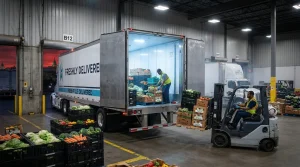
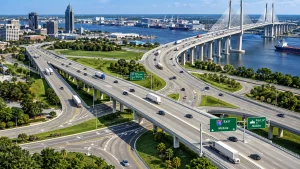
Transportation stocks in the United States have staged a strong rally so far in 2025, reflecting growing market confidence in the real economic activity behind logistics, freight movement, and mobility services more broadly.
This trend is clearly visible in the Dow Jones Transportation Average (DJT), the benchmark index that tracks the most influential companies in the transportation sector. The index has advanced steadily and is now hovering near recent highs, following a year in which many of its components delivered solid returns.
Transportation as an Economic Barometer
The Dow Jones Transportation Average—created in 1884 and made up of 20 stocks spanning ground, air, and logistics companies—is widely regarded by analysts as a leading indicator of the U.S. economy. Originally designed to track railroad performance, the index has evolved to include airlines, freight carriers, and logistics operators that now form the backbone of the physical movement of goods and people across the economy.
In 2025, the DJT has posted a notable performance: the index is up roughly 10% year to date and is approaching levels not seen in several months, breaking through key technical resistance points and signaling renewed investor optimism.
This rally has been led by several key names in the sector. Avis Budget Group, a major player in the car rental segment, has surged more than 60%, while companies such as C.H. Robinson and Uber have posted gains in the 40%–50% range, outperforming both the broader market and the Nasdaq over the same period.

Mixed Signals, but Clear Momentum
The transportation rally is not confined to a small group of standout stocks. Other major operators have also delivered positive results, though with some variation. Old Dominion Freight Line, one of the leading freight carriers in the U.S., has continued its upward trend in recent weeks, posting steady gains that reflect sustained investor interest.
Likewise, iconic companies such as United Parcel Service (UPS) have recorded several consecutive sessions of gains, albeit with more moderate returns compared to other index constituents. This pattern suggests that the momentum is broad-based, though not uniform, and reflects differing operational realities across the transportation ecosystem.
What’s Driving the Rally?
The strong equity performance in the transportation sector stems from a convergence of several factors. On one hand, there is growing expectation of broader economic stability, even amid ongoing global trade tensions and mixed signals about overall growth. In that environment, transportation and logistics are viewed as sectors with relatively resilient demand.
Another key factor is the market’s expectation of interest rate cuts by the Federal Reserve. Lower rates improve financing conditions for capital-intensive businesses such as transportation companies, supporting investment in fleet upgrades, infrastructure, and technology. Cheaper access to credit can significantly enhance both operational capacity and long-term competitiveness.
From a more structural perspective, the parallel strength of industrial and transportation stocks reinforces a positive reading of the economic cycle. Under this framework, the rally in transportation equities can be seen as confirmation of a broader trend toward recovery and market consolidation.
Beyond the Stock Market: What It Means for Real-World Logistics
Rising transportation stocks do not always translate immediately into higher physical freight volumes, but they do have tangible effects on the real economy. Companies with stronger valuations enjoy better access to capital, enabling them to invest in fleet renewal, automation, digitalization, and operational improvements.
A favorable financial market environment also tends to facilitate mergers and acquisitions, which can reshape routes, services, and logistics capacity. Over the medium term, these investments may also support job growth, driving hiring and service expansion across trucking, aviation, and maritime transport.
Risks and Challenges Still Ahead
Despite the positive tone, the sector is not without risks. Ongoing strains in global supply chains, along with potential shifts in trade policy, could weigh on international trade volumes and slow growth in certain transportation segments. At the same time, while digitalization and automation are critical to improving efficiency, they require continuous investment to remain competitive.
Even so, the rally in transportation stocks in 2025 stands out as an encouraging signal for the U.S. economy—and for the logistics industry in particular. While it does not eliminate the structural challenges inherent in moving goods and people, the sector’s strong market performance points to renewed investor confidence that could translate into greater investment, innovation, and real momentum for logistics activity in the coming quarters.

Trucking in Alaska and Hawaii: How America’s Non‑Contiguous States Break the Mold
When you step outside the contiguous U.S. and look at Alaska and Hawaii, the trucking industry becomes a very different story

FMCSA updates its coercion rule for drivers facing HOS and ELD pressure
The FMCSA’s updated guidance explains that the “coercion rule” is intended to protect commercial motor vehicle drivers.

New York Can Suspend Driver’s Licenses Over Tax Debt
New York has once again put the spotlight on driver’s license suspensions tied to unpaid state taxes, a situation that could affect thousands of transportation, delivery, and logistics workers who depend on driving to earn a living. For commercial drivers and CDL operators, the consequences can go far beyond a simple fine.

What you need to know about CVSA’s International Roadcheck 2026
The first annual inspection, as every year, kicks off with the International Roadcheck, also known as DOT Blitz Week. Here’s what you need to know.

Tariff Shock: Why U.S. Freight Demand Is Suddenly Surging
Companies are cutting inventories to avoid rising tariff-related and storage costs, forcing goods to move faster and in smaller batches. The unexpected result: stronger trucking demand

Bot Auto completes its first driverless commercial highway shipment
Bot Auto has completed its first long-distance commercial shipment without a driver in the cab or a remote operator.