 Hable con un agente al (888) 572-7520
  Enviar mensaje a un agente

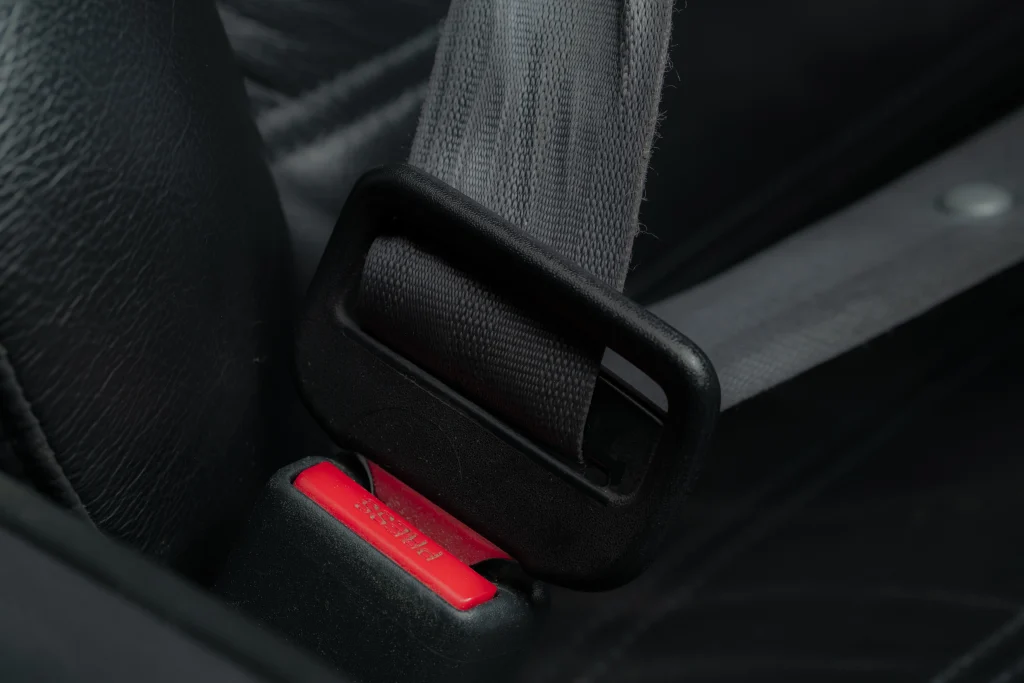

Seat belts are an integral part of every vehicle. Designed to protect passengers, they reduce the risk of fatalities in car crashes by 45%, according to the National Highway Traffic Safety Administration (NHTSA). However, this figure has not always been the same.
Seat belt use in the United States has increased significantly over time, rising from about 75% in 2002 to nearly 92% in 2023, according to NHTSA data. Over the past century, the seat belt has evolved from a niche concept into an essential and ubiquitous component of road safety.
Despite the automotive innovations we have seen in recent years, seat belts continue to use the same basic formula. Why does a Tesla have the same seat belt design as a 2008 Ford Taurus?
Why Has the Seat Belt Design Not Changed?
When automobiles were first invented and began traveling on roads, safety measures were virtually nonexistent. It was not until 1959 that Nils Bohlin, a Swedish engineer working for Volvo, developed the iconic three-point seat belt. The revolutionary system quickly became the global standard thanks to its simplicity and effectiveness.
Volvo chose to make the patent for the three-point seat belt available to the entire automotive industry, allowing any manufacturer to incorporate the technology to save lives. The company believed that the benefits to society far outweighed any potential financial gain. Since then, the physical principles that make the seat belt effective have remained unchanged:
- It distributes crash forces across the strongest parts of the body (the pelvis, chest, and shoulders).
- It prevents occupants from being ejected from the vehicle.
- It keeps passengers in the correct position for airbags to function properly.
- It is relatively inexpensive, lightweight, and reliable.
As a result, the basic design of the modern seat belt continues to solve the problem it was created to address. This is why virtually all vehicles still use this design despite major technological advancements. What has changed, however, is everything that works behind the scenes.

Thanks to advances in technology, many modern vehicles now include features such as:
- Pyrotechnic pretensioners: tighten the belt within milliseconds when a collision is detected.
- Load limiters: allow a small, controlled release of belt tension to reduce chest injuries.
- Automatic adjustments: some vehicles adapt belt tension based on the occupant’s weight or seating position.
- Inflatable seat belts: available in certain models to better distribute crash forces.
- Electronic reminders and monitoring systems: detect whether the seat belt is fastened and how the occupant is seated.
Experts consider the three-point seat belt to be one of the most successful safety innovations in automotive history, which is why it has never been replaced by a completely different design.
Why Don’t People Wear Seat Belts?
Despite the effectiveness of the design, approximately one in ten vehicle occupants still travels without wearing a seat belt. Many of those who do not wear seat belts mistakenly believe that restraint systems are unnecessary on short trips.
NHTSA survey data show the groups most likely to forgo seat belt use:
- About 85% of male drivers reported always wearing a seat belt, compared with 92% of female drivers.
- Only 80% of drivers aged 21 to 24 said they always buckle up.
- Just 79% of pickup truck drivers reported consistent seat belt use.
- Eighty percent of rural drivers said they always wore a seat belt, compared with 90% of urban drivers.
Although seat belt use stands at approximately 92%, the remaining 8% still do not consistently buckle up. Among the most common reasons passengers and drivers fail to use seat belts correctly are:
Overconfidence Behind the Wheel
Many drivers place excessive confidence in their driving abilities and therefore believe they are less likely to be involved in a crash.
Primary vs. Secondary Enforcement Laws
Seat belt laws vary from state to state. In some states, police officers can stop drivers solely for not wearing a seat belt, while in others they cannot.
Discomfort and Forgetfulness
People with larger body types may experience discomfort from the lap belt pressing against the abdomen. Pregnant women often report even greater discomfort because of the pressure on the stomach, along with concerns about their baby’s safety. Studies have found that the primary reasons pregnant women do not wear seat belts correctly are discomfort, forgetfulness, and fears about harming the baby.
However, safety should take precedence over comfort. Although its design was developed nearly 70 years ago, the seat belt has not been replaced because it continues to perform its primary function effectively: protecting vehicle occupants. It remains a fundamental safety device that significantly reduces the risk of injury in a crash and should be used by everyone, without exception.
 Business hours: Monday to Friday from 8:00 AM to 5:00 PM. California time