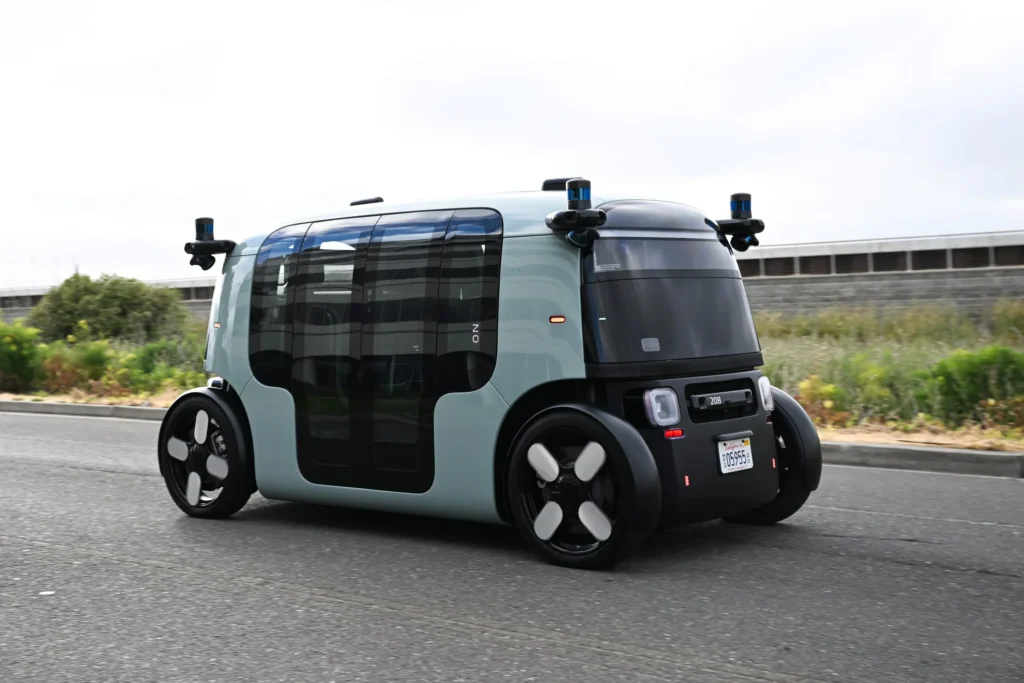
The United States has approved, for the first time, the public operation of autonomous vehicles fully designed and manufactured domestically. Zoox, an Amazon-owned company, became the first to benefit from a safety exemption that will allow real-world testing of its innovative, steering wheel– and pedal–free model, marking a milestone for the industry.
In a landmark decision for the future of mobility in the U.S., the National Highway Traffic Safety Administration (NHTSA) announced it has granted a safety exemption to Zoox, allowing the company to begin public road testing of its fully autonomous vehicle fleet. This is the first time such an exemption has been awarded to an American-built vehicle under the newly expanded Automated Vehicle Exemption Program.
The move was made possible through the Innovation Agenda led by U.S. Secretary of Transportation Sean P. Duffy, who has prioritized the advancement of next-generation technologies to modernize transportation infrastructure, strengthen domestic competitiveness, and position the U.S. as a global leader in smart mobility.
What does the exemption allow?
NHTSA has the authority to grant temporary exemptions to vehicle manufacturers wishing to test innovative technologies that don’t fully comply with current Federal Motor Vehicle Safety Standards (FMVSS). In this case, the exemption allows Zoox to test a completely autonomous vehicle—one that has no steering wheel, no pedals, and no traditional driver’s seat—on public roads.
Unlike many autonomous prototypes built on modified conventional cars, Zoox’s vehicle was purpose-built from the ground up to operate without a human driver. It is fully electric, bidirectional, and symmetrical, optimized for tight urban environments and shared mobility use cases.
Why is this decision significant?
Until now, NHTSA exemptions had primarily been granted to foreign automakers or U.S. companies adapting traditional vehicles with self-driving systems. This approval for Zoox signals a shift in policy direction, favoring domestically developed and manufactured autonomous technology.
The decision also carries geopolitical and economic weight. As global competition in artificial intelligence, electrification, and automation intensifies—especially from China and Europe—the U.S. government is working to reclaim technological leadership and reduce reliance on foreign platforms.
“The future of transportation should be built in America, with American technology, American jobs, and benefits for American communities,” said a spokesperson from the U.S. Department of Transportation. “This exemption represents a bold step toward a safer, more competitive, and more innovative national industry.”

A new regulatory approach to innovation
This exemption is part of a broader effort to redefine the government’s role in fostering innovation, without compromising its responsibility to protect public safety. The revamped Automated Vehicle Exemption Program provides a clear regulatory pathway for companies working on disruptive mobility solutions.
To qualify, companies must meet strict criteria, including:
Demonstrating safety performance equivalent to or greater than conventional vehicles
Submitting robust risk management plans
Disclosing testing protocols and emergency procedures
Sharing performance data with regulators
The goal is to ensure that testing in real-world environments does not endanger passengers, pedestrians, or other road users, while still enabling innovation to flourish.
What’s next for Zoox?
With the exemption granted, Zoox will begin operating its vehicles in authorized public areas, starting with select cities in California and Nevada, where it has already conducted extensive closed-course testing.
The company emphasized that the focus is on demonstration and data collection, not immediate commercialization. The results of these trials will inform future expansion, regulatory refinement, and potentially, nationwide deployment.
A road to the future, made in the U.S.A.
NHTSA’s decision marks a turning point in the history of American transportation. It not only opens the door for fully autonomous vehicles designed and built in the U.S. but also signals a strategic embrace of innovation as industrial policy.
In a time of rapid technological disruption, federal support for companies like Zoox shows that America intends not just to participate in the future of mobility—but to lead it, on its own terms. This exemption is only the beginning of that journey.

Teton Pass bridge will be closed to traffic for 10 days
Teton Pass is one of the most heavily traveled routes for truck drivers in Wyoming, serving as a vital corridor for the trucking industry. The

Terrifying Experiences of Truck Drivers Sleeping on the Road at Night

Cargo theft numbers drop for the third quarter of 2025
The cargo theft tracking company Verisk CargoNet released its report for the third quarter of 2025. The cargo theft tracking company Verisk CargoNet released its

40 major U.S. airports to see flight reductions due to government shutdown
40 U.S. airports, including those in New York, Los Angeles, and Chicago, will see flight reductions starting November 7 due to the government shutdown. 40

DOT Medical Card: Keeping Medical Certification Up to Date
Keeping your DOT Medical Card current is essential for both drivers and fleet operations.
Brake Safety Week 2025 results: almost 85% of commercial vehicles had no violations
Results of Brake Safety Week, organized jointly by the Commercial Vehicle Safety Alliance (CVSA) and the Department of Transportation, have been published. Results of Brake