TikTok users in the United States are encountering a surge of videos from Chinese influencers encouraging American consumers to bypass former President Donald Trump’s tariffs by purchasing directly from China, often referred to as “the world’s factory.”
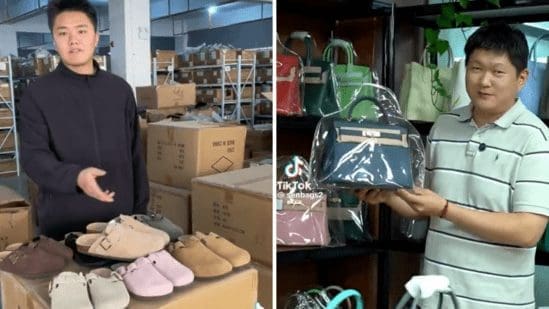
These influencers, frequently filming inside Chinese factories that claim to supply major U.S. brands like Lululemon Athletica Inc. and Nike Inc., aim to showcase how many consumer goods are produced in China. They often provide website links and contact information, enabling viewers to buy directly from manufacturers. “Why not contact us and buy directly? You won’t believe the prices we can offer!” one influencer exclaims.
In a notable video, TikTok creator @LunaSourcingChina stands outside a factory she asserts produces Lululemon-style yoga leggings for $5 to $6, contrasting with the over $100 price tags in U.S. stores. “The materials and labor are basically the same,” she claims.

Millions of views
A Lululemon spokesperson responded, stating that only about 3% of its finished products are made in mainland China and that authentic items are sold exclusively through Lululemon stores, official websites, and authorized retail partners.
Some of these videos, uploaded in March but recently gaining traction, have amassed millions of views. One titled “China exposes the truth” has garnered 8.3 million views and 492,000 likes as of Monday morning in New York. Another revealing Lululemon’s alleged Chinese supplier has 2.6 million views, while a clip titled “How to bypass tariffs” approaches 1 million views and 118,000 likes.
The proliferation of such content appears to be a grassroots response to Trump’s latest round of tariffs, including a 145% levy on Chinese goods. While it’s unclear how direct purchases from Chinese suppliers would allow Americans to avoid import taxes—especially since duty exemptions on small packages shipped to U.S. households are set to end on May 2—the videos reflect global backlash to Trump’s trade policies and the White House’s narrative that tariffs benefit American consumers.
@wangsen9998 Chinese manufacturing going to the US can make American people live better, not take away their jobs#senbag ♬ 原创音乐 - Wang Sen
TikTok’s powerful algorithm
The influx of these posts also underscores the growing ability of Chinese creators to reach into the daily lives of ordinary Americans.
TikTok’s powerful algorithm, which curates content for millions of users, is a key reason why U.S. lawmakers are pushing to compel its Chinese parent company, ByteDance Ltd., to divest its international operations. TikTok did not immediately respond to a request for comment.
Other Chinese social media platforms, like Xiaohongshu (also known as Red Note), are also gaining popularity among younger Americans amid uncertainty over TikTok’s future.
“These videos are much more confrontational and mocking toward the U.S., rather than portraying it as a threat,” said Tom Harper, a China international relations professor at the University of East London. Harper added that the trend follows a wave of AI-generated images depicting Americans working on factory assembly lines.
Some clips directly criticize U.S. trade policies and urge Americans to take action. “For decades, your government and oligarchs have shipped your jobs to China—not for diplomacy or peace, but to exploit cheap labor, destroy your middle class, crush your working class, and then tell you to be proud while they sell your future for profit,” says user @neil778027 in one video. “Americans, you don’t need a tariff—you need a revolution.”
Last Friday, the U.S. announced tariff exemptions for a range of Chinese goods, including electronics, computers, and semiconductors, though the duration of these exemptions remains unclear. In any case, they don’t apply to most of the products featured in the TikTok videos, such as clothing and accessories made by Chinese suppliers.
Some videos also showcase high-end European luxury brands, although it’s unclear why those brands are included in content critical of U.S. policy.
Another key question raised by the videos is whether these factories have confidentiality agreements with their international clients—and how this wave of exposure might impact long-standing business relationships between global brands and their suppliers.
Cameron Johnson, a senior partner at Shanghai-based consultancy Tidalwave Solutions, who recently visited China’s manufacturing hub in Yiwu, sees this as part of a broader shift in global sourcing practices. “In the past, you’d go through a middleman or trading company to source goods, conduct quality control, maybe visit the factory occasionally and build a relationship,” he told Bloomberg TV. “But now, we’re seeing a complete democratization of product sourcing.”

Truck drivers are at high risk of developing diabetes
About 11% of the adult population meets the criteria for prediabetes, and there is a particular group at high risk: truck drivers. Diabetes rates in

Starting in trucking: required permits, registrations, and compliance
Are you a new carrier? This is what you need to know about permits, registration, and compliance. The trucking industry can be quite challenging for

Alberta Clipper Brings an Early Polar Blast: A Critical Alert for Drivers
The Alberta Clipper is sweeping across the country with fast-moving Arctic air, sharp temperature drops, and dangerous road conditions that demand heightened attention from all professional drivers.

American manufacturers trigger truck “dumping” investigation
Foreign trailer manufacturers under investigation for alleged “dumping” in the U.S. The U.S. truck market is at the center of a trade dispute. After domestic

ATRI Warns: Litigation Is Rising Across the U.S. Trucking Industry
A new report from the American Transportation Research Institute (ATRI) reveals how escalating litigation, higher legal costs, and mounting insurance pressures are reshaping the U.S. trucking industry. The findings mark a critical moment for motor carriers, insurers, and logistics stakeholders who must understand the changing legal environment — and the increasingly strategic role of strong insurance partnerships.

FMCSA says no to hours-of-service exemptions
FMCSA rejects two requests for exemptions to hours-of-service rules for commercial drivers. The Federal Motor Carrier Safety Administration (FMCSA) has denied two exemption requests related