A long-delayed border infrastructure initiative in Southern California is finally moving ahead with fresh federal funding. The $150 million grant will fund a new Port of Entry at Otay Mesa, aiming to relieve freight bottlenecks and bolster border security.
The U.S. Department of Transportation has approved a major grant of $150 million to advance a border infrastructure project in the Otay Mesa region near San Diego. The funding will support the development of a new Port of Entry and a connecting roadway, enhancing trade efficiency and security along the U.S.–Mexico border.
This strategic initiative is designed to both strengthen national border controls and accelerate the flow of commercial goods between Southern California and Baja California. It’s a key step forward for a project originally awarded funding in 2022 but delayed due to a federal backlog.
Focus Shifts to Core Security and Transportation Needs
As part of finalizing the agreement, certain components initially tied to environmental sustainability—such as plans for electric vehicle charging stations—have been removed. Officials explained that the revised scope reflects a focus on transportation efficiency and national security priorities rather than broader environmental goals.
These adjustments align with evolving federal policy, where infrastructure funds are being redirected to meet the most pressing logistical and security needs.
“Thanks to the prior administration’s lack of focus, this critical project sat in limbo for two years. No more. We moved to finalize this deal so we can help protect our Southern border and crack down on drug trafficking while preventing tax dollars subsidizing pointless Green New Deal priorities,” said U.S. Transportation Secretary Sean P. Duffy. “This department will continue to clear the previous administration’s unprecedented grants backlog and deliver results.”
Clearing the Backlog to Restart Infrastructure Progress
Though the project secured its original grant through the INFRA (Infrastructure for Rebuilding America) program two years ago, the funds remained in limbo. The Department of Transportation cited an administrative backlog affecting thousands of approved projects nationwide under the Biden administration.
Transportation Secretary Sean P. Duffy confirmed efforts are underway to resolve the bottleneck and expedite critical infrastructure projects like this one.

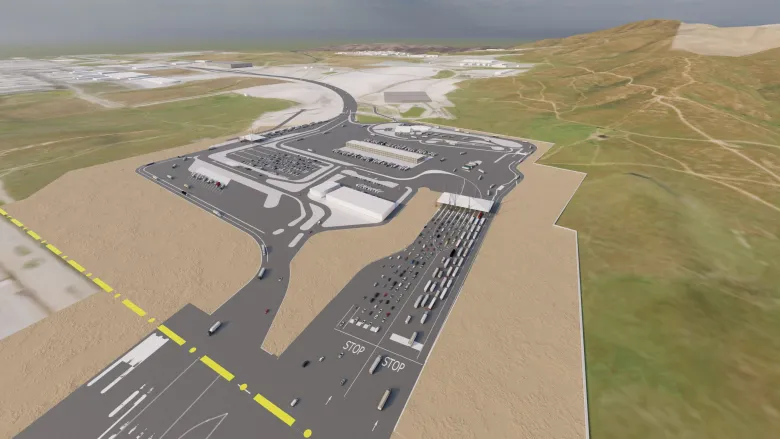
A draft rendering of the Otay Mesa East Port of Entry.
Relieving Freight Congestion at the Border
The new Otay Mesa East Port of Entry will be constructed east of the existing facility, which currently operates at full capacity. The crossing processes around 3,600 commercial trucks daily—shared between Otay Mesa and Tecate—leading to regular delays.
The project will introduce advanced inspection technologies for U.S. Customs and Border Protection, along with a Commercial Vehicle Enforcement Facility. Intelligent traffic systems and dynamic tolling will also be deployed to better manage truck flow and reduce waiting times.
Improving Conditions for Truckers and Trade
Truck drivers operating between Mexico and the U.S. stand to benefit significantly. With a new route available, wait times are expected to decrease, and delivery timelines may become more predictable. Freight operators could also see improved logistics planning due to the use of smart transportation tools.
Additionally, the infrastructure will provide more reliable access for goods traveling from Mexican manufacturers to key U.S. trade hubs, including the Ports of Los Angeles and Long Beach and inland centers like Riverside and San Bernardino.
New Technology to Enhance Inspection Capabilities
The facility will feature upgraded scanning and detection equipment aimed at streamlining inspections without compromising security. While specifics of the technology have not yet been released, officials say the improvements are meant to catch illicit cargo more effectively while keeping freight moving.
Supporting Trade Growth and National Priorities
Otay Mesa plays a crucial role in North American trade. The expansion is seen as essential to supporting growing cross-border commerce and maintaining supply chain resilience.
This latest grant reaffirms the federal government’s commitment to strengthening trade infrastructure while addressing national security. By trimming non-core components, officials say the focus remains on delivering practical benefits where they matter most—at the intersection of commerce and security.

The best roadside attractions for truckers in the U.S.
America’s highways hide unique places that break up the routine, don’t hesitate to check out these roadside attractions along the way. The road is much

The trucker style: comfort, function, and identity
Truckers’ style is much more than workwear; it’s an identity. These are the most commonly worn garments among truckers. Truckers’ style is much more than

Chaos on Highway 61: Viral Wrong-Way Truck Video Reignites the CDL Debate
An 80-ton tractor-trailer traveling miles in the wrong direction on Missouri’s Highway 61 has reignited a nationwide debate over Commercial Driver’s License (CDL) standards, training

How technology affects driver retention
Friend or foe? 52% of drivers say technology directly influences their decision to stay with or leave a fleet. Fleet telematics company Platform Science published

Dalilah Law seeks to remove non-english speaking commercial drivers
President Donald Trump proposed the “Dalilah Law,” an initiative aimed at prohibiting undocumented immigrants from obtaining commercial driver’s licenses. On February 24, President Donald Trump

FORMULA 1 and the AI That Could Transform Transportation in the U.S.
The artificial intelligence system that Formula 1 implemented to monitor every car on every turn is opening the door to new applications in trucking, logistics,