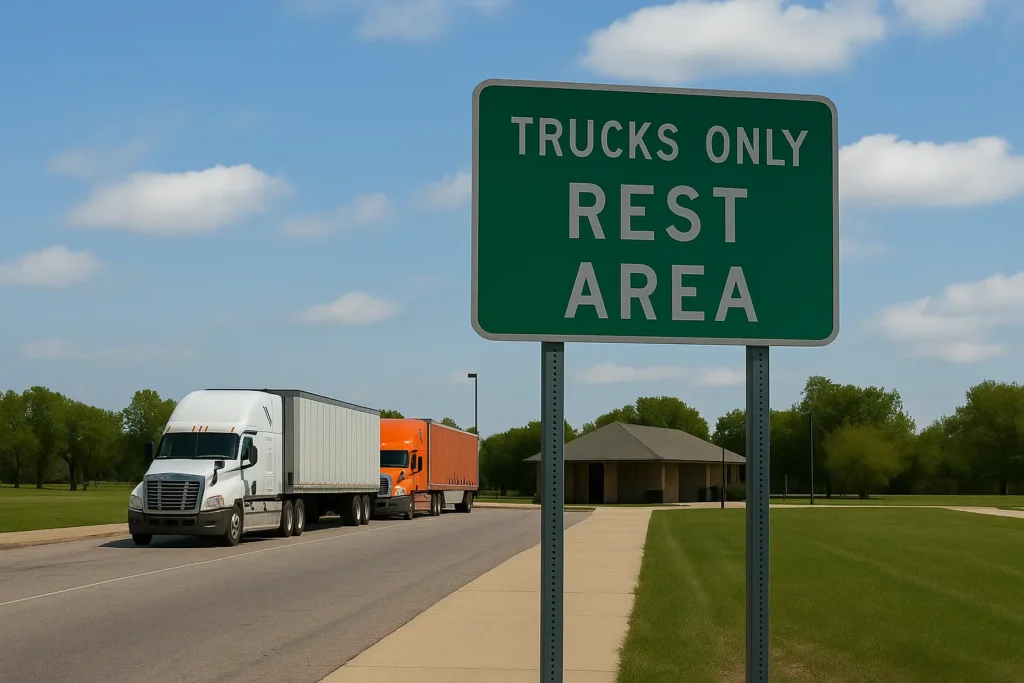
With federal funding and legislative support, the U.S. government is pushing forward with the construction and modernization of truck rest areas nationwide. More than 3,000 new parking spots are expected to be available by the end of 2025.
In response to one of the most urgent demands of the freight transportation sector, the U.S. government is moving ahead with the expansion and modernization of truck stops and rest areas across the country.
The project, backed by the Truck Parking Expansion Act and funded through the Infrastructure Investment and Jobs Act (IIJA), aims to improve the safety, well-being, and efficiency of professional drivers.

A Critical Need
According to the American Trucking Associations (ATA), over 98% of truckers have had to continue driving past their legal hours because they couldn’t find a safe place to park.
This situation not only increases the risk of accidents but also leads to fatigue, stress, and penalties for violating rest regulations.
“It’s a national crisis. We’re not just talking about comfort—this is about road safety and mental health for the people keeping our economy running,” said a spokesperson from OOIDA (Owner-Operator Independent Drivers Association).

What the Plan Includes
The Truck Parking Expansion Act, passed in committee in 2023 with funds allocated starting in 2024, is already being implemented in at least 17 states, including Texas, Florida, Illinois, North Carolina, and California. The plan includes:
Construction of new rest areas with truck-only parking
Expansion of existing stops, including lighting, restrooms, signage, and security cameras
Installation of electric charging stations, anticipating the future electrification of freight transport
Development of real-time availability apps so drivers can plan stops in advance
States Under Construction
Here are some of the projects already underway:
Texas: Expansion of rest areas along I-10 and I-35, with over 500 new parking spaces planned
Florida: Upgrades along the I-75 corridor, especially in the southern part of the state
Illinois: Construction of a mega rest area on I-80 with 120 spaces, showers, and free Wi-Fi
In total, more than 3,000 new truck parking spaces are expected to be available before the end of 2025.
Funding and the Road Ahead
The federal budget commitment totals $755 million through 2027, with a combination of funding from the Department of Transportation (DOT), state governments, and private associations.
In the long term, the plan envisions a nationwide network of smart and safe rest areas, as part of the government’s broader commitment to road safety and logistics infrastructure.
With this expansion, the U.S. aims not only to reduce fatigue-related accidents, but also to dignify the essential work of thousands of truckers who keep the nation supplied and moving.

FORMULA 1 and the AI That Could Transform Transportation in the U.S.
The artificial intelligence system that Formula 1 implemented to monitor every car on every turn is opening the door to new applications in trucking, logistics,

$170 billion at stake: 1,500 companies demand tariff refunds
Companies have challenged the global tariffs imposed by President Donald Trump, asking federal courts to reactivate proceedings to begin the refund process. The companies that

In brief: enforcement measures target speeding, CDL training gaps and more
Major enforcement actions across the U.S., including speeding, CDL fraud, and chain violations Colorado launches Speed Enforcement Program The Colorado Department of Transportation (CDOT) has

Chinese Vehicles Raise Espionage and Remote Sabotage Concerns
Investigations into Chinese technology in connected vehicles warn of espionage risks, massive data transmission, and potential remote access vulnerabilities that concern U.S. transportation and security

Between the Court and the Fed: the market redefines its roadmap for 2026
Trade policy in limbo as markets price in 2026 rate cuts and Supreme Court strikes down Trump tariff plan. In the latest episode of the

New 10% U.S. import tariff takes effect amid legal and market uncertainty
The implementation of these new tariffs has generated global uncertainty among exporters, increasing confusion around U.S. trade policy. The United States has implemented a new