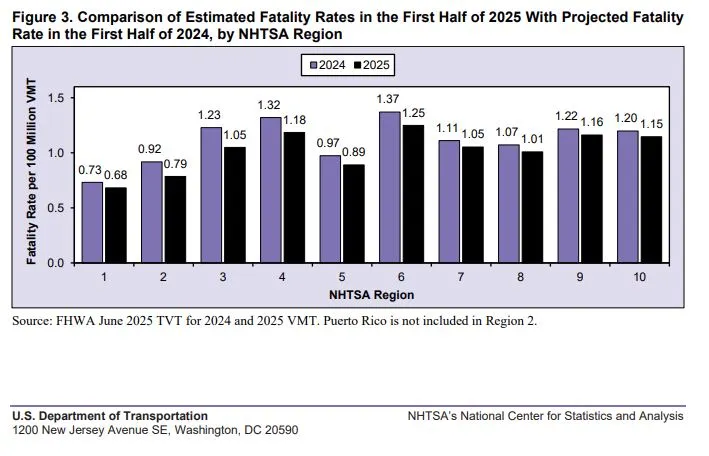
The NHTSA Road Safety Data Report reveals a decrease in traffic accident deaths in the United States.
The Highway Safety Facts report from the National Highway Traffic Safety Administration (NHTSA), published in September, shows that traffic accident fatalities in the United States have decreased, indicating that highways are becoming less deadly and drivers are increasingly adhering to traffic laws.
According to the report, NHTSA estimates a significant 8.2% decrease in highway fatalities nationwide during the first half of 2025. This means that traffic accident fatalities dropped to 17,140 people as of June 2025, compared to 18,680 deaths during the same period in 2024.
Peter Simshauser, NHTSA’s Chief Counsel, stated that these preliminary figures are encouraging and reflect a collective effort to improve road safety across the United States. “But while we’re seeing progress, the numbers are still too high, and we remain focused on further reducing traffic fatalities,” Simshauser warned.

Traffic accident fatalities reduction: states with the highest and lowest percentage changes
The decline in fatalities occurred despite an increase of 12.1 billion vehicle miles traveled in the first half of 2025. As a result, the fatality rate per 100 million vehicle miles traveled dropped to 1.06, a decrease of 8.6%. This marks the lowest mid-year fatality rate since 2014.
Additionally, an estimated 38 states, along with the District of Columbia and Puerto Rico, saw decreases in traffic fatalities. Only 11 states are expected to show increases, while one state will remain unchanged.
The states with the largest percentage decreases compared to 2024 were:
- Connecticut: -32.5%
- Delaware: -26.6%
- Mississippi: -25.7%
- Maryland: -23.5%
- Kentucky: -21.8%
In contrast, the following states saw the highest increases in recorded fatalities:
- Hawaii: +47.8%
- Kansas: +21.2%
- Idaho: +18.6%
- Massachusetts: +15.1%
- Wyoming: +10.2%
However, despite these being the states with the highest percentage increases, none of them rank among those with the highest total number of fatalities. California, Florida, and Texas continue to report the most traffic accident fatalities to date, with 1,783, 1,538, and 1,851 fatalities respectively, due to motor vehicle accidents.

Downward trend
In its report, NHTSA noted that during the COVID-19 pandemic in 2020, both the number of deaths and the fatality rate per 100 million vehicle miles traveled (VMT) increased significantly, a trend that continued throughout 2021 and into the first quarter of 2022. However, since then, there have been 13 consecutive quarterly declines in the number of traffic deaths.

$170 billion at stake: 1,500 companies demand tariff refunds
Companies have challenged the global tariffs imposed by President Donald Trump, asking federal courts to reactivate proceedings to begin the refund process. The companies that

In brief: enforcement measures target speeding, CDL training gaps and more
Major enforcement actions across the U.S., including speeding, CDL fraud, and chain violations Colorado launches Speed Enforcement Program The Colorado Department of Transportation (CDOT) has

Chinese Vehicles Raise Espionage and Remote Sabotage Concerns
Investigations into Chinese technology in connected vehicles warn of espionage risks, massive data transmission, and potential remote access vulnerabilities that concern U.S. transportation and security

Between the Court and the Fed: the market redefines its roadmap for 2026
Trade policy in limbo as markets price in 2026 rate cuts and Supreme Court strikes down Trump tariff plan. In the latest episode of the

New 10% U.S. import tariff takes effect amid legal and market uncertainty
The implementation of these new tariffs has generated global uncertainty among exporters, increasing confusion around U.S. trade policy. The United States has implemented a new

Military Trucks That Moved a Base in Syria
Convoys of advanced HEMTT and PLS military trucks carried armored vehicles, prefabricated base structures, mobile workshops and heavy equipment during the U.S. withdrawal from northeastern