Llame al (888) 572-7520 para hablar con un agente

The truck transport of live animals for research came under scrutiny after a rollover in Mississippi led to escaped monkeys and public concern. The case highlights the need for stronger safety planning and communication in sensitive cargo logistics.

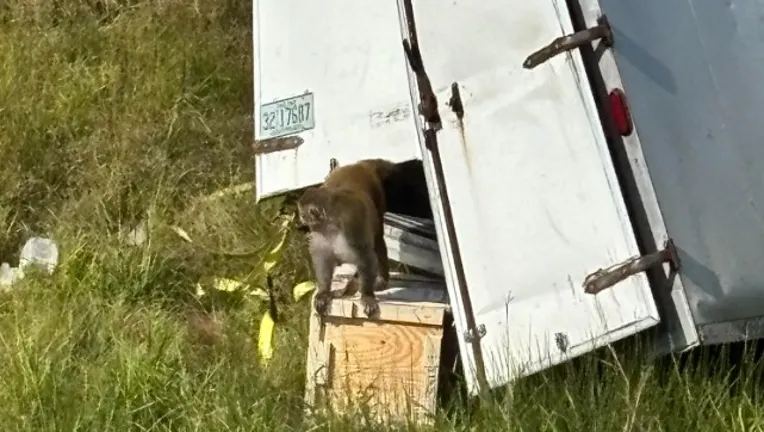
The transport of live animals for research requires strict safety standards, clear communication, and well-defined emergency response procedures. The recent incident in Mississippi—where a truck overturned and several rhesus monkeys escaped—has drawn national attention and raised critical questions about how sensitive cargo is handled on American highways. For the trucking and logistics sector, the case serves as a high-stakes reminder: when hauling specialized biological cargo, preparation is everything.

What Happened on the Highway in Mississippi

The incident occurred on Interstate 59, near Heidelberg, Mississippi. The truck was transporting 21 rhesus macaques to a research facility when it overturned. Most of the monkeys were killed in the crash, but several escaped into the surrounding area. In the days that followed, local residents reported sightings. The situation escalated when a homeowner shot and killed one of the escaped monkeys, saying she feared for her children after hearing that the animals might carry diseases.

Confusion quickly grew because the information shared publicly in the immediate aftermath of the crash was not accurate or coordinated. Initial statements suggested that the monkeys could pose health risks. Later, the research institution clarified that the animals had recently undergone pathogen screening and were not infectious. The conflicting messages led to public fear, frustration, and avoidable escalation.

This communication gap is one of the clearest lessons from the event.

Why This Type of Transport Is Highly Regulated

The transport of live animals for research falls under multiple layers of U.S. regulation. Agencies involved include:

  • The U.S. Department of Agriculture (USDA) under the Animal Welfare Act

  • The U.S. Department of Transportation (DOT) for commercial transport safety

  • The U.S. Fish and Wildlife Service, overseeing species trade and compliance

  • The Centers for Disease Control and Prevention (CDC) if there is any zoonotic risk

These regulations govern everything from the type of crate and locking systems used, to vehicle climate control, to the documentation certifying the animal’s health and destination. Rhesus macaques, in particular, are tightly controlled because they are used extensively in medical research and can exhibit high stress responses if transported improperly.

Yet regulation alone does not prevent failure. Consistent training, oversight, and contingency planning are just as critical.

When an Accident Happens: Communication Matters as Much as Containment

Accidents are not always preventable—but response is. Standard emergency procedures for the escape of research animals include:

  1. Establishing a clear safety perimeter

  2. Notifying local law enforcement and state wildlife authorities

  3. Alerting specialized veterinary capture teams

  4. Communicating accurate, science-based information to the public

In Mississippi, however, the messaging was disorganized and overly vague. Without clarity, rumors filled the space that official guidance should have occupied. The result was heightened anxiety, distrust, and, ultimately, an avoidable fatal action by a member of the community.

A strong emergency plan must include not just containment, but communication—quick, calm, and factual.

The Driver’s Role: More Than Vehicle Operation

This incident also highlights the often-overlooked importance of driver training specific to sensitive cargo. Drivers transporting research animals must:

  • Understand the animals’ stress behavior

  • Know how to secure containment equipment

  • Follow chain-of-custody documentation

  • Be trained in public communication under stress

The first narrative that reaches the public after an accident often comes from the driver. A single off-hand remark can be enough to trigger panic. Professional training must therefore include how to describe the situation accurately, briefly, and safely.

Industry Takeaway: Precision Is Not Optional

The transport of live animals for research is not a routine freight assignment. It demands:

  • Consistent equipment inspection

  • Scenario-based emergency planning

  • Inter-agency communication protocols

  • Specialized driver preparation

  • A unified public-facing communication strategy

The Mississippi case did not draw attention because of sensational circumstances—it drew attention because a procedural breakdown created avoidable risk.

For the trucking and logistics sector, the message is clear:

When transporting sensitive cargo, safety is not only physical.
Safety is operational. Safety is informational. Safety is shared responsibility.

And when any one of those components fails, the consequences move far beyond the highway.

Truck driver: stop choosing the worst route

Facebook
Twitter
LinkedIn

ATRI Warns: Litigation Is Rising Across the U.S. Trucking Industry

A new report from the American Transportation Research Institute (ATRI) reveals how escalating litigation, higher legal costs, and mounting insurance pressures are reshaping the U.S. trucking industry. The findings mark a critical moment for motor carriers, insurers, and logistics stakeholders who must understand the changing legal environment — and the increasingly strategic role of strong insurance partnerships.

Read More »

Leave a Reply

Your email address will not be published. Required fields are marked *

Business hours: Monday to Friday from 8:00 AM to 5:00 PM. California time
Leave your number and a member of our company will contact you
Horario de atención: Lunes a viernes de 8.00 AM a 5.00 PM. Hora california

Deje su número y un miembro de nuestra empresa se pondrá en contacto con usted

Privacy summary

This website uses cookies so that we can offer you the best possible user experience. Cookie information is stored in your browser and performs functions such as recognizing you when you return to our website or helping our team understand which sections of the website you find most interesting and useful.

More information about the privacy policy: Privacy Policy

More information about the terms of use: Terms of use 

More information about the disclaimer: Disclaimer 

More information on acceptable use policies: Acceptable Use Policies