A new study analyzed the relationship between traffic accidents and drivers who violate the English Language Proficiency (ELP) regulation.
A new study analyzed the relationship between traffic accidents and drivers who violate the English Language Proficiency (ELP) regulation, demonstrating that noncompliance with ELP requirements is associated with higher accident rates on U.S. highways.
The study, co-authored by Alex Scott, Associate Professor of Supply Chain Management at the University of Tennessee in Knoxville, highlights the need to assess whether truck drivers who violate ELP standards are indeed less safe than other drivers, as well as to examine the role of the transportation companies that employ them. The goal is to develop policies that help improve safety in the trucking industry.
Scott conducted the analysis using data from the Federal Motor Carrier Safety Administration (FMCSA) through its BASIC scoring system. The study period covered May 1 to September 21, 2025, using violation codes related to ELP compliance to identify accidents connected to this regulation. From this process, Scott identified several trends linking traffic accidents with noncompliance with the ELP rule.
Rising ELP violations: statistics and trends
Following the executive order issued by President Trump in April, data show a steady increase in the enforcement of ELP regulations during June and July. According to the analysis, the peak increase reached approximately 6,000 violations per month. With around 200,000 non-domiciled CDL holders, enforcement measures have become increasingly strict.
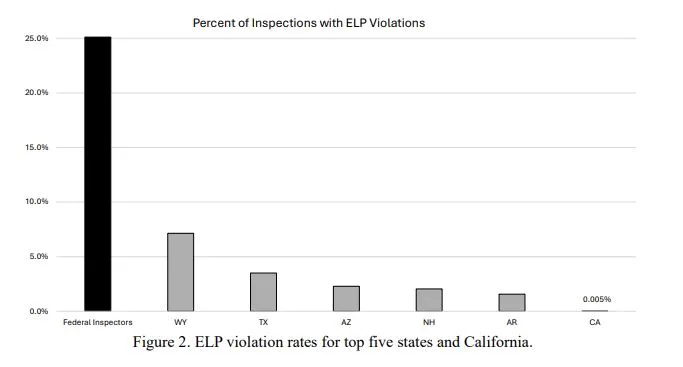
The study also found significant differences in ELP violation rates between individual states and federal data. At the federal level, violations were 3.5 times higher than those recorded in Wyoming, the state with the highest rate. The states with the highest ELP violation rates were Wyoming, Texas, and Arizona.
In addition to the number of violations, the analysis examined the safety ratings of carriers with ELP violations, which were on average lower than those of carriers without such violations.
The average FMCSA BASIC score in the Vehicle Maintenance category for carriers with ELP violations was 9.06, while in the Unsafe Driving category it was 6.23. The study noted that these elevated values indicate poor safety performance.
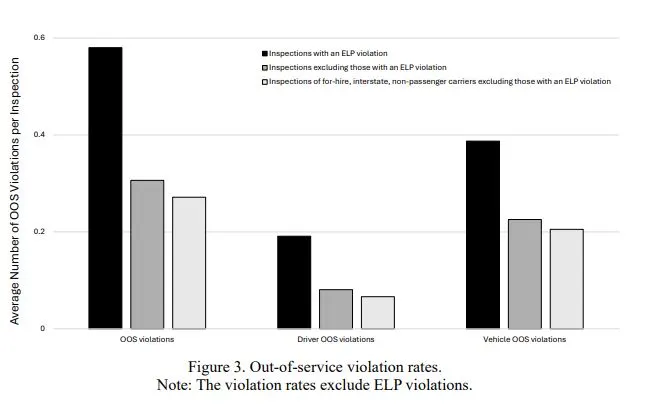
Furthermore, inspections involving ELP violations showed a higher number of additional violations compared to inspections without ELP infractions. Inspections with an ELP violation averaged 3.9 additional violations, compared to 1.69 violations for those without ELP issues, 2.3 to 1 ratio, according to the study. This gap widened when considering only interstate freight carriers. In addition, inspections with ELP violations also reported a greater number of Out-of-Service (OOS) violations compared to those without ELP infractions.
Finally, the study found that Hours of Service (HOS) noncompliance among carriers with ELP violations was higher than the average for all other drivers, both across all carriers and specifically among interstate freight carriers.
Conclusions: drivers or carriers?
Based on these data, the report concludes that there are two possible explanations for the correlation between ELP violations and highway accidents. The first relates to language proficiency: drivers with limited English skills are less likely to understand complex federal rules and regulations, which can lead to a lack of awareness regarding proper maintenance procedures and Hours of Service compliance.
The second explanation suggests that some trucking companies and their managers may choose to hire drivers with poor English proficiency because they accept lower wages than those with the proper linguistic and professional qualifications.
In either case, the study emphasizes the need for immediate action to address this issue and strengthen safety in the U.S. trucking industry.
Truck driver: stop choosing the worst route

Jerome Powell under investigation as tensions between Trump and the Fed escalate
The investigation into Powell has raised global concerns over a potential threat to the independence of the U.S. central bank. In the new episode of

Road Alert: 25 States Under Extreme Driving Conditions
Snow, ice, strong winds, and low visibility are keeping major highways under active travel advisories. The alert now affects 25 states and calls for extra caution, especially among truck drivers and freight carriers operating along key corridors.

Human Trafficking: A Nationwide Call to Action on America’s Roads
Human trafficking is the focus of a nationwide awareness week aimed at educating truck drivers, motor carriers, law enforcement, and the public about human trafficking, how to spot the warning signs, and what to do if someone may be in danger.

TAA Compliance: When Safety Complaints Turn Into Six-Figure Losses
STAA compliance is no longer a technical detail for fleet owners—it is a financial, legal, and insurance exposure. A recent enforcement action in Texas shows how mishandling safety complaints can lead to termination claims, retaliation findings, and six-figure penalties, and what carriers must do to avoid becoming the next case

U.S. labor market raises red flags on Wall Street
The U.S. labor market closed 2025 with clear signs of weakening, as evidenced by the latest employment data released in December. In the latest episode

DOT finds half of North Carolina CDLs were issued illegally
The DOT warns that half of North Carolina’s CDL licenses are irregular after a federal audit uncovered serious compliance failures. The findings directly affect truckers, fleets, and transportation companies, raising urgent questions about road safety, legal operations, and the future of the trucking industry.