The annual TomTom Traffic Index produces a ranking of the most congested cities in the world.
The annual TomTom Traffic Index presents an analysis of global traffic trends and commuting habits based on 2025 mobility data. By recording congestion levels and the average number of hours lost during peak hours, the Traffic Index produces a ranking of the most congested cities in the world.
Los Angeles, New York, and Atlanta are among the cities with high congestion levels; however, the United States ranks as one of the least congested countries in the world, according to TomTom’s analysis. The mapping and location technology company found that global congestion increased from 20% to 25% in 2025, while the United States ranked 54th worldwide, with an average congestion level of 19%.
According to the report, the relatively low national congestion level reflects the scale and capacity of the U.S. road network, as well as faster average travel speeds.
The most congested cities in the United States
The report evaluates congestion by collecting all travel times recorded by TomTom over a given period in a specific area and comparing them with the lowest recorded travel times when traffic flows freely.
Despite the United States’ low global ranking in the analysis, congestion patterns in 2024, according to the INRIX Global Traffic Scorecard, showed that the average driver lost one week per year stuck in traffic. According to TomTom, a driver in Los Angeles, California, spends an average of 83 hours in traffic.
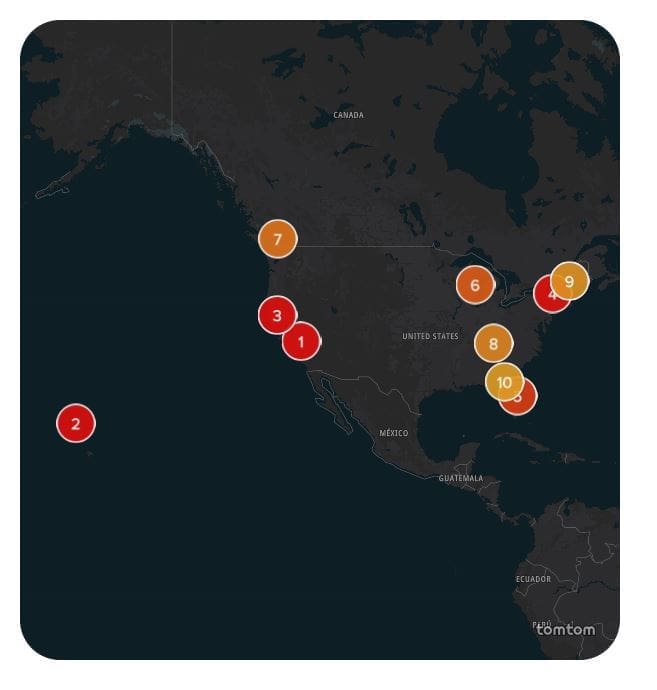
The 10 most congested cities in the United States, according to TomTom Index data, are:
- Los Angeles – 58.9% congestion level
- Honolulu – 50.5%
- San Francisco – 49.7%
- New York – 48.4%
- Miami – 46.8%
- Chicago – 46.1%
- Seattle – 44.9%
- Atlanta – 44.3%
- Boston – 42.1%
- Tampa – 41.5%
With the exception of two cities, all others experienced an increase in congestion in 2025 compared with the previous year. Atlanta recorded the largest increase, at 4%, while New York remained unchanged and Boston saw a decrease.
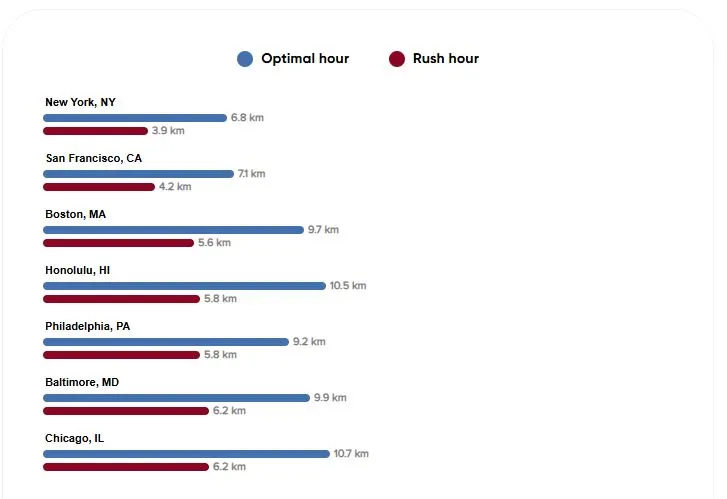
Peak hours have a significant impact on the distance drivers can travel, resulting in longer commute times. During optimal hours, a driver in New York can travel 6.8 km in 15 minutes, while during peak hours that distance is reduced to 3.9 km. Most cities see the distance traveled nearly cut in half during the most congested hours. In Los Angeles, a distance of 13.8 km covered in 15 minutes is reduced to 6.9 km during peak hours.
Although traffic congestion in the United States has declined slightly in recent years, its cost has risen dramatically. According to the American Transportation Research Institute (ATRI) study Cost of Congestion, published in 2024, fuel costs reached $32.1 billion, associated with more than 6.4 billion gallons of wasted diesel fuel, representing an additional cost of nearly $109 billion for the trucking industry in 2022.
The most congested cities in the world
The remainder of the analysis, which evaluated nearly 500 cities in 2025, shows that only 34 cities recorded reductions in travel times compared with the previous year. Groningen (Netherlands), Kiel (Germany), New Orleans (United States), Paris (France), Rome (Italy), Mumbai (India), and Riyadh (Saudi Arabia) experienced decreases in congestion levels ranging from 23% to 5%, respectively.
On the other hand, Mexico City, Mexico, ranked first as the most congested city in this year’s Traffic Index, with a score of 75.9. Its uncongested travel time is just 1 minute and 57 seconds per kilometer, but its actual average travel time is 3 minutes and 27 seconds per kilometer. By travel time, it ranks seventh in the world.
Bengaluru, India, ranks second with a score of 74.4, followed by Dublin’s historic city center in Ireland, which ranks third with 72.9.

Artemis II and the logistics of space: more like trucking than you think
On Wednesday, April 1, 2026, NASA launched the Artemis II mission, and it made us wonder: what do a truck and a spacecraft have in common?

FMCSA report: HOS violations increase after 2020 rule changes
In a recent report presented to Congress, the Federal Motor Carrier Safety Administration (FMCSA) evaluated the 2020 changes to hours-of-service (HOS) regulations.

How Artificial Intelligence Is Redefining Cargo Theft in the Trucking Industry
The rapid rise of AI-driven fraud schemes—deepfakes, double brokering, and identity theft—is generating multimillion-dollar losses across the freight industry, forcing companies and regulators to rethink security systems.

Wall Street: Transport sector bets on peace and market rebound
Industry leaders predict a significant logistics surge as stabilizing global trade routes and the prospect of peace ignite a much-needed recovery for major transport firms.

Truck Mechanics: The Most In-Demand Job in the United States
The shortage of truck mechanics has become a critical challenge for the transportation industry—but also a high-paying career opportunity.

The “Easter Effect” in logistics
Decorations, sweets, and Easter eggs are central to the holiday, particularly in the United States.