President Donald Trump proposed the “Dalilah Law,” an initiative aimed at prohibiting undocumented immigrants from obtaining commercial driver’s licenses.
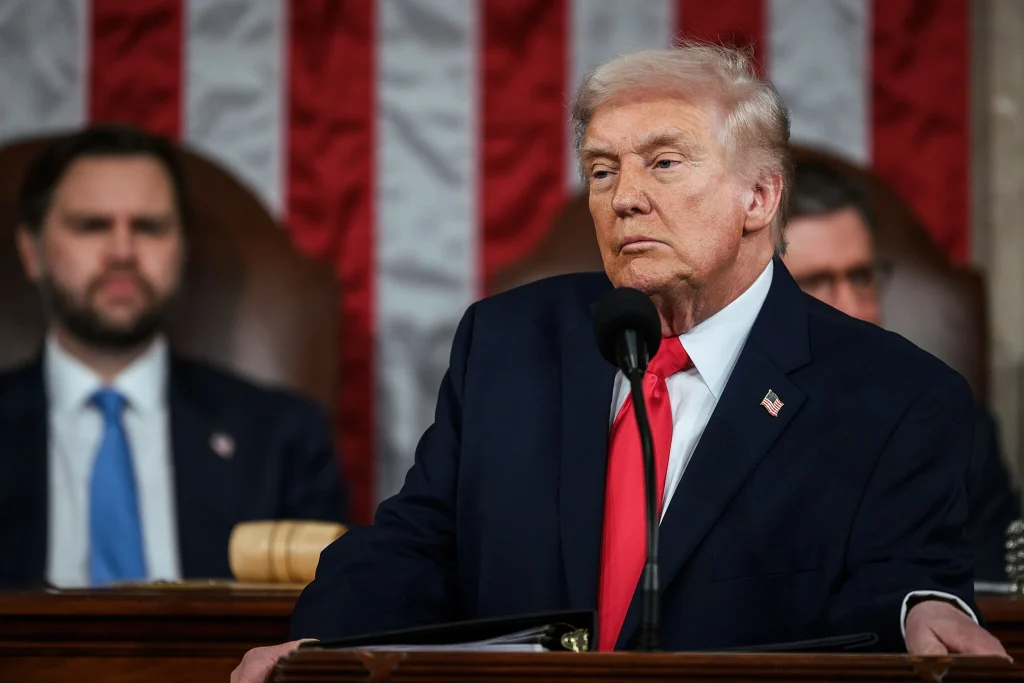
On February 24, President Donald Trump delivered his State of the Union address, during which he proposed the “Dalilah Law,” an initiative aimed at prohibiting undocumented immigrants from obtaining commercial driver’s licenses.
The proposal was backed by the Chairman of the House Transportation and Infrastructure Committee, Sam Graves, who described it as a “common-sense” safety measure. During his remarks, Trump stated that, if not all, then most undocumented foreign nationals do not have sufficient command of English to understand directions related to routing, speed, hazard warnings, or locations.
The initiative is named after Dalilah Coleman, who was present at the address and was the victim of an accident in California involving a commercial vehicle.
Dalilah Law: the next step in removing non-english speaking commercial drivers
In addition to praising the proposal, Graves noted that in recent years approximately 40,000 traffic-related deaths have been recorded nationwide. In his view, the guidelines put forward by Trump would help improve road safety across the United States.
Since the beginning of President Trump’s second term, both the Department of Transportation and the Administration have focused their efforts on strengthening English proficiency requirements for commercial drivers, as well as the conditions for obtaining Commercial Driver’s Licenses (CDLs). The “Dalilah Law” falls within these broader transportation policy guidelines.
Both Graves and Transportation Secretary Sean Duffy have voiced support for the legislative proposal. Following the president’s remarks, Duffy stated that “thanks to his leadership, we are taking strong action against dangerous foreign drivers operating trucks.” He also reiterated his call for Congress to approve stricter CDL-related standards for undocumented immigrants.
Last week, the Department of Transportation reported that approximately 14,000 truck drivers have been suspended for failing to demonstrate sufficient English proficiency. In response to what it described as a “crisis,” the Federal Motor Carrier Safety Administration (FMCSA) issued a final rule that, according to estimates, could affect up to 194,000 non-domiciled commercial licenses.
The name of this new law, which seeks to strengthen road safety in the United States, traces back to an accident that occurred in 2024. According to a report from the United States Department of Homeland Security, on June 20 of that year authorities determined that an undocumented driver from India, Partap Singh, had caused a multi-vehicle crash while operating a commercial truck. The driver, who was later detained, had obtained a commercial license in California. Dalilah Coleman, who was five years old at the time, was injured in the accident.
PASS THE DALILAH LAW.
— Homeland Security (@DHSgov) February 25, 2026
Dalilah Coleman was only 5 when she suffered life changing injuries caused by an illegal alien driving an 18-wheeler.
What happened to Dalilah is a tragedy that could have been PREVENTED if California did not grant commercial driver’s licenses to illegal… https://t.co/DvdozYfDLb
Preventable accidents and safer highways
Although the bill must still undergo congressional review, these efforts demonstrate the administration’s determination to remove commercial drivers who do not meet the new English proficiency requirements. Homeland Security Secretary Kristi Noem stated in September that Dalilah’s accident was entirely preventable and that the five-year-old’s life was forever changed after a “foreigner” put her family at risk. Noem described the incident as yet another example in California, which continues to issue non-domiciled CDLs.
The Owner-Operator Independent Drivers Association (OOIDA) also expressed support for the initiatives proposed by the Department of Transportation and President Trump, stating that they ensure only properly trained and qualified drivers operate tractor-trailers, thereby enhancing safety for all motorists on the road.

Dalilah Law seeks to remove non-english speaking commercial drivers
President Donald Trump proposed the “Dalilah Law,” an initiative aimed at prohibiting undocumented immigrants from obtaining commercial driver’s licenses. On February 24, President Donald Trump

FORMULA 1 and the AI That Could Transform Transportation in the U.S.
The artificial intelligence system that Formula 1 implemented to monitor every car on every turn is opening the door to new applications in trucking, logistics,

$170 billion at stake: 1,500 companies demand tariff refunds
Companies have challenged the global tariffs imposed by President Donald Trump, asking federal courts to reactivate proceedings to begin the refund process. The companies that

In brief: enforcement measures target speeding, CDL training gaps and more
Major enforcement actions across the U.S., including speeding, CDL fraud, and chain violations Colorado launches Speed Enforcement Program The Colorado Department of Transportation (CDOT) has

Chinese Vehicles Raise Espionage and Remote Sabotage Concerns
Investigations into Chinese technology in connected vehicles warn of espionage risks, massive data transmission, and potential remote access vulnerabilities that concern U.S. transportation and security

Between the Court and the Fed: the market redefines its roadmap for 2026
Trade policy in limbo as markets price in 2026 rate cuts and Supreme Court strikes down Trump tariff plan. In the latest episode of the