 Hable con un agente al (888) 572-7520
  Enviar mensaje a un agente

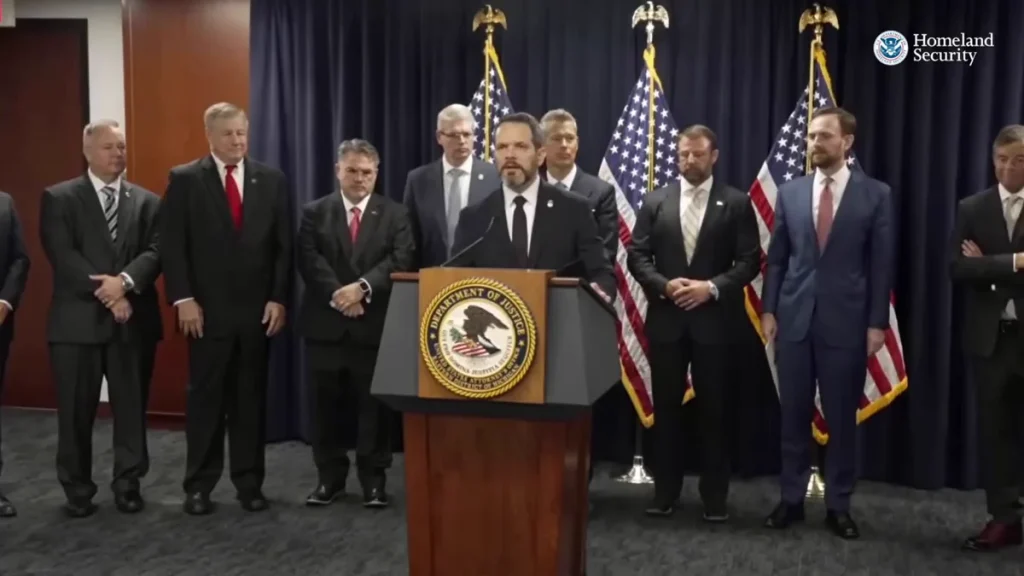

The federal government has launched Crossroads of America, one of the largest coordinated enforcement efforts targeting the trucking industry in recent years. The stated goal is to detect fraud involving CDLs, driving schools, unauthorized employment, identity documents, medical certifications and companies operating outside federal requirements.
The initiative brings together the U.S. Department of Transportation (USDOT), Federal Motor Carrier Safety Administration (FMCSA), Department of Homeland Security (DHS), Homeland Security Investigations (HSI), Immigration and Customs Enforcement (ICE), Department of Justice (DOJ), federal prosecutors and state and local authorities.
For truckers, the announcement has a practical consequence: inspections may go beyond checking the mechanical condition of the truck. Authorities are cross-checking information involving drivers, CDLs, carriers, employers, driving schools and documentation.
How Will the Operation Work?
One of the major developments is the creation of the Joint Task Force Crossroads of America, initially involving federal prosecutors in Illinois, Indiana, Michigan and Ohio, along with state and local authorities and federal agencies including DOT, FMCSA, FBI, DEA, HSI, ICE and ATF.
At the same time, DHS and USDOT are conducting coordinated enforcement actions nationwide.
HSI announced a simultaneous operation targeting more than 200 driving schools, along with investigations involving CDL-related businesses, carriers and employers.
Authorities have also distributed more than 1,000 leads involving companies suspected of unsafe practices or possible violations within the trucking industry.
But enforcement is also reaching the highways directly.
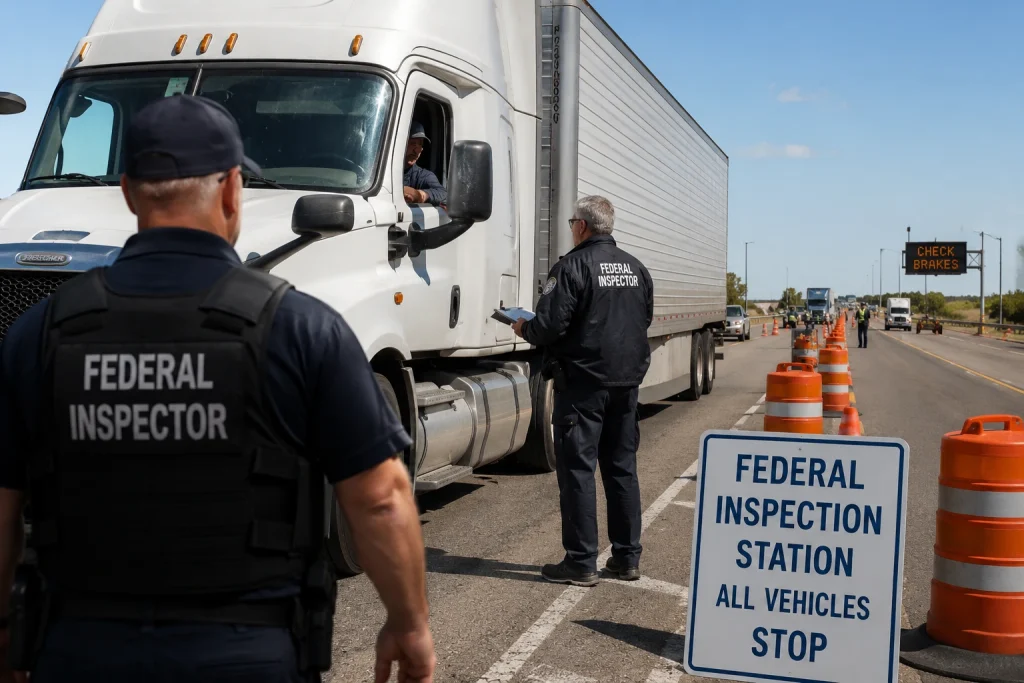
Among the announced actions are joint operations at weigh stations, commercial motor vehicle inspections and checkpoints involving immigration personnel working alongside FMCSA-certified inspectors and state authorities.
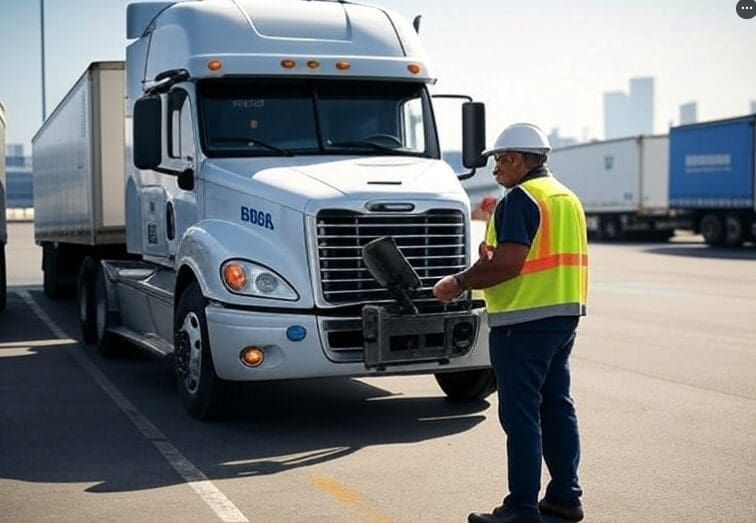
That means a trucker could encounter an inspection that goes beyond brakes, tires, lights or vehicle weight. Depending on the operation and circumstances, authorities may also verify the driver’s license, Hours of Service records, vehicle documentation, cargo paperwork and compliance with other federal requirements.
What Are Authorities Looking For?
The operation has several targets. One of the biggest is CDL fraud.
FMCSA announced the emergency removal of more than 110 Entry-Level Driver Training (ELDT) providers linked to more than 5,000 drivers who later failed to meet federal English Language Proficiency requirements.
In addition, 175 investigators conducted nearly 400 investigations of training providers across 40 states. Inspections uncovered issues ranging from instructors without proper licenses and missing documentation to facilities that did not meet the requirements for conducting required driving maneuvers.
FMCSA has also launched a nationwide audit of third-party CDL skills testers — individuals or organizations authorized by states to administer the skills tests required to obtain a commercial driver’s license.
But the federal investigation goes much further.
HSI said it is investigating possible cases involving CDL fraud, unauthorized employment, identity-document fraud, financial crimes, money laundering and labor exploitation, as well as possible connections to human smuggling and drug trafficking.
Authorities are also investigating employees of state agencies suspected of accepting payments to help individuals bypass licensing or CDL requirements, as well as medical professionals suspected of improperly certifying medical examinations required for commercial drivers.
If You Get Pulled Over: What Documents Should You Have Ready?
The most important rule for any driver is simple: don’t wait until you’re standing in front of an inspector to discover that a document is missing.
FMCSA recommends that carriers and drivers verify before departure that required documentation kept in the vehicle or carried by the driver is current and available.
Depending on the vehicle, cargo and operation, documents that may be required during an inspection include:
- Valid CDL. The driver must hold the appropriate commercial driver’s license for the vehicle and type of operation.
- Medical certification, when applicable. Medical information for many CDL holders is integrated into the electronic CDLIS record, but certain situations may require proof of certification or additional documentation, particularly when a driver has a waiver or Skill Performance Evaluation Certificate.
- Record of Duty Status (RODS). Drivers subject to Hours of Service regulations must be able to produce their records. For most drivers covered by the rule, that means having a properly functioning ELD. Certain exceptions allow paper logs.
- ELD documentation. Drivers using an ELD must carry the required information packet, including instructions for operating the device, transferring records to an inspector, handling malfunctions and enough blank logs to manually record duty status for at least eight days.
- Tractor and trailer registration, when applicable.
- Periodic inspection documentation for vehicles being operated.
- Shipping papers or bill of lading for the cargo.
- Proof of insurance.
- Receipts and supporting documents collected during the trip that may be used to verify Hours of Service records. Drivers must provide supporting documents in their possession when requested during an inspection.
- Hazmat documentation, when transporting hazardous materials. This may include shipping papers, permits, cargo-specific information and other documents required for the operation.
- IFTA, IRP and other tax or registration documents, when required by the state or type of operation.
Some operations may require additional paperwork. Lease agreements, special permits, oversize/overweight permits or credentials associated with specific types of cargo may also need to be available.
This list should therefore be considered a general checklist. Exact requirements can vary depending on the vehicle, cargo, state and type of operation.
Pay Special Attention to Your ELD
During an enforcement operation of this scale, Hours of Service records deserve particular attention.
Simply having an ELD installed is not enough. Drivers must be able to operate the device and display or transfer the required information during an inspection.
FMCSA states that a driver subject to the ELD rule who is stopped without the required device installed and in use may be cited and placed out of service for 10 hours. The violation may also affect the carrier’s Safety Measurement System record.
Supporting documents can also be used to determine whether a driver’s duty-status records match the trip actually performed. These can include bills of lading, itineraries, dispatch records, certain receipts, fleet communications and records related to driver pay.
In other words, your trip documentation should tell the same story as your ELD.
CDLs Are Also Under Scrutiny
The federal government is paying particular attention to how some CDLs were obtained.
FMCSA is comparing roadside inspection results with information from the Training Provider Registry to identify schools that repeatedly certified drivers who later failed to meet federal requirements.
The agency is also reviewing how states oversee third parties authorized to administer CDL skills tests.
That means the enforcement effort does not stop with the driver on the highway. Investigators can follow the chain backward: who trained the driver, who administered the test, who issued the license and which company hired the driver.
An Inspection Can Go Far Beyond the Truck
The new federal strategy significantly expands the scope of enforcement.
A traditional roadside inspection may begin with the truck and its driver, but the investigations announced by federal authorities mean that an irregularity discovered on the road could eventually be linked to a carrier, driving school, medical examiner, employer or even officials responsible for issuing documentation.
For truckers operating legally and keeping their records in order, preparation remains straightforward: keep your CDL current, carry medical documentation when required, make sure your ELD and Hours of Service records are accurate, and have tractor and trailer registrations, proof of insurance, periodic inspection records and cargo documents available before starting the trip.
The federal crackdown on trucking fraud is no longer concentrated within a single agency. Transportation, Homeland Security, Justice and state and local authorities are sharing information and conducting coordinated enforcement actions.
And as inspections increase, checking your physical or digital document folder before starting the truck could prevent a paperwork problem from turning into a violation — or an out-of-service order.
 Business hours: Monday to Friday from 8:00 AM to 5:00 PM. California time