 Hable con un agente al (888) 572-7520
  Enviar mensaje a un agente


CDLs and the schools responsible for training commercial drivers are facing a new level of federal scrutiny. More than 110 Entry-Level Driver Training (ELDT) providers have been ordered to stop operating, while another 160 are facing proposed removal from the Federal Motor Carrier Safety Administration (FMCSA) Training Provider Registry.
The measures are part of a coordinated federal crackdown involving the U.S. Department of Transportation (USDOT), FMCSA, the Department of Homeland Security (DHS), and the Department of Justice (DOJ) targeting irregularities in commercial driver training, testing, and licensing.
One of the findings that raised concerns involves English proficiency. The more than 110 schools removed on an emergency basis from the Training Provider Registry (TPR) were associated with more than 5,000 drivers who later failed roadside checks related to the federal English Language Proficiency (ELP) requirement.
Separately, 175 federal investigators conducted nearly 400 inspections of training providers across 40 states. As a result, more than 160 providers received notices of proposed removal from the federal registry.
For truckers, fleets, and motor carriers, the message is clear: federal oversight no longer ends with a roadside inspection. Authorities are also examining how future truck drivers are trained, who is training them, and how the tests required to obtain a CDL are administered.
What Did Inspectors Find at CDL Schools?
Federal investigators identified several types of violations among training providers.
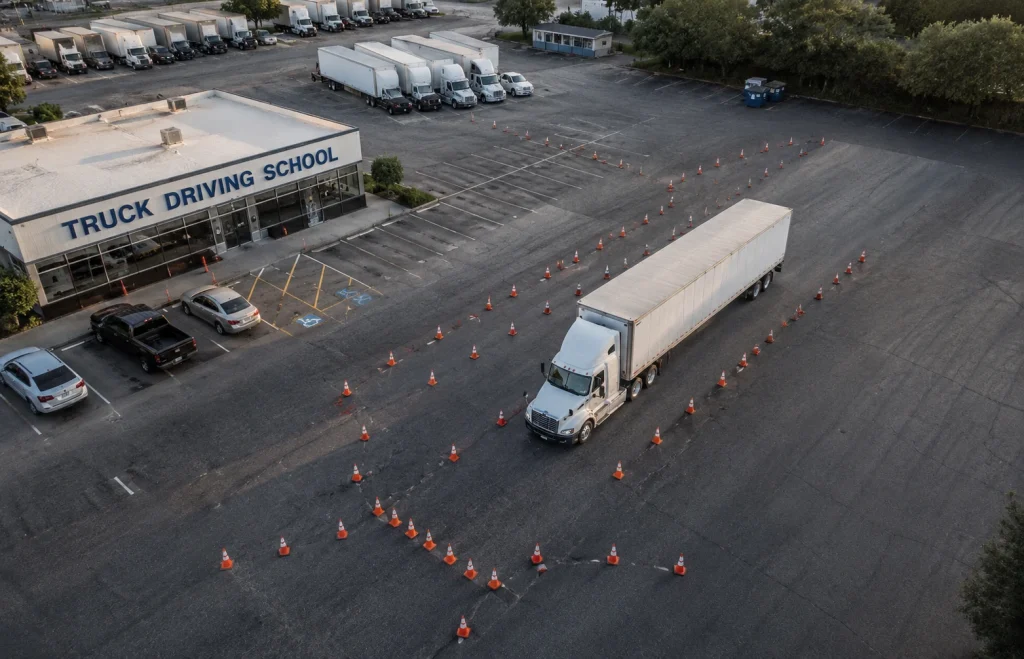
These included inadequate space for required driving maneuvers, instructors who did not hold the proper licenses, missing documentation for required evaluations, and facilities that failed to meet training requirements.
One case cited by FMCSA involved a provider that claimed its classroom operated inside a school bus located in the back of a trailer.
For the more than 110 providers subject to emergency removal, the consequences are immediate: they must stop operating as registered training providers. That includes classroom instruction, use of training facilities, and behind-the-wheel training.
But the crackdown does not stop with CDL schools. The federal government also announced a nationwide audit of third-party examiners who administer CDL skills tests, as well as a review of how states oversee those testing programs.
English Proficiency Returns to the Center of CDL Enforcement
A major part of the federal crackdown involves compliance with the English Language Proficiency requirement.
Since June 2025, more than 28,000 drivers have been placed out of service for violations related to the requirement, according to figures released by the Department of Transportation.
FMCSA reviewed roadside inspection records involving drivers cited for ELP violations and cross-referenced that information with the Training Provider Registry. The goal was to identify providers that repeatedly certified drivers who later failed to meet federal standards.
For anyone beginning a career in trucking, the enforcement action reinforces the importance of making sure a school is properly listed in the FMCSA registry and meets all Entry-Level Driver Training requirements.
Obtaining a CDL through a provider that is later removed from the registry can create problems that extend far beyond the cost of training.
Third-Party CDL Examiners Are Also Under Review
The federal crackdown is not limited to those providing the training.
FMCSA announced a nationwide audit of third-party skills testers — outside examiners authorized to administer the practical skills tests required for certain commercial driver’s licenses.
States will also face increased scrutiny.
When FMCSA identifies deficiencies in a state CDL program, it can require the state to implement a Corrective Action Plan. If the problems are not resolved, the state could face the withholding of federal highway funds.
In more serious cases, FMCSA can begin decertification proceedings. A state whose CDL program is decertified may be prohibited from issuing, renewing, transferring, or upgrading CDLs.
The scope of the enforcement effort shows that federal authorities are looking beyond individual schools and examining multiple parts of the system used to train, test, and license commercial drivers.
More Than 200 CDL Schools and Businesses Inspected
The Department of Homeland Security has also launched enforcement actions targeting the industry.
Homeland Security Investigations (HSI) coordinated inspections on August 31 involving more than 200 CDL schools and related businesses across 23 states.
The investigations cover potential commercial driver’s license fraud, unauthorized employment, identity fraud, financial crimes, labor exploitation, and other violations connected to the transportation industry.
Ongoing investigations also involve employees of state agencies suspected of accepting payments to help individuals bypass licensing requirements, as well as possible irregularities involving medical certifications required to obtain a CDL.
The Department of Justice also announced the creation of the Joint Task Force Crossroads of America, bringing together authorities from Illinois, Indiana, Michigan, and Ohio with federal agencies including DOT, FMCSA, FBI, DEA, HSI, and ICE.
The initiative is aimed at combating fraud and other illegal activity involving commercial transportation while strengthening highway safety.
What Does This Mean for Truckers?
For drivers who obtained their CDL by following all required procedures, this new enforcement environment could mean closer scrutiny of licenses and documentation, particularly when questions arise about where the driver was trained or how the required tests were administered.
For new drivers, choosing an authorized school is more important than ever. A provider promising to dramatically speed up the licensing process or help applicants bypass certain requirements could ultimately create much bigger problems for the trucker.
Fleets and motor carriers also have reasons to pay attention.
Verifying CDLs, driving records, medical certificates, and hiring documentation could become increasingly important as federal investigations expand across different parts of the licensing and employment process.
The Department of Transportation reported that more than 8,000 training providers considered unqualified have been removed from the FMCSA registry over the past year and a half. In addition, states were required to cancel more than 30,000 licenses that federal authorities said had been improperly issued to foreign drivers.
CDLs Are Facing Increasing Scrutiny
The debate surrounding commercial driver’s licenses has also become intertwined with immigration policy. But for the trucking industry, there is a much more practical issue at stake: making sure anyone who receives a CDL has been properly trained, tested, and qualified to operate a commercial motor vehicle.
The current investigations target multiple links in that process, including schools, instructors, examiners, state agencies, medical certifications, and businesses.
It is also important to distinguish licensing or training violations from broader claims about highway safety. Fraud and noncompliance should be investigated, but a driver’s immigration status or national origin does not, by itself, determine whether that person is a safe driver.
What is clear is that the CDL system is entering a period of heightened federal oversight.
For truckers who follow the rules, maintaining a valid license, keeping documentation current, and making sure training comes from registered providers will be increasingly important.
A CDL problem can put a truck out of service and affect income, contracts, operations, and even insurance coverage. Meeting federal requirements is more than paperwork — it is part of protecting your livelihood, your business, and staying insured on the road.
 Business hours: Monday to Friday from 8:00 AM to 5:00 PM. California time